Lead Generation Automation: How to Build a System That Scales Without Adding Headcount
by Stella L
A maturity framework for automating B2B lead generation from manual processes to scalable systems.
There is a pattern that repeats across B2B sales organizations of every size. The team hits a growth target, leadership decides to accelerate, and the default response is to hire more salespeople. Each new SDR adds a roughly linear increment of outreach capacity, which produces a roughly linear increment of pipeline, which eventually produces a roughly linear increment of revenue. The math works until it does not.
The point where it stops working is predictable. Coordination costs rise with every person added. The best lead sources get saturated faster than new ones are developed. Training and ramp time create a lag between hiring and output. Quality variance across the team widens because the process depends on individual judgment rather than system design. And the economics shift: the cost of each incremental opportunity climbs while the marginal return on each new hire declines.
Lead generation automation addresses this structural problem. Not by replacing people, but by shifting the boundary between what humans do and what systems do. The repetitive, high-volume, low-judgment work, researching prospects, maintaining data quality, sequencing outreach, tracking engagement, moves to automated systems. The high-judgment work, building relationships, navigating complex deals, making strategic decisions about market approach, stays with people who now have more time and better information to do it.
This article presents a maturity framework for thinking about where your team is today and what to automate next. Rather than prescribing a single architecture, it describes three stages that most B2B teams move through, what each stage looks like when it works, what signals indicate it is time to advance, and where the common failure points are.
The Headcount Trap
The economics of people-driven lead generation contain a structural ceiling that becomes visible around the third or fourth SDR hire.
In the early stages of a sales team, adding headcount works well. The first few SDRs learn the market, refine the pitch, and develop outreach patterns that generate pipeline. Their individual output is high because the lead sources are fresh, the market is not saturated with the company's messaging, and each rep has enough time to research and personalize their approach.
The degradation begins when the team grows past the point where informal coordination is sufficient. With two or three SDRs, the team can avoid overlapping on the same prospects through conversation. With eight or ten, they cannot. Lead assignment becomes a problem. Data hygiene becomes a problem. Consistency of messaging across the team becomes a problem. Each new hire adds capacity but also adds friction, and the net productivity gain per hire shrinks.
The headcount trap is not a failure of the people involved. It is a property of the architecture. A process that depends on human effort for every step, from identifying a prospect to researching their company to composing a message to scheduling a follow-up, scales linearly at best and sub-linearly in practice. The alternative is not to stop hiring. It is to automate the parts of the process where human judgment adds the least value, so that the people on the team can focus on the parts where it adds the most.

Stage 1: Manual with Pockets of Automation
Most B2B teams begin here and many stay longer than they realize. The defining characteristic of Stage 1 is that the core prospecting workflow runs on human effort, with isolated automation tools handling specific tasks that someone decided to streamline at some point.
In a typical Stage 1 operation, lead lists come from a combination of manual research and purchased databases. SDRs spend a significant portion of their day, often more than half, on activities that are not direct prospect engagement: looking up companies, finding contact information, checking whether a lead was already contacted by a colleague, entering data into tracking systems, and composing individual outreach messages. An email automation tool handles the sending, but the content creation, targeting decisions, and follow-up scheduling are manual.
This setup works within a specific scale range. When the team manages twenty to fifty active prospects at a time, the manual overhead is tolerable. SDRs can keep track of where each conversation stands, personalize their outreach based on individual research, and maintain reasonable follow-up discipline through personal organization.
When Stage 1 Breaks
Three signals indicate that the manual approach has reached its limit. The first is time allocation. When SDRs spend more time on research and data management than on actual prospect engagement, the process is consuming itself. The second is follow-up inconsistency. Prospects that showed initial interest go cold because the rep was busy researching new targets or updating records. The third is source blindness. The team cannot answer basic questions about which lead sources produce the best pipeline because nobody is tracking it systematically.
The Upgrade Path
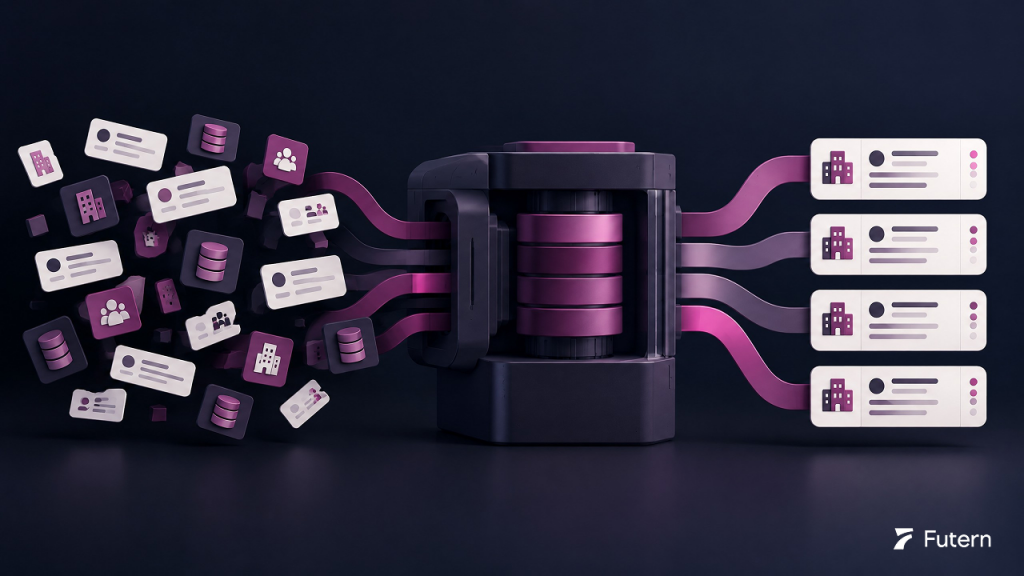
The first layer to automate is data. AI-powered prospecting can replace the hours spent manually researching target companies and contacts with a continuous identification process that runs against the team's ideal customer criteria. Data enrichment fills in the firmographic, technographic, and organizational details that SDRs currently assemble by hand. Together, these two automations reclaim the research time that consumes Stage 1 teams and produce more complete, more current prospect data than manual research typically achieves.
Stage 2: Automated Data, Manual Execution
In Stage 2, the data layer is automated. Prospect identification and enrichment run continuously against defined criteria, producing a stream of fully profiled leads without manual research effort. SDRs receive leads that already include company size, industry, technology stack, key contacts, and organizational structure.
The improvement is immediate and measurable. Reps spend their time on engagement rather than research. The volume of prospects the team can work at any given time increases significantly. Data quality improves because automated systems apply consistent enrichment standards rather than relying on individual research thoroughness.
But a new set of problems emerges. The data layer now produces more qualified leads than the team can manually process with the same level of personalization. The bottleneck shifts from "not enough leads to work" to "not enough capacity to work the leads we have." This is where many teams make the mistake of hiring more SDRs to handle the increased volume, recreating the headcount trap at a higher throughput level.
When Stage 2 Breaks
The failure signals at this stage are different from Stage 1. The first is response rate decline despite good data. The leads are well-targeted and fully enriched, but outreach performance is flat or declining because the execution side, message quality, channel selection, timing, and follow-up cadence, is not keeping pace with the improved sourcing. The second is channel fragmentation. The team uses email, LinkedIn, and phone, but each channel operates independently rather than as a coordinated sequence. Prospects receive redundant or inconsistent messages across channels. The third is scoring lag. The team has more data than ever but still qualifies leads based on gut feel or simple demographic thresholds rather than a systematic scoring model that incorporates buying signals and intent data.
The Upgrade Path
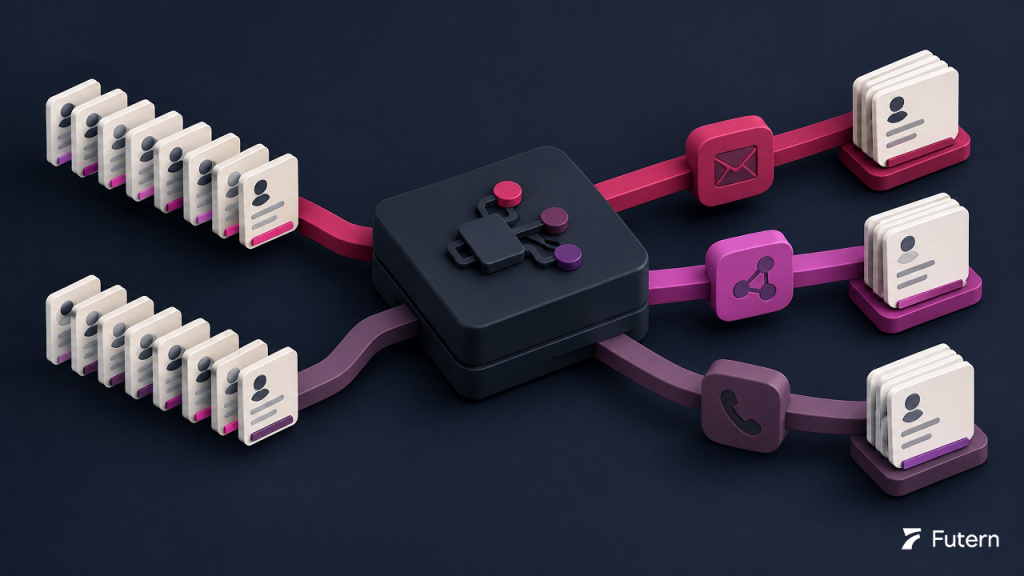
The next layer to automate is the execution and prioritization stack. Scoring automation converts the enriched data and behavioral signals into a real-time priority ranking that tells the team which leads to engage first and which to nurture. Outreach orchestration automates the coordination of multi-channel sequences, ensuring that email, social, and direct outreach work as a unified campaign rather than parallel efforts. Personalization at scale becomes possible when the system has both the data depth and the sequencing logic to tailor messages based on prospect attributes and behavior.
Stage 3: Systematic Automation
At Stage 3, the lead generation process operates as an integrated system rather than a collection of tools and human workflows. Data acquisition, enrichment, signal detection, scoring, outreach orchestration, and follow-up sequencing run as a coordinated pipeline. The system continuously identifies target prospects, evaluates their fit and intent, initiates personalized outreach through the appropriate channels at the appropriate time, and adjusts priority as new signals arrive.
The role of the sales team shifts fundamentally. Instead of executing the process, they manage exceptions and build relationships. An SDR in a Stage 3 operation spends their time on activities that require human judgment: responding to engaged prospects who have questions the system cannot answer, navigating multi-stakeholder deals that require political awareness, and making strategic decisions about which accounts deserve deeper investment. The repetitive execution work that consumed their predecessors in Stage 1 has been absorbed by the system.
What Stage 3 Looks Like in Practice
Several characteristics distinguish a Stage 3 operation from a Stage 2 team with better tools. The first is continuous operation. The system does not stop when the team goes home. Prospect identification, scoring updates, and outreach sequencing run around the clock, which is particularly valuable for teams covering multiple time zones or international markets. A lead that becomes active at 2 AM in the team's local time zone gets scored and queued for outreach immediately rather than waiting until someone checks the dashboard the next morning.
The second is closed-loop learning. When a deal closes or a lead is lost, the outcome data feeds back into the scoring model automatically. Weights adjust based on actual results rather than periodic manual calibration. The system gets better at identifying high-value leads over time because it learns from every outcome.
The third is proportional scaling. Adding a new market, a new vertical, or a new product line does not require proportional headcount increases. The system's data layer expands to cover the new segment, the scoring model incorporates new fit criteria, and the outreach sequences adapt to the new audience. The team grows by extending the system's reach rather than duplicating the team's effort.
What Stage 3 Does Not Mean
Systematic automation does not mean full autonomy. The system handles the high-volume, pattern-based work. The humans handle the judgment calls that the system is not equipped to make: whether a particular account's organizational politics make it a poor fit despite strong scoring signals, whether a market shift requires rethinking the ICP, whether a high-value prospect's unusual engagement pattern warrants a departure from the standard sequence. The boundary between automated and human work is deliberate, not arbitrary, and it should be revisited as the system's capabilities and the team's strategic needs evolve.
The Calibration Layer: What Keeps the System Honest
An automated system's most dangerous state is producing bad results efficiently. When a scoring model drifts away from actual buying behavior, when sourcing criteria go stale, when outreach templates fatigue, the system will generate declining pipeline with the same operational consistency it used to generate growing pipeline. The decline is harder to detect than in a manual process because the activity metrics remain healthy. Emails go out on schedule, scores update in real time, leads move through the funnel. But the quality degrades invisibly until the pipeline review reveals that nothing is closing.
The calibration layer is what prevents this failure mode. It consists of three mechanisms that should operate on a recurring schedule.
The first is a structured audit. The diagnostic framework from the process audit approach applies directly: examine the system's output for volume problems, quality problems, efficiency problems, and visibility problems. The difference is that in an automated system, these problems trace to configuration rather than human execution. A volume problem means the sourcing criteria are too narrow or the data sources have degraded. A quality problem means the scoring model needs recalibration.
The second is scoring model maintenance. The quarterly calibration process compares the model's predictions against actual outcomes: what percentage of high-scoring leads converted, what attributes characterized the leads that the model missed, and what the sales team's rejection patterns reveal about scoring blind spots. In a Stage 3 system with closed-loop learning, some of this calibration happens automatically. But human review remains necessary because the system optimizes for the patterns it can measure, and some of the most important signals, like market shifts or competitive moves, are not yet in the data.
The third is outreach performance review. Message effectiveness, channel mix productivity, and sequence completion rates should be reviewed monthly. Template fatigue is real: a message that produced strong response rates three months ago may be generating diminishing returns today, and the system will keep sending it until someone intervenes. A/B testing frameworks embedded in the outreach layer help identify when a message or sequence is losing effectiveness, but the decision to revise the approach requires human judgment about what the data means and what to try next.

Choosing Your Entry Point
The maturity stages described in this article are not a mandatory sequence. A team does not need to perfect Stage 1 before moving to Stage 2, and the transition from Stage 2 to Stage 3 does not require rebuilding everything from scratch. The stages describe states of system maturity, not a linear construction project.
The practical question is where to start, and the answer depends on where the current process is failing. A process audit identifies the most expensive bottleneck. If the team spends most of its time on research and data management, the data layer is the priority, the Stage 1 to Stage 2 transition. If the data is good but outreach is uncoordinated and scoring is inconsistent, the execution layer is the priority, the Stage 2 to Stage 3 transition. If the system is automated but results are declining, the calibration layer needs attention.
The most common mistake is attempting to automate everything at once. A system that automates sourcing, enrichment, scoring, multi-channel outreach, and measurement simultaneously, before any individual layer has been validated, produces complexity without clarity. When something goes wrong, and something always goes wrong in the first iteration, the team cannot isolate which layer is responsible.
A more productive approach is to automate one layer at a time, validate that it produces the expected improvement, and then extend to the next layer. Each layer of the lead generation process builds on the one below it. Automated scoring requires automated data as an input. Automated outreach orchestration requires automated scoring to know who to contact first. Measurement and calibration require all of the above to produce the data they analyze. The sequence matters because each layer depends on the quality of the layer beneath it.
Start where the bottleneck is. Validate before extending. And build the calibration mechanisms from the beginning rather than adding them after the system is already running, because an uncalibrated automated system will scale its mistakes just as efficiently as it scales its successes.
Read More
AI Sales Agents: Complete Buyer's Guide
Global Outbound Sales in 2026: What Actually Scales and What Doesn't
Explore more Selling Skills insights here.