Multi-Channel B2B Outreach: Why Coordination Matters More Than Channel Count
by Stella L
Design multi-channel B2B outreach that works from the buyer's perspective.
Sales teams have more channels available for outreach than at any point in B2B history. Email, LinkedIn, WhatsApp, phone, and an expanding set of messaging platforms all offer direct paths to decision-makers. Most teams have responded by adding channels to their outreach sequences, operating on a reasonable assumption: more channels mean more chances to connect.
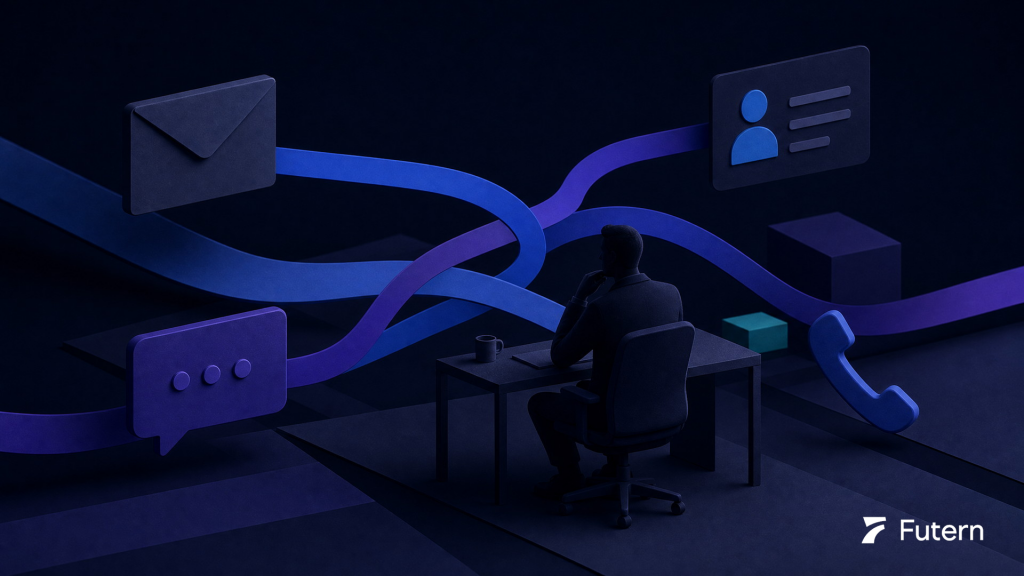
The assumption is reasonable, but the results frequently contradict it. Adding channels without coordination often produces the opposite of what teams intend. Instead of surrounding a prospect with a coherent narrative, uncoordinated multi-channel outreach surrounds them with noise. The prospect receives an email pitch on Monday, a LinkedIn connection request on Tuesday with a different value proposition, and a follow-up email on Wednesday that ignores the LinkedIn interaction entirely. From the seller's dashboard, this looks like a well-structured sequence. From the buyer's inbox, it looks like three different strangers.
Understanding why more channels often produce worse results requires shifting perspective from the sender's workflow to the receiver's experience. That shift changes how teams think about channel selection, message design, sequencing, and measurement.
What B2B Buyers Actually Experience on the Receiving End
The volume of unsolicited outreach reaching B2B decision-makers has increased steadily as automation tools have lowered the cost of sending. A VP of operations at a mid-market company might receive fifteen to twenty cold emails per day, five to ten LinkedIn connection requests per week, and occasional WhatsApp messages or cold calls layered on top. The decision about what to engage with and what to ignore happens in seconds, driven by three rapid assessments.
The first is relevance. Does this message connect to something the buyer is actively working on or a problem they recognize? Generic outreach about "improving efficiency" or "driving revenue" fails this test because it could apply to anyone. Messages that reference a specific challenge in the buyer's industry, company stage, or functional area clear the bar more often.
The second is timing. Even a relevant message lands differently depending on whether the buyer is actively exploring solutions. A procurement director who just started evaluating new suppliers will engage with outreach that arrives during that window. The same message six months earlier or three months later gets ignored. Buying signals and intent data, such as job postings, technology adoption patterns, and content engagement that indicate active evaluation, are what allow sellers to distinguish between these two scenarios.
The third is effort signal. Buyers have become skilled at detecting whether a message was crafted for them or generated at scale. This detection does not require sophisticated analysis. A message that opens with a detail pulled from the buyer's recent LinkedIn post or a specific development at their company signals effort. A message that opens with the buyer's first name and job title, followed by a paragraph that could describe any company in any industry, signals automation.
When multi-channel outreach fails all three assessments across multiple platforms, the cumulative effect is worse than a single bad email. The buyer does not think "this company is trying hard to reach me." They think "this company is spamming me on every platform they can find." The negative impression compounds with each additional touchpoint that lacks relevance, timing, or effort.
The Gap Between Seller Intent and Buyer Experience
Most sales teams believe they are running personalized, multi-channel outreach. The disconnect between that belief and the buyer's actual experience is systematic, and it shows up differently on each channel.
On email, personalization often means inserting the prospect's company name, job title, and industry into a template. The seller sees a customized message. The buyer sees a template with merge fields, because the surrounding paragraph structure, the value proposition, and the call to action are identical to what every other company in their segment received. The personalization is cosmetic rather than substantive, and buyers recognize the pattern instantly.
On LinkedIn, the gap manifests differently. Many teams treat LinkedIn as an extension of email outreach, sending connection requests followed by immediate pitch messages. The seller's intent is to "build a relationship through social selling." The buyer's experience is a connection request that turns into a sales pitch within twenty-four hours, which feels like a bait-and-switch. The social context of LinkedIn creates an expectation of genuine professional interaction, and violating that expectation generates more resistance than a cold email would.
On WhatsApp and messaging platforms, the gap is sharpest. These channels carry an implicit expectation of personal communication. A cold outreach message on WhatsApp can feel intrusive in a way that the same message on email would not, because the channel itself signals a closer relationship than actually exists.
The most damaging version of this gap occurs when channels operate independently. The email sequence does not know that the prospect accepted a LinkedIn connection request yesterday. The LinkedIn follow-up does not reference the email that the prospect opened and read. The result is not a coordinated multi-channel strategy. It is three separate single-channel strategies running in parallel, each unaware of the others. From the buyer's perspective, this creates a disorienting experience, as if different people at the same company are reaching out without talking to each other. In many cases, that is exactly what is happening.
Why Channel Fit Matters More Than Channel Count
The instinct to maximize channels rests on a volume assumption: more touchpoints increase the probability of a response. This is true in the abstract but misleading in practice, because channel effectiveness varies dramatically based on who is being contacted, where they are, and what stage of the buying process they are in.
Role and seniority influence channel receptivity in predictable ways. C-level executives tend to have gatekeepers managing their email and rarely accept LinkedIn connection requests from unknown senders. Mid-level managers and directors, who often do their own research during evaluation phases, tend to be more responsive on LinkedIn and email. Operational leads in technical roles may prefer direct, concise communication on channels like WhatsApp or Slack where their teams already communicate.
Geographic and cultural factors create significant variation. WhatsApp is a primary business communication channel across much of Southeast Asia, Latin America, and the Middle East. In Northern Europe, email remains the dominant professional channel, and unsolicited LinkedIn messages are received more cautiously. In North America, LinkedIn has higher engagement rates for B2B outreach than in most other regions. These patterns are not absolute, but ignoring them leads to channel choices that feel natural to the sender and foreign to the receiver.
Buying stage shapes which channels carry the most value at a given moment. During early awareness, when a prospect is not yet actively seeking solutions, a LinkedIn connection combined with relevant content sharing can plant a seed without requiring the prospect to take action. During active evaluation, email's capacity for structured information, attachments, and detailed follow-up becomes more valuable. During late-stage decision-making, phone calls and real-time messaging channels allow the kind of rapid back-and-forth that email cannot support.
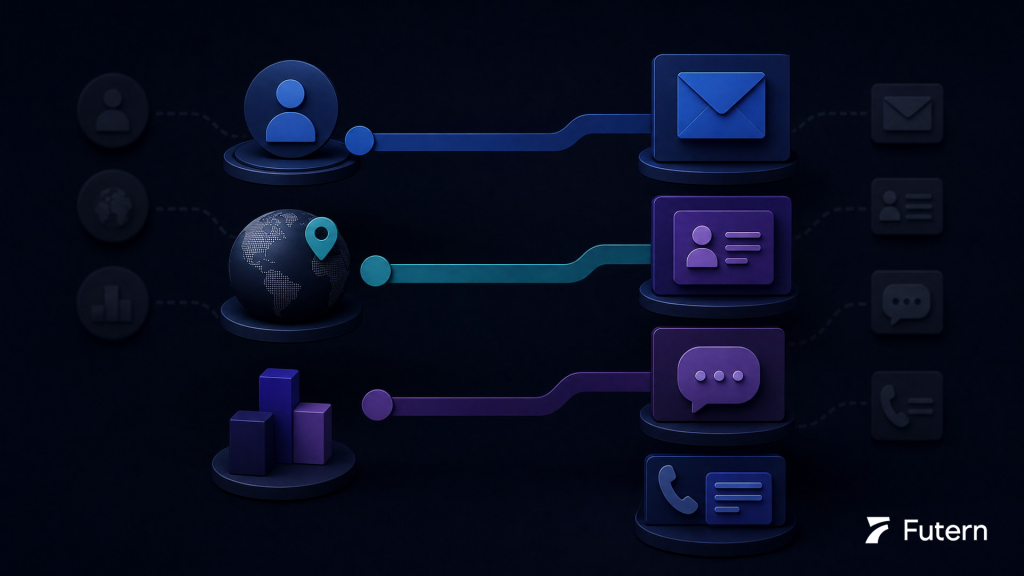
The practical implication is that channel selection should be a decision made per prospect or per segment, informed by enrichment data about role, region, industry, and available contact information. Understanding how enrichment data fills gaps in contact records and how buying signals reveal prospect readiness provides the foundation for making these judgments. Without that data, channel selection defaults to whatever channels the team has access to, applied uniformly, which is the root of most multi-channel underperformance.
Designing Outreach That Respects the Buyer's Context
Effective multi-channel outreach starts with a question that most sequences skip: what does this specific prospect need to see, on which channel, at this moment? Answering that question requires pulling together the targeting, timing, and enrichment work from earlier stages of the lead generation process and translating it into channel-level execution decisions.
The first design principle is conversation continuity. Every touchpoint across every channel should feel like a continuation of the same conversation, adapted to the channel's native communication style. An email might introduce a specific challenge the prospect's industry is facing and reference a relevant data point. A LinkedIn message two days later should not repeat that information. Instead, it might share a related insight or ask a question that builds on the email's premise. If the prospect engages on LinkedIn, the next email should acknowledge that interaction. The underlying message stays consistent. The surface-level expression changes to fit each channel.
This is where the difference between adaptation and repetition becomes critical. Repetition means taking the same core message and distributing it across channels with minor formatting changes. The prospect recognizes it immediately because they have already seen the argument once. Adaptation means expressing the same underlying relevance through different lenses. Email can carry data, specifics, and structured reasoning. LinkedIn works better for shorter, more conversational prompts. WhatsApp suits brief follow-ups, quick questions, or time-sensitive updates. Each channel adds something to the conversation rather than echoing what the other channels already said.
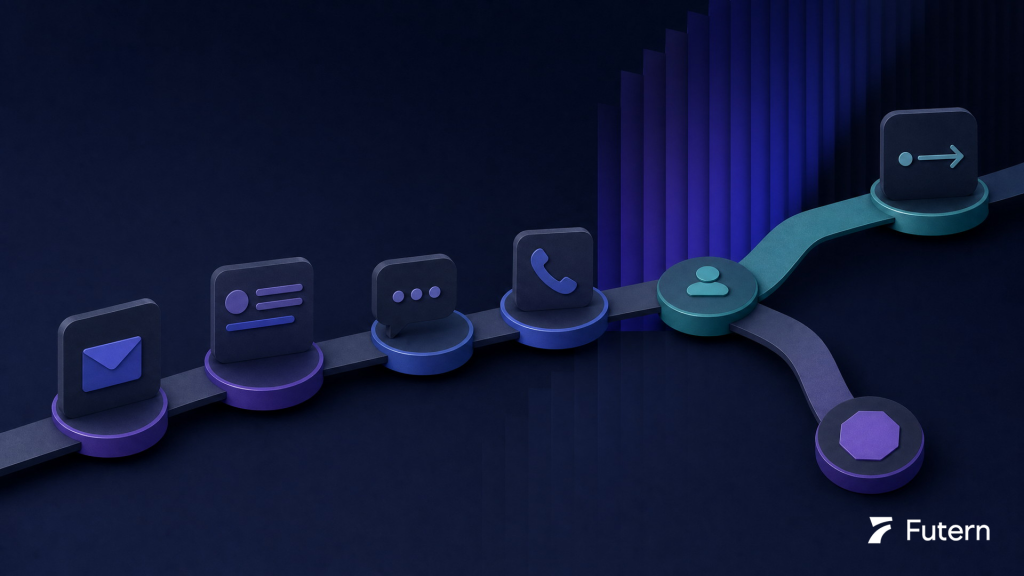
The second design principle is adaptive sequencing. Traditional outreach sequences are fixed: email on day one, LinkedIn on day three, follow-up email on day five, phone call on day seven. The sequence runs identically regardless of whether the prospect opened the first email, ignored it, replied to the LinkedIn message, or visited the company's website after receiving the first touchpoint. Adaptive sequencing uses prospect behavior to determine the next step. If a prospect opens an email and clicks a link but does not reply, the next touchpoint might move to LinkedIn with a message that references the content they viewed. If a prospect accepts a LinkedIn connection but does not respond to a direct message, pushing harder on LinkedIn is less likely to work than switching to email with a different angle.
The third design principle is knowing when to pause or stop. Outreach sequences are typically designed around the seller's need to maximize touchpoints within a time window. From the buyer's perspective, continued outreach after clear signals of disinterest, such as ignoring multiple messages across channels, creates a negative association with the brand that extends beyond the individual sequence. Setting explicit exit criteria based on engagement signals prevents the damage that over-persistence causes.
Measuring Multi-Channel Outreach Beyond Per-Channel Metrics
Most teams measure outreach performance at the channel level: email open rates, LinkedIn acceptance rates, call connection rates. These metrics are useful for diagnosing channel-specific execution problems, but they are misleading as indicators of multi-channel strategy effectiveness, because they cannot capture cross-channel effects.
The most common distortion is attribution misallocation. A prospect might first notice a seller's name through a LinkedIn connection request, then open a subsequent email because the name is now familiar. The email gets credit for the open, but the LinkedIn touchpoint created the recognition that made the open possible. Channel-level metrics cannot distinguish between engagement that a channel generated independently and engagement that was enabled by another channel's prior touchpoint.
Prospect-level measurement provides a more accurate view. Instead of asking "what is our email reply rate," the relevant question becomes "what is the reply rate across all channels for prospects who received our multi-channel sequence?" This shift reveals whether the combination of channels is producing better results than any single channel alone. If a three-channel sequence produces the same reply rate as email-only outreach, the additional channels are adding cost without adding value.
Three metrics offer the clearest view of multi-channel effectiveness. Sequence-level engagement rate measures whether any channel in the sequence produced a meaningful response, capturing the cumulative effect that per-channel metrics miss. Time to meaningful engagement tracks how quickly the sequence converts a cold prospect into a real conversation, measuring efficiency rather than just volume. Pipeline quality by sequence type compares the downstream outcomes, such as opportunity creation and close rates, of prospects engaged through multi-channel sequences versus single-channel outreach.
These measurements require prospect-level tracking that connects interactions across channels, which is operationally harder than measuring each channel in isolation. But without prospect-level visibility, teams cannot distinguish between multi-channel strategies that are working and multi-channel strategies that are simply multiplying effort.
What This Means for How Teams Build Their Outreach Process
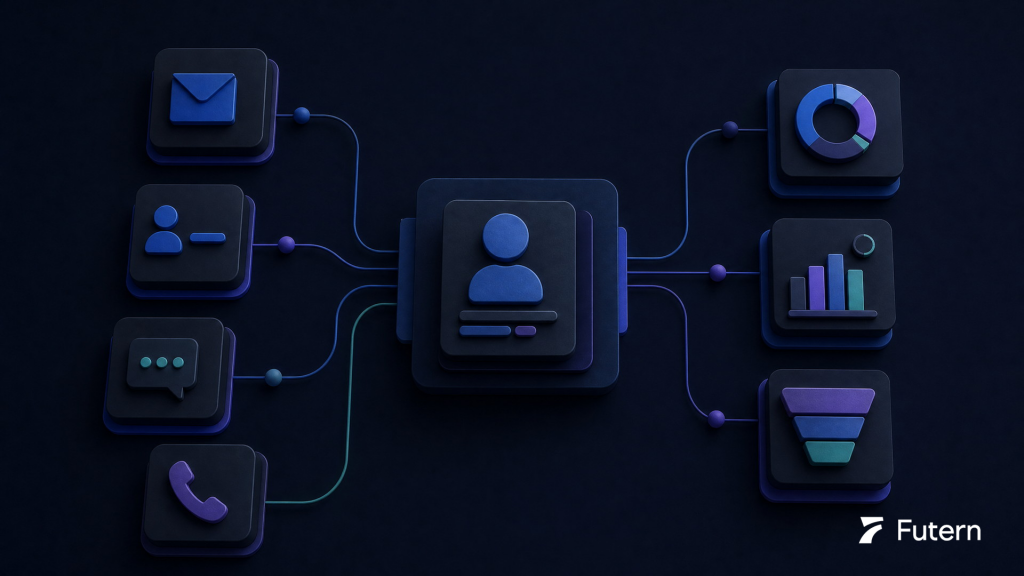
The buyer-side perspective on multi-channel outreach leads to a conclusion that is uncomfortable for teams invested in maximizing channel coverage: fewer channels, better coordinated, almost always outperform more channels running independently. The challenge is that coordination at the individual prospect level requires capabilities that manual processes struggle to deliver.
An SDR managing a pipeline of two hundred prospects cannot realistically track which channel each prospect last interacted on, what message they received, how that message connects to the prospect's current buying signals, and what the optimal next touchpoint should be. The cognitive load of true prospect-level orchestration across three or more channels exceeds what individual sellers can maintain at scale. This is precisely the point where the process either simplifies back to template-driven sequences, losing the coordination that makes multi-channel effective, or moves toward systems that can manage prospect-level logic automatically.
Accurate prospecting, timely signal detection, and thorough data enrichment are the prerequisites for effective lead generation. Multi-channel outreach is where those prerequisites either translate into results or get wasted. A team that has identified the right prospects, detected genuine buying signals, and enriched their contact data has done the hard work. The outreach stage should deploy that preparation with precision across the channels where each prospect is most likely to engage. When it does, multi-channel outreach fulfills its promise: reaching the right person, through the right channel, with the right message, at the right time. When it does not, the preparation is still there, but the delivery fragments it across disconnected channels that individually fail to represent the quality of the underlying work.
Read More
AI Sales Agents: Complete Buyer's Guide
Global Outbound Sales in 2026: What Actually Scales and What Doesn't
Explore more Selling Skills insights here.