Buying Signals and Intent Data: What They Tell You and What They Don't
by Stella L
How signal types differ in reliability and why combinations produce better prospecting decisions.
Every conversation about modern B2B prospecting eventually arrives at the same concept: buying signals. The idea is intuitive. If you could detect when a prospect is actively considering a purchase, you could time your outreach to arrive during the window when they are most receptive. Response rates would improve. Sales cycles would shorten. Pipeline quality would increase.
"Buying signal" has become one of the most overloaded terms in B2B sales, though, and that overloading creates real problems. A prospect visiting your pricing page is called a buying signal. So is a company posting a job listing. So is a third-party data vendor telling you that someone at a target account consumed content related to your category. These are fundamentally different types of information with different levels of reliability, different time horizons, and different implications for what a sales team should do next.
This article breaks down the major categories of buying signals, examines what each type can and cannot tell you, and explains why the real value emerges when signals are combined rather than treated individually.
What Counts as a Buying Signal
At its core, a buying signal is any observable behavior or status change that suggests a prospect may be moving toward a purchase decision. The word "suggests" matters. Signals are probabilistic indicators, not confirmations. A demo request is a strong signal of active interest. A single blog post view is a weak one. Both get called "buying signals," which is why the category needs more precision to be useful.
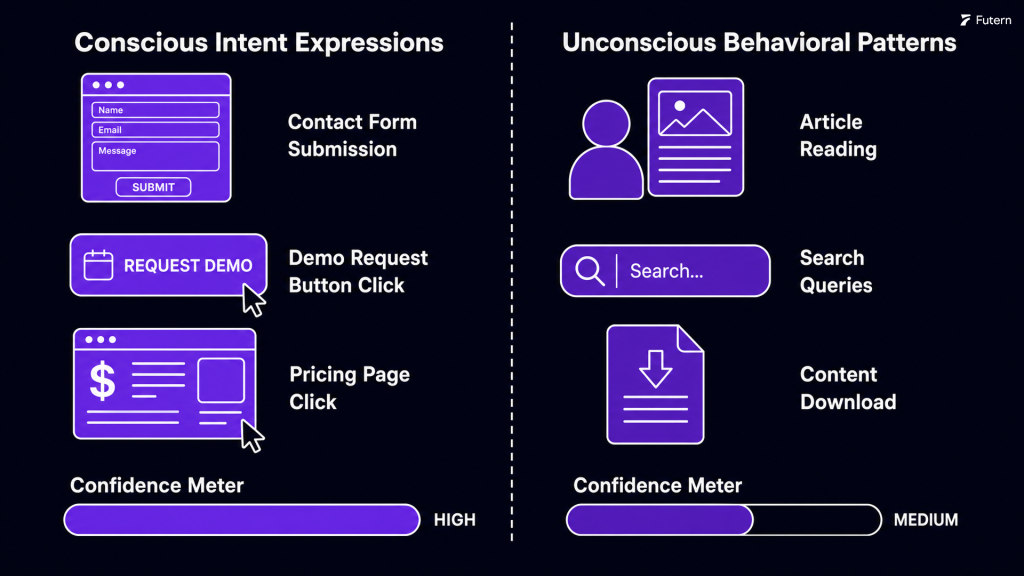
The most important distinction is between conscious intent expressions and unconscious behavioral patterns. A conscious intent expression is an action the prospect takes knowing it signals interest: submitting a contact form, requesting a proposal, attending a vendor webinar, or directly asking for pricing. These signals are high-confidence but low-volume. By the time a prospect takes one of these actions, they are already deep in a buying process and likely evaluating multiple vendors.
Unconscious behavioral patterns are actions that correlate with purchase intent but are not performed with the purpose of signaling it. A procurement director reading three articles about sales automation tools in a week does not think of that as sending a message to vendors. But the pattern, when detected, suggests the topic is on their mind. These signals are higher-volume but individually less reliable. Their value depends entirely on how accurately they are captured and how intelligently they are interpreted.
Understanding this distinction matters because it determines how aggressively a team should act on a given signal. Treating an unconscious pattern with the same urgency as a conscious expression leads to outreach that feels premature and intrusive. Ignoring unconscious patterns entirely means missing early-stage opportunities that competitors will catch first.
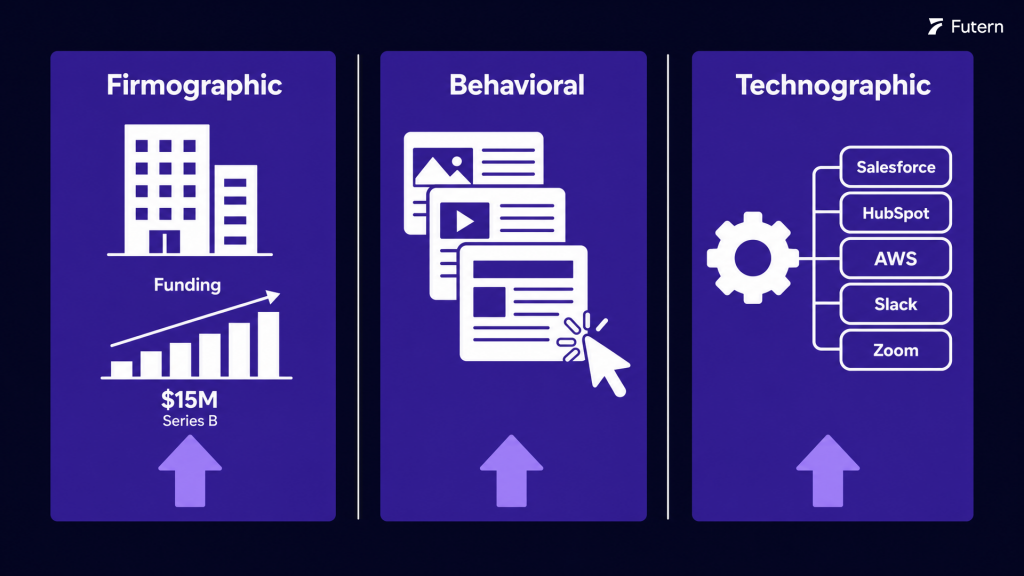
How intent depth gets assessed in practice depends on the data sources available. The sections that follow examine three major categories of signal data — firmographic, behavioral, and technographic — each of which captures different aspects of a prospect's situation and carries different reliability characteristics. Effective signal interpretation requires understanding not just what each data source measures, but how it maps to actual purchase intent.
Firmographic and Organizational Signals
Some of the most accessible buying signals come from changes at the company level. A new funding round, a leadership hire, an office expansion, entry into a new market, a merger announcement — these are public, verifiable events that indicate shifting priorities and new budget availability.
Firmographic signals appeal to sales teams because they are concrete and easy to source. Funding announcements appear in press releases and industry databases. Job postings are public. Executive changes show up on professional networks. A sales team does not need specialized data infrastructure to monitor these events, though doing so manually at scale is impractical.
These signals are inherently indirect, however. A company raising a Series B does not mean they are about to purchase your product. It means they have new capital and likely new growth objectives, which might eventually translate into a purchase in your category — or might not. The causal chain between "company event" and "purchase decision" has multiple links, and any one of them can break.
Timing is another constraint. By the time a funding round is publicly announced, the company may have already started vendor conversations weeks or months earlier. The signal is real, but it arrives with a delay that varies unpredictably. A team that relies primarily on firmographic signals will consistently enter conversations later than teams that detect intent through behavioral data.
Where these signals perform best is as qualifying context rather than outreach triggers. When a prospect is already showing other signs of interest, a recent firmographic event adds confidence to the assessment. A contact who has been consuming relevant content and whose company just announced a market expansion is a stronger prospect than one showing only one of those signals.
Behavioral and Content Signals
Behavioral signals capture what individuals and organizations are doing rather than what is happening to them. Content consumption patterns, search behavior, website visits, webinar attendance, email engagement, and social media activity all fall into this category. These signals attempt to measure attention — where a prospect is spending their time and what topics are occupying their thinking.
What matters most with behavioral signals is the data source. First-party signals come from your own channels: who visited your website, which emails were opened, what content was downloaded, how prospects interacted with your product if you offer a trial. These signals are specific to your brand, which makes them high-relevance but narrow in scope. A prospect might be actively researching your category without ever visiting your website.
Third-party intent data attempts to fill this gap. Data vendors aggregate content consumption, search behavior, and engagement data across networks of publisher sites, content platforms, and B2B media properties. When someone at a target account consumes content related to your product category across these networks, the vendor flags it as an intent signal. The coverage is much broader than first-party data, which is the primary appeal.
Reliability is where the trade-off appears. Third-party intent data operates at the account level rather than the individual level in many cases. The signal tells you that someone at the company showed interest, but not necessarily who. Attribution accuracy varies by vendor and methodology. The data may be days or weeks old by the time it reaches your system. And because the same data is often sold to multiple buyers, the competitive advantage of acting on it diminishes as adoption increases.
None of this means third-party intent data is useless. It means the signal needs to be weighted appropriately: as one input among several, not as a standalone trigger for outreach. Teams that treat every intent data flag as a green light for immediate contact end up with high outreach volumes and low response rates, because many of those signals were too weak, too old, or too vaguely attributed to justify action.
Technographic Signals
A less discussed but often more reliable category of buying signals comes from changes in a prospect's technology stack. When a company adopts a new CRM, switches email platforms, deploys a new analytics tool, or lets a software contract expire, these events directly reflect purchasing behavior rather than inferring it from content consumption.
Technographic data reveals what tools a company is actually using, which serves two purposes for prospecting. First, it establishes compatibility and relevance. If a prospect already uses tools that integrate well with your product, the friction to adoption is lower. If they use a competitor's product, you know they have budget allocated to the category and understand the problem your product solves. Second, technology changes signal active decision-making. A company that just switched CRMs is unlikely to switch again soon, but a company whose current tool shows signs of underinvestment or whose contract is approaching renewal may be entering an evaluation window.
Data freshness is the primary challenge. Technology adoption is not always publicly visible, and detection methods range from web scraping and code analysis to survey data and self-reporting. Each method has different coverage and latency characteristics. A technographic snapshot from six months ago may not reflect the company's current stack, especially for fast-moving mid-market organizations that adopt and discard tools more frequently than enterprises.
Despite these limitations, technographic signals carry a distinctive advantage: they are directly tied to purchasing behavior. A company that installed a new marketing automation platform last quarter made a real purchasing decision. That single data point tells you more about their buying patterns, budget allocation, and technology maturity than dozens of content consumption events.
Why Individual Signals Mislead and Combinations Work
The most common mistake teams make with buying signals is treating any single signal as sufficient grounds for action. A prospect visited your pricing page — should you call them immediately? A target account showed up in your intent data feed — should you launch a cadence? A company just raised funding — should you add them to the outreach queue?
In each case, the honest answer is: maybe. The signal is real, but its predictive value in isolation is low. A pricing page visit might be a serious buyer comparing options, or it might be a curious employee, a competitor doing research, or a bot. An intent data flag might reflect genuine category interest, or it might be noise from a single content interaction that barely registered. A funding round might lead to vendor purchases, or the capital might be directed entirely toward hiring and product development.
False positives are the central problem of signal-based prospecting. When outreach is triggered by weak signals, the sales team spends time on prospects who are not ready, not relevant, or not real. And the cost extends beyond wasted effort. Poorly timed outreach can create negative impressions that make future engagement harder when the prospect does enter a buying window.
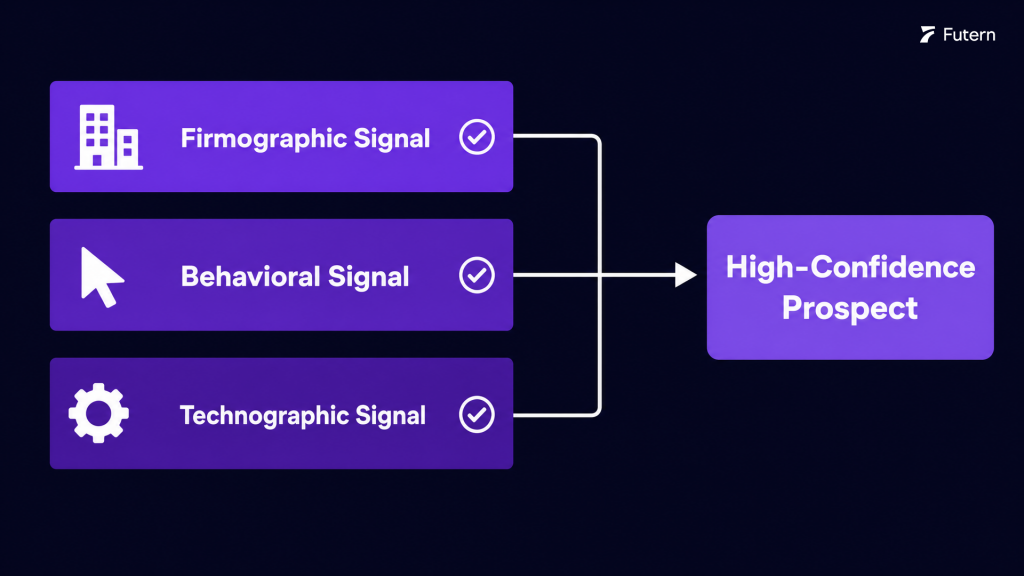
Signal stacking addresses this by requiring multiple signals across different categories before triggering action. A single firmographic event is interesting. That same event combined with behavioral signals showing content consumption in the relevant category, plus a technographic signal indicating the company's current tool contract is nearing renewal, creates a composite picture that is far more reliable than any individual data point.
The time dimension matters as much as the category dimension. Signals that converge within a compressed time window are more meaningful than the same signals spread over six months. A company that posted a relevant job listing, showed intent data activity, and had an executive publish about the topic within the same month is showing a pattern of concentrated attention that isolated events do not convey.
From Raw Signals to Prospecting Decisions
Collecting signals is only valuable if the team has a framework for translating them into specific actions. Without that framework, intent data becomes another dashboard that sales leaders check occasionally but rarely act on systematically.
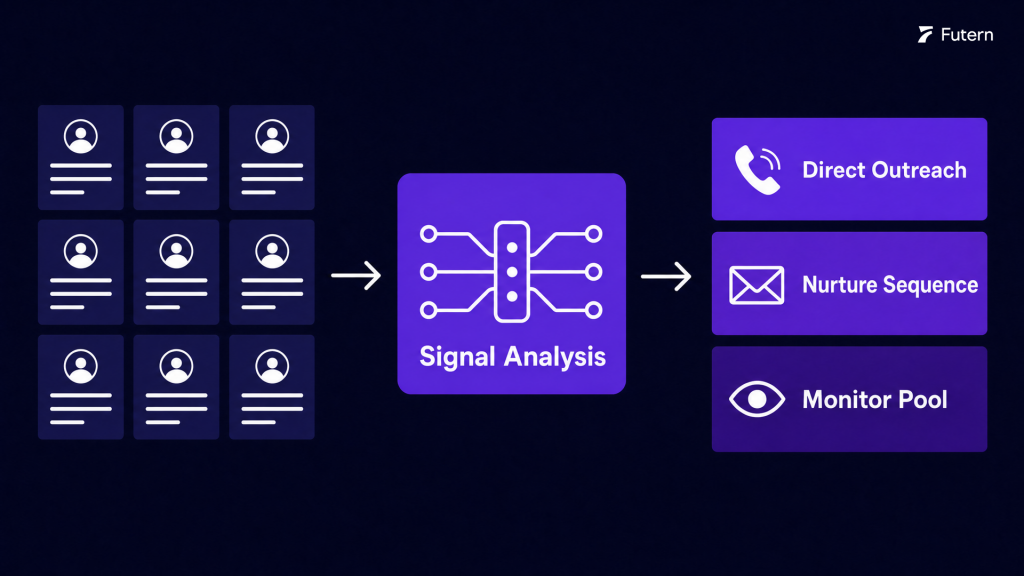
Translating signals into action requires two judgments. The first is confidence: does this combination of signals provide enough evidence to warrant spending sales time on this prospect? The second is urgency: does the timing suggest the prospect is in an active evaluation window, or is this early-stage interest that should be monitored rather than acted on?
These judgments produce three basic response categories. High-confidence, high-urgency signal combinations trigger direct outreach. The prospect is showing strong, recent indicators of purchase intent across multiple dimensions, and the window for engagement may be limited. Moderate signals trigger nurture sequences: the prospect is worth engaging, but through lighter-touch channels that maintain presence without the pressure of a direct sales conversation. Weak or ambiguous signals move the prospect into a monitoring pool where the system continues tracking for signal escalation.
This tiered approach is where the connection between signal quality and prospecting effectiveness becomes most visible. Teams that operate on a calendar-driven outreach model reach everyone at the same cadence regardless of readiness. Teams that operate on a signal-driven model allocate their outreach effort in proportion to the evidence of opportunity. The second approach produces fewer total outreach attempts but significantly higher conversion rates, because each attempt is backed by a reason to believe the timing is right.
Effective signal interpretation is also where AI systems provide their clearest advantage. A human analyst can evaluate signals for a handful of prospects per day. Monitoring signal combinations across thousands of accounts, weighting them by recency and reliability, and continuously reprioritizing the outreach queue is precisely the kind of pattern recognition and data processing that scales computationally but not manually.
Making Signals Work for Prospecting
B2B sales teams today have access to more intent data than at any point in the past, yet most report that their prospecting results have not improved proportionally. The gap is not in signal availability but in signal interpretation.
Understanding the differences between firmographic, behavioral, technographic, and conscious intent signals is a necessary starting point. Each type carries different information, arrives with different latency, and has different reliability characteristics. Treating them as interchangeable, or over-indexing on any single category, produces exactly the kind of poorly targeted outreach that erodes response rates over time.
The real leverage comes from combining signals across categories within compressed time windows, applying confidence thresholds before triggering action, and maintaining systematic monitoring so that prospects are engaged when the evidence supports it rather than when the calendar dictates it. Signal quality is the variable that determines whether an AI prospecting system produces high-quality pipeline or just high-volume activity. With strong signal interpretation upstream, the next stage of the process — enriching the data behind each qualified prospect — builds on a solid foundation.
Global Outbound Sales in 2026: What Actually Scales and What Doesn't