Why Most B2B Lead Generation Still Runs on Guesswork
by Stella L
Why Most B2B Lead Generation Still Runs on Guesswork.
Most B2B sales teams believe they have a lead generation process. They have tools for finding contacts, software for sending sequences, and dashboards that report how many leads entered the pipeline last month. From the outside, it looks systematic.
Look closer, though, and the decisions driving that process are largely based on assumptions. Which companies to target, which contacts to prioritize, when to reach out, what to say, and how to measure success are all questions that most teams answer through experience and intuition rather than through data. The tools automate the execution, but the underlying logic remains manual.
This is not a criticism of sales teams. B2B lead generation is genuinely difficult, and the information needed to make precise decisions has historically been expensive or unavailable. But the gap between what teams assume and what the data would actually tell them creates a pattern of waste that compounds at every stage of the pipeline. A targeting assumption that is slightly off at the top produces outreach that is significantly off in the middle and pipeline numbers that are misleading at the bottom.
This article follows a lead through the typical B2B generation process, from initial sourcing through qualification and outreach to measurement. At each stage, it identifies where guesswork enters, why it persists, and what it costs.
Finding Prospects and the List-Building Problem

Lead generation starts with a question that sounds simple: who should we be selling to? In practice, most teams answer this question through a combination of purchased lists, LinkedIn searches, conference badge scans, and referral networks. Each of these sources carries its own set of assumptions, and few teams examine those assumptions closely.
Purchased lists offer scale but sacrifice specificity. A list of 10,000 contacts matching a job title and industry filter feels like a starting point, but the match between list criteria and actual buying propensity is rarely tested. The list vendor's data model and the sales team's ideal customer profile may define the same terms differently. "Decision-maker" means something different to a data provider selling volume than it does to an account executive qualifying an opportunity.
LinkedIn prospecting introduces a different kind of assumption. Search filters on LinkedIn reflect how people describe themselves, not how they buy. A VP of Operations at a 200-person manufacturer and a VP of Operations at a 200-person software company share a title but almost nothing else in terms of buying behavior, budget authority, or pain points. Teams that prospect primarily through title and company size filters are targeting a demographic proxy rather than an actual buying profile.
Conference leads and referrals are often treated as higher quality because they involve some form of human interaction, but they carry their own bias. Conference attendees self-select for topics they already care about, which means the pool is pre-filtered in ways that may not match the broader market. Referral networks produce warm introductions, but they also reproduce the existing customer profile rather than expanding into adjacent segments.
The deeper problem is that most teams build prospect lists without a clear model of their total addressable market versus their reachable qualified prospects. "Total addressable market" is a planning number. "Reachable qualified prospects" is a much smaller set defined by data availability, contact accuracy, timing, and channel accessibility. The gap between these two numbers is where the first layer of guesswork lives, and everything downstream inherits it.
Researching Prospects with Partial Information
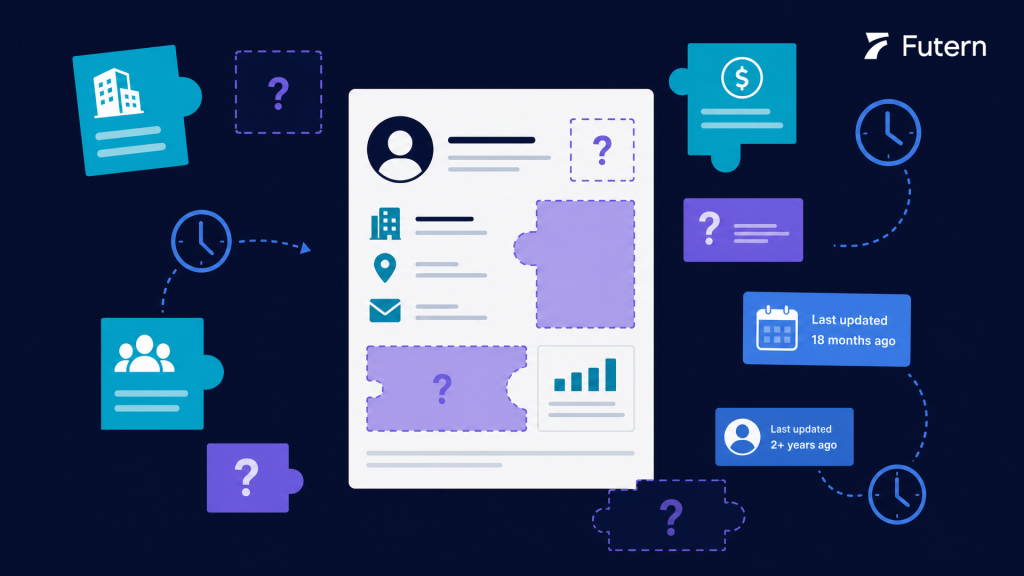
Once a prospect list exists, someone needs to research those prospects before outreach begins. In many B2B teams, this step is either skipped entirely or performed manually by SDRs spending 15 to 30 minutes per account reviewing LinkedIn profiles, company websites, and news articles.
Manual research is time-consuming and inconsistent. An SDR reviewing 20 accounts per day will inevitably cut corners on some and over-research others, with no standardized framework for what constitutes "enough" information. The quality of the research depends on the individual rep's judgment, their familiarity with the industry, and how much time pressure they are under that week.
The data available during research is also structurally incomplete. B2B contact data decays at a rate of roughly 30 percent per year as people change roles, companies restructure, and phone numbers rotate. A contact record that was accurate when it was created may be partially or fully outdated by the time an SDR picks it up. Email addresses bounce, direct dials connect to the wrong person, and LinkedIn profiles reflect previous roles. Teams that rely on static data snapshots are working with an increasingly inaccurate picture of their market.
What most research processes miss entirely is contextual information that would change the outreach strategy. Knowing that a company just closed a funding round, expanded into a new market, or posted three new sales hiring positions in the past month would significantly change how and when to approach them. This kind of information exists, but it lives in scattered sources that manual research cannot systematically cover. Job boards, press releases, regulatory filings, social media activity, and technology adoption signals all contain relevant intelligence, but synthesizing them into an actionable prospect profile requires infrastructure that most teams do not have.
The result is that outreach begins with a prospect profile that is simultaneously overloaded with irrelevant details (company founding year, headquarters city) and missing the details that actually matter (current priorities, recent organizational changes, technology stack shifts). Sales teams are sending messages based on who the prospect was three to six months ago rather than who they are today.
Lead Qualification Built on Circular Assumptions
After sourcing and research, leads enter some form of qualification process. In most B2B organizations, this means a scoring system that assigns points based on demographic and firmographic attributes: company size, industry, job title, geography, and sometimes technology usage. Leads that cross a threshold get flagged as "qualified" and passed to account executives.
Most scoring systems are built on circular logic. Teams analyze their closed-won deals to identify common attributes, then use those attributes to score new leads. A company that has historically sold well to 200-500 person manufacturing firms will build a scoring model that prioritizes 200-500 person manufacturing firms. The model confirms the existing pattern rather than testing whether other segments might convert at equal or higher rates.
This approach conflates fit with intent. A lead can match every demographic criterion perfectly and still have zero interest in buying. Conversely, a lead from an unexpected segment might be actively looking for a solution but gets deprioritized because the scoring model was not built to recognize it. The scoring system measures how much a prospect resembles past customers, not how likely they are to become a future one.
The intent dimension is where the largest gap exists. Traditional lead scoring captures a static snapshot of what a company looks like, but it cannot capture what a company is doing right now. A prospect who visited a pricing page twice last week, downloaded a competitor comparison guide, and started following three industry analysts on LinkedIn is exhibiting buying behavior that a firmographic scoring model will never detect.
Teams that recognize this gap sometimes layer behavioral scoring on top of firmographic scoring, tracking website visits, email opens, and content downloads. This is directionally correct, but it only captures behavior within the team's own properties. A prospect who is deep in a buying process but has never visited your website is invisible to behavioral scoring systems that depend on first-party data. The prospects who are most ready to buy may be the ones your scoring system knows least about, because they have been researching through channels you do not track.
Outreach Timing, Channel, and Message as Three Separate Guesswork Layers
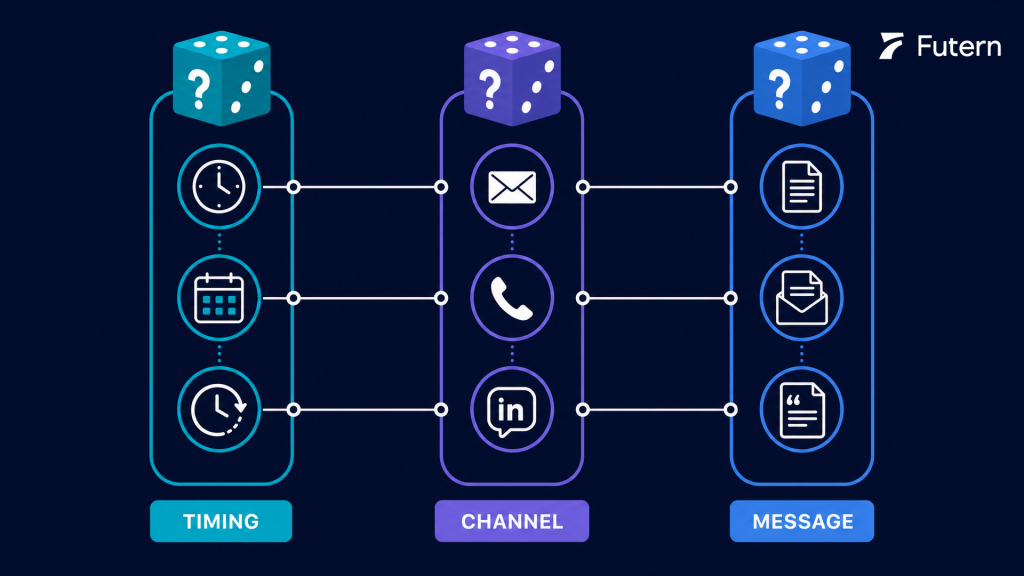
When a lead is deemed qualified, the outreach process begins. Most B2B teams treat this as a sequencing problem: load the lead into a cadence, set the email schedule, add LinkedIn touchpoints at defined intervals, and let the sequence run. The tools that manage this process are sophisticated in their execution but largely indifferent to the three decisions that determine whether outreach works: when to reach out, through which channel, and with what message.
Timing Based on the Sales Team's Calendar
Timing is typically determined by the sales team's own calendar rather than the prospect's buying timeline. Sequences start when the lead is loaded, not when the prospect is ready. A quarterly business review may make a decision-maker receptive to new vendor conversations in weeks 2 through 4 of a quarter but distracted during close periods. Budget cycles, fiscal year boundaries, and organizational planning periods all create windows of receptivity that most outreach ignores because the team has no systematic way to detect them.
Channel Sequences That Follow a Template
Channel selection is similarly defaulted rather than decided. Most sequences follow a template: email first, LinkedIn connection request second, follow-up email third, phone call fourth. This order reflects the team's comfort and tool availability, not the prospect's communication preferences. Some decision-makers respond to LinkedIn messages within hours but let emails accumulate for days. Others treat LinkedIn as a broadcast channel and reserve email for substantive business conversations. A fixed sequence treats all prospects as if they use channels identically.
Personalization That Stays on the Surface
Message personalization has become a paradox. Teams know that generic messages underperform, so they invest in "personalization" that typically means inserting the prospect's name, company, and a reference to a recent company event into a templated structure. This surface-level customization is detectable and often counterproductive. A message that opens with "I noticed {company} just expanded into APAC" followed by a product pitch teaches the recipient that the personal reference was a pretense, not a genuine conversation starter.
The cumulative effect of defaulted timing, templated channel sequences, and superficial personalization is an outreach program that executes efficiently but connects poorly. High activity metrics mask low engagement rates, and the response rate that does exist is difficult to attribute to any specific outreach decision because the variables were never isolated.
Measuring Lead Generation by Volume Instead of Quality
Most B2B lead generation programs report on volume metrics: leads generated, emails sent, meetings booked, and pipeline created. These numbers are easy to track, satisfying to report, and almost entirely disconnected from the question that matters, which is whether the leads entering the pipeline are likely to become revenue.
Volume metrics create a specific kind of organizational blindness. A team that generated 500 leads last month and booked 40 meetings will report those numbers with confidence, but neither number reveals how many of those leads were genuinely qualified, how many meetings advanced to a second conversation, or how many will still be in the pipeline 90 days later. The lag between lead generation activity and revenue outcome is long enough that by the time the quality signal arrives, the team has already generated several more months of leads using the same assumptions.
This lag also makes it difficult to diagnose problems. When pipeline conversion rates decline, the instinct is to increase volume at the top, generating more leads to compensate for lower conversion. This response treats the symptom while reinforcing the cause. If the leads being generated are poorly targeted, generating more of them accelerates waste rather than solving it.
Teams that measure lead generation effectively track metrics at each pipeline stage rather than aggregating at the top. Conversion rate by lead source reveals which sourcing channels produce leads that actually close. Time-to-qualify measures how quickly the team can determine whether a lead is worth pursuing. Pipeline-to-close ratio by segment shows which types of leads convert at the highest rates. Cost per qualified opportunity, rather than cost per lead, reveals the true economics of each generation channel.
The shift from volume to quality metrics is conceptually simple but operationally difficult. It requires attribution models that connect upstream sourcing decisions to downstream revenue outcomes across months or quarters. It requires the discipline to reduce lead volume if quality improves, which conflicts with most sales organizations' instinct to keep the top of funnel full. And it requires data infrastructure that can track a lead from its source through every pipeline stage to close, which many teams lack.
How Guesswork at Each Stage Compounds Downstream

The stages described above are not independent problems. They are a connected system in which each upstream assumption amplifies the next downstream error.
When prospect targeting is based on demographic proxies rather than behavioral data, the lead pool contains a structural quality problem from the start. Incomplete research means that even the good leads in that pool are approached with partial information, reducing the relevance of the outreach. Scoring systems built on historical patterns rather than current intent cannot distinguish between the leads worth pursuing now and the leads that might be relevant later. Outreach that defaults on timing, channel, and message cannot compensate for the upstream gaps because it lacks the information needed to make better decisions.
The measurement layer then obscures the entire chain. Volume metrics report that the system is producing output, which it is. But they cannot reveal that the output is built on a series of compounding assumptions that degrade quality at each stage. A team might generate 1,000 leads, send 3,000 emails, book 50 meetings, and create $500,000 in pipeline while operating at 40 percent of its potential effectiveness, and the dashboard would show only the absolute numbers.
This compounding effect explains why incremental improvements to individual stages often produce disappointing results. Upgrading the sequencing tool improves email deliverability but does not fix the targeting problem. Buying better data improves contact accuracy but does not address the scoring gap. Adding a new channel increases touchpoints but does not improve timing. Each fix addresses one layer of guesswork while leaving the others intact, and the remaining layers limit the impact of the improvement.
Moving lead generation from guesswork to system requires addressing the chain as a whole rather than optimizing individual links. This means building processes in which targeting decisions are informed by behavioral data rather than demographic assumptions, research is continuous and automated rather than manual and point-in-time, qualification incorporates real-time signals alongside firmographic fit, outreach adapts to prospect behavior rather than following fixed sequences, and measurement tracks quality outcomes rather than activity volume.
The articles that follow in this series examine each of these stages in detail, starting with how modern prospecting works and moving through data enrichment, buying signals, multi-channel outreach, lead scoring, and the economics of lead generation at scale. Each article takes one of the guesswork layers identified here and explores what replacing it with data-driven decision-making actually involves.
Lead generation has operated on guesswork for so long that many teams accept it as the natural state of the process. It is not. The information, infrastructure, and analytical approaches needed to make lead generation systematic exist today. The question is not whether it is possible to move beyond guesswork, but how to do it without disrupting the pipeline that is currently producing results. That transition, from assumption-driven to data-driven lead generation, is what this series is designed to support.
AI Sales Agents: Complete Buyer's Guide
Global Outbound Sales in 2026: What Actually Scales and What Doesn't