Data Requirements for AI Sales Agents: What You Need and What the Platform Handles
by Stella L
What data AI sales agents need, what they generate, and how it all connects.
When teams evaluate AI sales agents, the conversation tends to focus on capabilities, channels, and pricing. Rarely does someone ask the more fundamental question: what data does this platform actually need from us, and what does it handle on its own? This gap in the evaluation process leads to two opposite problems. Some teams overestimate the data preparation required and delay adoption because they feel their data "isn't ready yet." Others underestimate how much their own data inputs shape results and miss opportunities to improve AI performance through better information.
The reality is more nuanced than either extreme. Modern AI sales agents are designed to operate with significant data autonomy. They source leads, enrich prospect records, verify contact information, and monitor market signals without requiring a team to feed them structured databases. At the same time, the quality of what a team does provide, from targeting parameters to messaging context to product positioning, acts as a multiplier on everything the AI produces. Understanding this dynamic is essential for setting realistic expectations, planning a smooth deployment, and evaluating platforms against your actual situation.
This article maps the full data ecosystem that supports AI-powered outbound sales. Rather than framing data as a checklist of prerequisites, it starts with the two primary input categories, data the platform sources on its own and data your team provides to sharpen results, then explores a third category that most buyers overlook: the engagement and performance data that accumulates automatically once outbound is running. Knowing where each category fits helps you assess what you already have, what you might want to develop, and what to look for during platform evaluation.
Two Categories of Data in AI-Powered Outbound
A useful starting point is to distinguish between platform-sourced data and team-supplied data. This distinction matters because it reframes the data conversation. Instead of asking "do we have enough data to use an AI sales agent," the better question is "what does the platform handle, and what can we add to improve results?"
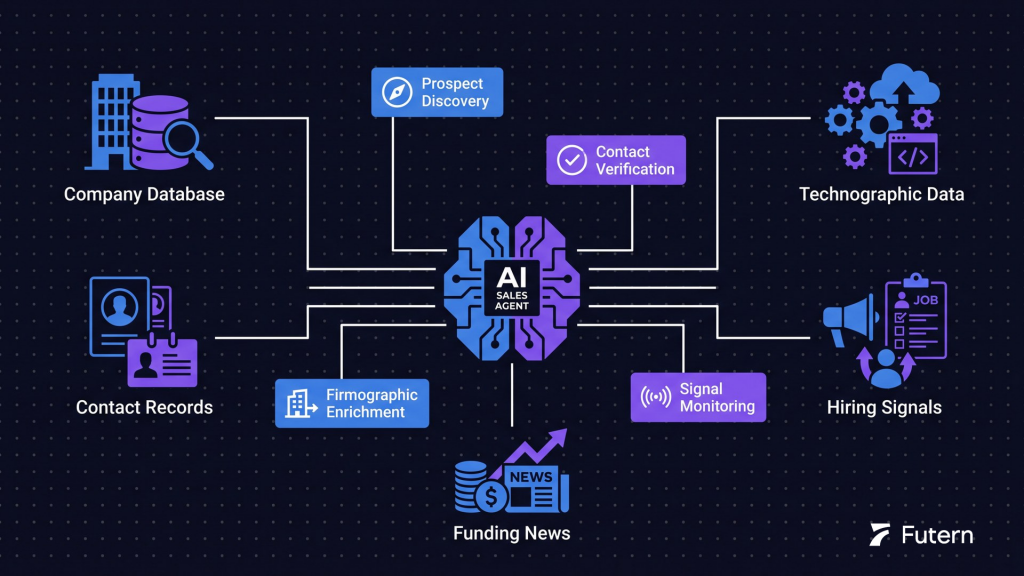
Platform-sourced data includes everything the AI agent acquires and maintains through its own capabilities: prospect identification, contact discovery, firmographic and technographic enrichment, and real-time signal monitoring. This is the engine that makes autonomous outbound possible. The platform does not wait for you to upload a prospect list. It builds one.
Team-supplied data is the strategic context that helps the AI agent make better decisions about who to target, what to say, and how to prioritize. This includes your Ideal Customer Profile parameters, messaging guidelines, value proposition framing, and competitive positioning. These inputs are valuable and worth developing, but they are enhancers. They improve the precision and relevance of what the AI produces. They are not gatekeeping requirements that must be complete before the system can function.
The balance between these two categories varies by platform maturity. Platforms with strong autonomous data capabilities require less upfront input from teams, which translates to faster time-to-value and lower setup friction. This is an important evaluation dimension, particularly for teams that want to move quickly or lack dedicated data operations resources.
Platform-Sourced Data: What the AI Handles on Its Own
One of the most underappreciated aspects of modern AI sales agents is the breadth of data they acquire independently. Teams accustomed to traditional outbound workflows, where someone manually builds prospect lists, researches companies, and verifies contact details, often assume that AI agents need similar inputs. They do not.
A capable AI sales agent handles prospect discovery and identification as a core function. Given targeting parameters (even broad ones), it searches across data sources to identify companies and individuals that match. This is fundamentally different from working with a static list. The AI continuously discovers new prospects as they enter the addressable market, which means the pipeline of potential contacts refreshes without manual intervention.
Contact verification is another layer the platform manages. Outdated or incorrect contact information is one of the biggest drains on outbound efficiency. AI agents that verify email addresses, phone numbers, and professional profiles before initiating outreach eliminate a category of waste that traditionally required dedicated tools or manual checking.
Firmographic and technographic enrichment adds depth to each prospect record. The AI attaches data about company size, industry classification, technology stack, growth indicators, and organizational structure. This enrichment happens automatically and continuously, which means prospect records become more complete over time rather than degrading as they would in a static database.
Finally, leading platforms monitor public signals that indicate timing and intent. These signals include hiring activity in specific functions, recent funding rounds, leadership changes, geographic expansion announcements, and technology adoption events. Signal monitoring transforms prospecting from a static exercise (who fits the profile) into a dynamic one (who fits the profile and is showing signs of readiness right now).
The practical implication is significant. A team can deploy an AI sales agent with relatively minimal data preparation and still get a functioning outbound operation, because the platform's autonomous data capabilities cover the foundational requirements. The question then becomes how to layer team-supplied data on top of this foundation to improve targeting precision and messaging quality.
Team-Supplied Data: The Inputs That Sharpen Results
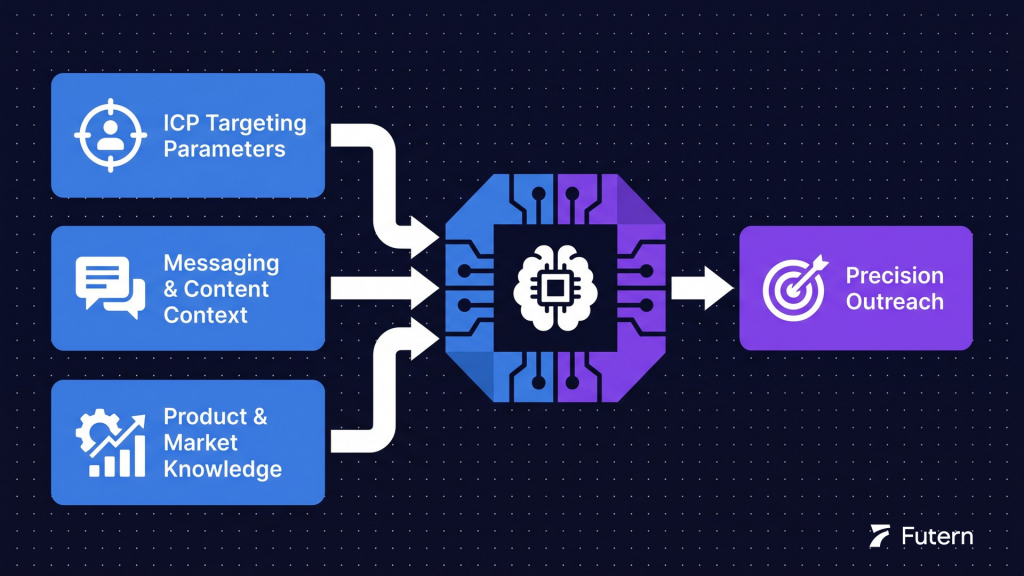
While the platform handles the heavy lifting on prospect data, what your team provides shapes how effectively the AI uses that data. Team-supplied inputs fall into three areas, each adding a different dimension of precision.
The first area is targeting parameters. This is where your Ideal Customer Profile translates into actionable instructions for the AI. The more structured and specific your targeting criteria, the more precisely the AI can filter and prioritize prospects from the universe of possibilities it discovers. We covered ICP readiness in depth in a previous article, including how to assess your ICP maturity and what different readiness levels mean for platform selection. For the purposes of data requirements, the key point is that even a foundational ICP with basic industry, size, and geographic parameters gives the AI enough to start. Richer targeting criteria (buyer persona details, behavioral signals, disqualification rules) progressively improve results as you develop them.
The second area is messaging and content context. An AI sales agent can generate outreach messages autonomously, but the relevance and resonance of those messages improve substantially when the team provides clear inputs about value proposition, competitive differentiation, and communication style. This does not mean writing every email template manually. It means giving the AI enough context to understand what your company does, what problems it solves for specific segments, and what tone fits your brand. Some teams provide this as a structured brief. Others start with a few paragraphs of positioning language and refine based on what the AI produces. Either approach works, and the AI's messaging quality improves iteratively as the team reviews output and adjusts inputs.
The third area is product and market knowledge that goes beyond basic positioning. This includes information about pricing context (without specific numbers, simply how your offering is positioned relative to alternatives), common objections and how the team addresses them, specific use cases by segment or industry, and any regulatory or compliance considerations that affect how you sell in certain markets. This category of data is particularly valuable for teams selling into multiple verticals or geographies, where the same product may need very different framing depending on the audience.
None of these team-supplied inputs require a massive upfront data project. The most effective approach is to start with whatever you have, observe how the AI performs, and progressively add context where you see the clearest opportunity for improvement. Teams that treat data input as an ongoing refinement process rather than a one-time preparation exercise consistently see better long-term results.
The Data That Builds Itself: Engagement and Performance Feedback
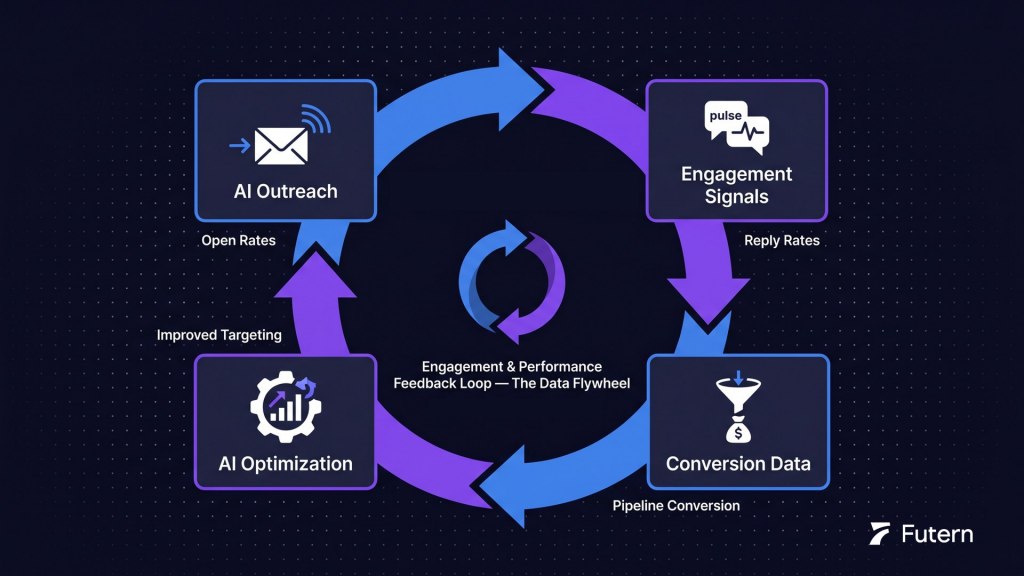
Beyond platform-sourced data and team-supplied inputs, there is a third category that deserves attention: the data generated by the AI agent's own outbound activity. Every email sent, every LinkedIn message delivered, every response received creates a data point. Over time, this engagement data becomes one of the most valuable assets in your outbound operation.
Engagement patterns reveal what works and what does not at a granular level. Which subject line approaches generate higher open rates in specific segments? Which messaging angles drive replies from certain persona types? What time windows produce the best response rates in different markets? The AI agent collects this data automatically, and platforms with strong analytics capabilities surface it in ways that inform both AI optimization and human strategic decisions.
Conversion signals track which engaged prospects progress through the pipeline and which ones stall or drop off. This data connects outbound activity to actual business outcomes, which is essential for measuring return on investment and identifying which targeting and messaging combinations produce the highest-quality pipeline.
Feedback loops are where this data category becomes a compounding advantage. When engagement and conversion data feeds back into the AI's targeting and messaging algorithms, the system improves its own performance over time. Messages that generate replies get weighted more heavily. Prospect profiles that convert influence future targeting. The AI effectively learns from its own execution, and each cycle of outreach generates data that makes the next cycle more effective.
The team's role in this feedback process is review and guidance. Periodically examining performance data, identifying patterns the AI may not be weighting correctly, and adjusting targeting parameters or messaging inputs based on observed outcomes. This is a relatively light operational commitment, but it has outsized impact on long-term performance. Teams that build a regular review cadence, even a brief monthly check, maintain stronger AI performance than those that deploy and disengage.
Data Flow Architecture: How Information Moves Through Your Sales Stack
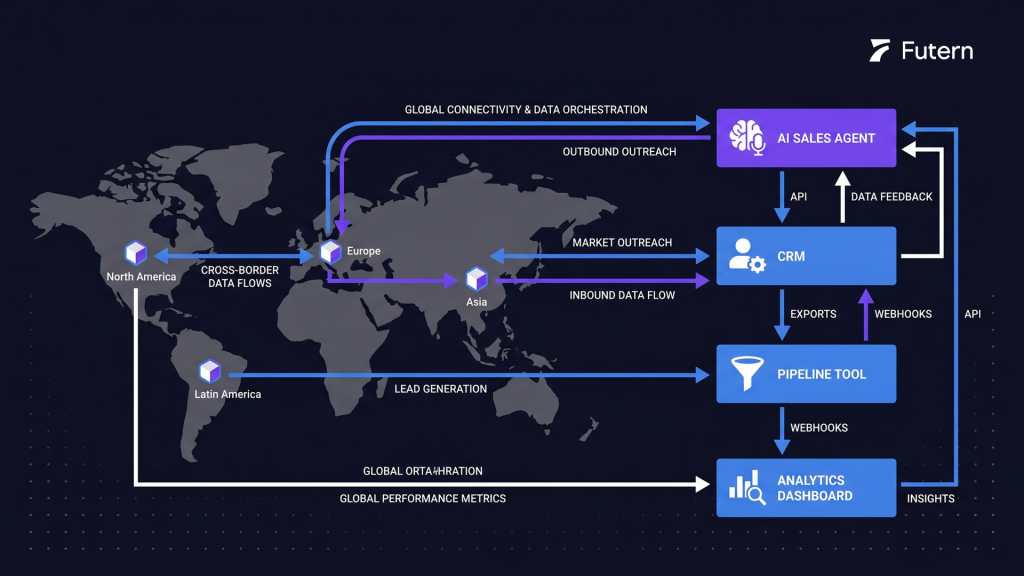
The question of data requirements naturally leads to a related question: how does data move between your AI sales agent and the rest of your sales tools? This is a practical concern for every team, because AI-powered outbound does not operate in isolation. Prospect data, engagement records, and qualified leads need to flow into whatever systems your team uses for pipeline management, deal tracking, and customer relationship management.
The good news is that there are multiple proven approaches to data connectivity, and the right one depends on your team's technical infrastructure and workflow preferences rather than on any single "correct" architecture.
API-based connections offer the most flexibility for teams with technical resources. APIs allow you to build custom data flows that move specific information between systems on your own schedule and terms. A team might configure an API connection that pushes qualified leads from the AI agent into their pipeline management tool every evening, or that pulls updated account information from their CRM into the AI's targeting parameters on a weekly basis.
Scheduled exports and imports provide a simpler path for teams that prefer manual control or lack dedicated technical staff. Many AI platforms support exporting prospect data, engagement records, and performance reports in standard formats that can be imported into other tools. This approach trades real-time synchronization for simplicity and human oversight.
Webhook-based workflows sit between these two options, offering event-driven automation without full API development. When a prospect reaches a specific engagement threshold or qualifies based on the AI's criteria, a webhook can automatically trigger an action in another system, such as creating a new record, sending a notification, or updating a status.
The evaluation question is straightforward: does the platform support data connectivity methods that align with your existing infrastructure? A team that already uses API connections across their stack should evaluate AI platforms on API quality and documentation. A team that operates primarily through manual workflows and spreadsheets should prioritize platforms with clean export capabilities and intuitive data management interfaces. What matters is that data can flow where it needs to go, through whatever mechanism fits your operational reality.
Global Outbound Data Challenges
For teams running outbound across multiple international markets, data requirements carry additional complexity that domestic-only operations do not face.
Data availability varies significantly by market. The depth and accuracy of business contact data in North America and Western Europe is generally strong, with multiple data providers offering comprehensive coverage. In other regions, such as Southeast Asia, Latin America, the Middle East, and parts of Africa, data coverage is thinner, verification is harder, and the sources that work in mature markets may not apply. AI platforms with global data sourcing capabilities partially offset this gap, but teams should understand that prospect data quality in emerging markets may require different expectations and potentially different outreach strategies.
Multilingual data processing adds another dimension. An AI agent prospecting across German-speaking Europe, Japan, and Brazil needs to handle prospect data, company descriptions, job titles, and engagement signals in multiple languages simultaneously. This is a platform capability question: can the AI accurately process and act on non-English data, or does it require everything to be normalized into English first? Platforms with native multilingual processing maintain higher data fidelity across markets.
Cross-border compliance affects data practices. Different regions have different rules about how business contact data can be collected, stored, and used for outreach purposes. GDPR in Europe, LGPD in Brazil, and various national regulations in Asia create a patchwork of requirements. While the specifics of compliance are beyond the scope of this article, the data implication is clear: AI platforms operating in global outbound need built-in awareness of regional data use constraints, and teams should evaluate this capability during selection.
These global data challenges reinforce a broader point: the AI platform's autonomous data capabilities become even more critical in international contexts. A team cannot reasonably be expected to source, verify, and enrich prospect data across dozens of markets manually. The platform's ability to handle multi-market data acquisition and processing is a meaningful evaluation criterion for any team with cross-border ambitions.
Using Data Requirements to Sharpen Platform Evaluation
Data requirements are rarely the first topic in an AI sales agent evaluation, but they should inform the process throughout. Knowing what data the platform handles, what your team provides, and how information flows between systems helps you ask better questions and set more realistic expectations.
During evaluation, consider the platform's autonomous data capabilities as a baseline. How does it source prospects? How current is its enrichment data? What signals does it monitor? Platforms with stronger autonomous data capabilities reduce your team's preparation burden and deliver faster time-to-value, which is especially important for smaller teams without dedicated data operations resources.
Assess what minimum team inputs the platform requires to get started, and compare that to what you currently have available. If a platform requires extensive data preparation, structured templates, or pre-built integration pipelines before it can begin outbound, that is a signal about setup complexity that should factor into your decision. Platforms that can operate effectively with basic targeting parameters and a clear value proposition give you a faster starting point and more room to optimize progressively.
Evaluate data connectivity options against your actual infrastructure. The goal is practical data flow that fits your workflow, through whatever connectivity method matches your technical capacity and operational preferences.
Finally, look at how the platform surfaces engagement and performance data. The data your AI agent generates during operation is only valuable if you can access, interpret, and act on it. Platforms with clear analytics dashboards, exportable performance reports, and actionable engagement insights give your team the visibility needed to refine inputs and improve results over time.
This article is part of our AI Sales Agents: Complete Buyer's Guide, which covers the full evaluation and implementation journey. Whether you are assessing platform capabilities, building your evaluation framework, or planning your first 90 days after deployment, the guide walks through each stage of the process.
Read More
Global Outbound Sales in 2026: What Actually Scales and What Doesn't
Explore more AI & Automation insights here.