AI Sales Agent Pricing Models Explained: Understanding the True Cost
by Stella L
How to evaluate AI sales agent pricing using a total cost of ownership framework.
Pricing is often the first thing buyers research and the last thing they fully understand. When evaluating AI sales agents, most teams start by comparing subscription fees across platforms. This is a reasonable instinct, but it creates a narrow view of what the investment actually involves. A platform with a lower monthly fee can end up costing significantly more when implementation, training, data preparation, and ongoing operational overhead are factored in. Conversely, a platform that appears expensive at list price may deliver lower total cost when it eliminates setup fees, reduces ramp time, and requires minimal human intervention to operate.
The challenge is that AI sales agent pricing has not yet standardized. Different vendors use different models, bundle different capabilities, and structure their fees in ways that make direct comparison difficult. Some charge per user, others per lead or per contact reached. Some offer flat subscriptions, others layer usage-based fees on top of a base rate. Without a consistent framework for evaluation, buyers risk making decisions based on incomplete cost pictures.
This article provides that framework. Rather than comparing specific vendor prices, which change frequently and vary by negotiation, it maps the common pricing structures in the market, identifies the hidden costs that inflate total spend, and builds a total cost of ownership perspective that connects pricing to actual business value. If you have worked through the earlier articles in this guide, covering capabilities, evaluation frameworks, team structure, implementation planning, and data requirements, this final piece addresses the question that ties everything together: what does this investment actually cost, and how does it compare to the alternatives?
Common Pricing Models in the AI Sales Agent Market
The AI sales agent market currently uses several distinct pricing structures, each with its own economic logic and implications for buyers at different scales.
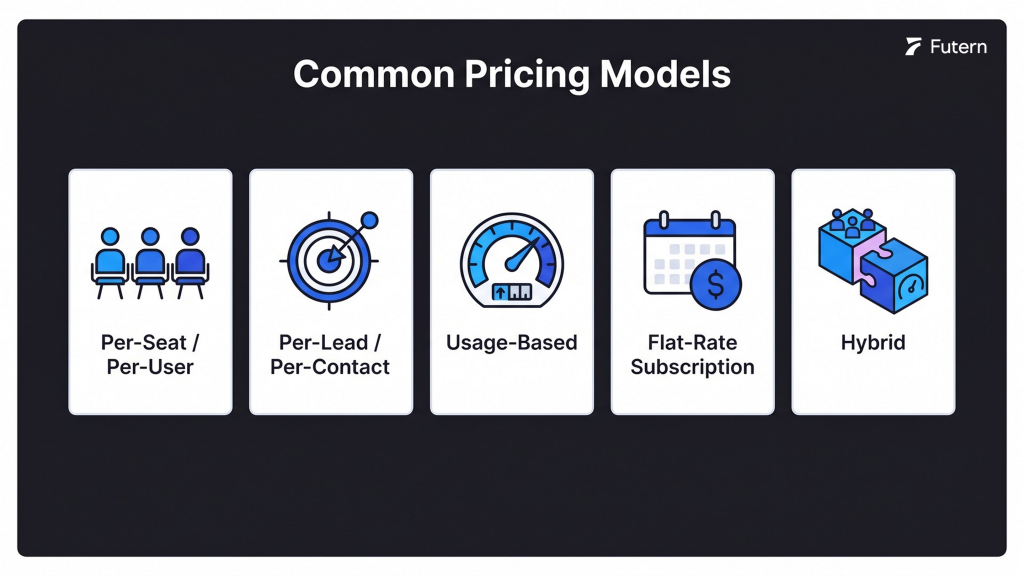
Per-seat or per-user licensing charges a fixed fee for each team member who accesses the platform. This model is familiar from traditional SaaS tools and offers straightforward budgeting: multiply the per-seat cost by your team size, and you have your annual spend. The appeal is predictability. The limitation is that costs scale linearly with team growth, regardless of how intensively each user engages with the platform. For teams that are expanding headcount, per-seat pricing can create budget pressure that has nothing to do with the value being delivered.
Per-lead or per-contact pricing ties costs to outbound volume. You pay based on the number of leads sourced, contacts reached, or messages sent. This model aligns cost with activity, which feels intuitive: you pay for what you use. The risk is unpredictability. During high-volume campaigns or market expansion pushes, costs can escalate rapidly. Teams that start with modest volumes and then scale often discover that their per-unit economics change unfavorably as volume increases, particularly when overage tiers apply.
Usage-based or consumption pricing is a broader variant of per-lead models. Instead of counting individual leads, it meters overall platform usage across multiple dimensions: compute time, data enrichment calls, messages sent, or some combination. This model works well for teams with variable demand patterns, but it makes annual budgeting difficult and can create internal friction when teams feel pressure to limit usage to control costs.
Flat-rate subscription charges a fixed monthly or annual fee that covers a defined scope of capabilities and usage. The primary advantage is budget certainty. Teams know exactly what they will spend regardless of how aggressively they use the platform. The trade-off is that flat-rate models sometimes include usage caps, and exceeding those caps may trigger overage charges that undermine the predictability the model was supposed to provide. Understanding what is included in the flat rate and what triggers additional fees is essential during evaluation.
Hybrid models combine elements of the above. A common structure is a base subscription that covers core platform access plus variable charges for specific high-value activities like verified lead delivery or qualified meeting generation. Hybrid models attempt to balance predictability with usage alignment, but they also increase pricing complexity and make cross-vendor comparison harder.
No single model is inherently better than the others. The right fit depends on your team's size, growth trajectory, outbound volume patterns, and tolerance for cost variability. What matters more than the model itself is understanding the total financial picture behind it.
The Hidden Costs That Inflate Total Spend
The subscription or licensing fee is the most visible component of AI sales agent pricing, but it is rarely the most important one. Several cost categories regularly catch buyers off guard because they do not appear on the initial quote.
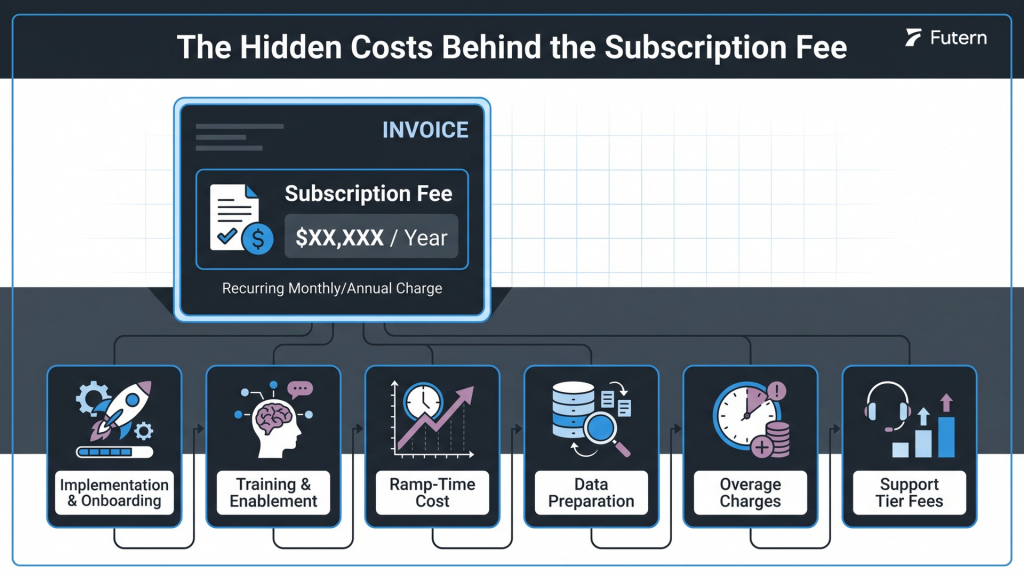
Implementation and onboarding fees are common with platforms that require configuration, customization, or technical setup before they can begin operating. These fees can range from modest one-time charges to substantial professional services engagements that add weeks to the deployment timeline. The variation across platforms is significant: some require dedicated implementation teams and multiple rounds of configuration, while others are designed to operate with minimal setup and can begin outbound activity almost immediately after activation. This difference in implementation burden is one of the most underweighted factors in pricing evaluation.
Beyond the platform fee itself, training and enablement costs add up in ways that are easy to underestimate. These include both the direct fees for training programs and the indirect cost of team time spent learning the platform. A system that requires extensive training for sales managers, operators, or administrators carries a real cost even when the training itself is offered for free. The hours your team spends learning the platform are hours they are not spending on revenue-generating activities. Platforms that operate autonomously with minimal human oversight inherently reduce this cost category, because there is simply less for the team to learn and manage.
Perhaps the most overlooked expense is ramp time cost. If a platform requires three months to reach full operational effectiveness, the revenue impact of that delayed performance is a real cost. During ramp, the AI is underperforming relative to its potential, which means pipeline generation is below expected levels. Teams that factor ramp time into their cost analysis often find that it changes the relative economics between platforms more than the subscription fee difference does.
Data preparation and connectivity costs cover any work required to prepare your data for the platform and establish data flows between the AI agent and your other sales tools. Our article on data requirements explored this topic in detail, including the distinction between platform-sourced and team-supplied data. From a cost perspective, these expenses vary widely depending on how much autonomous data sourcing the platform provides and what connectivity methods it supports. Platforms with strong built-in data capabilities and flexible connectivity options (API, export, webhook) reduce this cost category. Platforms that depend on imported prospect lists or require specific technical integrations increase it.
When you exceed the usage limits included in your base pricing, overage and expansion charges come into play. These are particularly important to understand in per-lead, usage-based, and capped flat-rate models. Ask during evaluation what happens when you exceed limits, whether overages are charged at premium rates, and whether there are automatic scaling mechanisms that adjust pricing as volume grows.
Support tier fees differentiate access to customer support, account management, and strategic guidance. Basic support may be included, but priority support, dedicated account management, or access to optimization consultants often come at additional cost. For teams that plan to actively optimize their AI agent's performance over time, the support tier can meaningfully affect outcomes.
Taken together, these hidden costs can represent a substantial portion of total first-year spend. Evaluating them alongside the subscription fee transforms the pricing conversation from a simple rate comparison into a genuine assessment of investment efficiency.
Building a Total Cost of Ownership Framework
A total cost of ownership approach organizes all cost components into a structured view that enables meaningful comparison across platforms and against alternative approaches like traditional SDR teams.
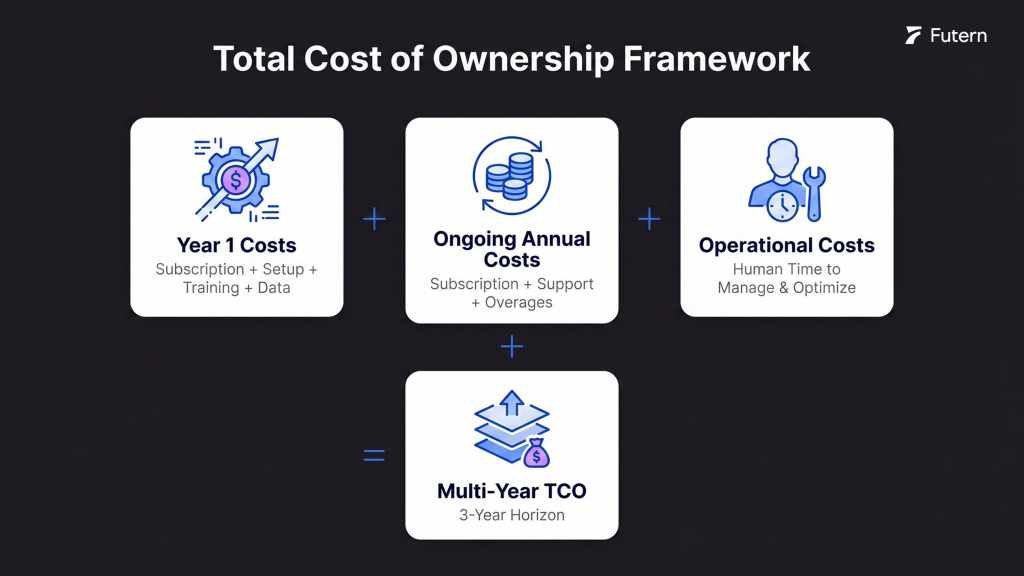
Year 1 costs include the platform subscription, implementation and onboarding fees, training and enablement investment (both direct fees and team time), data preparation and connectivity setup, and any hardware or infrastructure requirements. Year 1 is almost always the most expensive year because it absorbs one-time setup costs. The magnitude of these one-time costs varies dramatically between platforms. A platform that eliminates implementation fees, requires no training, and operates with minimal setup produces a Year 1 cost profile that is much closer to its steady-state annual cost. A platform that requires months of implementation and training creates a significant gap between Year 1 and subsequent years.
Ongoing annual costs cover the recurring subscription, support fees, overage charges based on actual usage patterns, and any periodic optimization or reconfiguration expenses. These costs are more predictable after the first year, but they still require attention. Annual price increases, usage growth, and expanding team size can all affect the ongoing cost trajectory.
Operational costs capture the human time required to manage, monitor, and optimize the AI sales agent on an ongoing basis. This is the cost category most frequently excluded from TCO analysis, and its omission distorts comparisons. If a platform requires a dedicated operator spending twenty hours per week on management and optimization, that is a meaningful labor cost. If another platform operates autonomously with only periodic strategic review, its operational cost is a fraction of the first. The level of human involvement required to keep the system performing well is a direct function of platform maturity and autonomy, and it should be quantified in any honest cost comparison.
Combining these three layers, Year 1, ongoing annual, and operational, gives you a multi-year TCO figure that reflects the actual financial commitment. When comparing platforms, normalize the comparison to a consistent time horizon, typically three years, to ensure that high Year 1 costs for one platform are weighed against potentially higher ongoing costs for another.
The Economic Comparison: AI Sales Agent vs. Traditional SDR Team
For many buyers, the relevant comparison is not just between AI platforms but between an AI sales agent and the traditional alternative: hiring human SDRs to handle outbound prospecting.
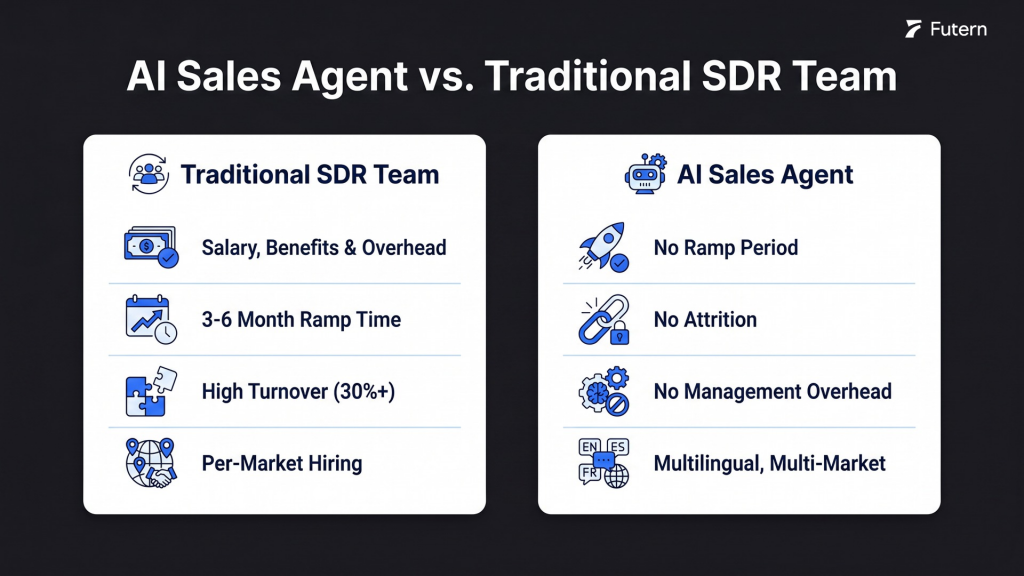
The cost structure of a traditional SDR team is well understood. Base compensation, benefits, payroll taxes, and management overhead represent the core personnel costs. On top of these, there are tool and technology costs (CRM, email sequencing, data providers, dialer software), office or remote work infrastructure, and recruiting expenses. SDR roles typically experience high turnover, often exceeding thirty percent annually in competitive markets, which creates recurring recruiting and onboarding cycles that add cost and disrupt pipeline continuity.
One of the most significant cost factors in traditional SDR teams is ramp time. A newly hired SDR typically requires three to six months before reaching full productivity. During this period, the company is paying full compensation for partial output. When turnover is factored in, a portion of the SDR team may be perpetually in some stage of ramping, which means the team's effective capacity is consistently below its headcount-implied capacity.
AI sales agents alter this economic equation in several fundamental ways. There is no ramp period. The platform begins operating at its full capability from deployment, assuming adequate targeting and messaging inputs. There is no attrition. The system does not leave for a competitor, require a retention raise, or need to be replaced. There is no management overhead in the traditional sense: no one-on-ones, no performance reviews, no coaching sessions.
There is also a potential offset that buyers sometimes overlook. Traditional SDR teams require a stack of supporting tools: email sequencing software, data enrichment providers, dialer platforms, and prospecting databases. When an AI sales agent consolidates some of these functions into a single platform, the subscriptions it replaces may partially offset the AI platform's cost. The extent of this consolidation varies by platform and by the team's existing tool stack, but it is worth mapping during evaluation rather than treating the AI subscription as purely additive spend.
For teams operating across multiple markets, the cost advantage compounds. A traditional approach to global outbound might require hiring native-speaking SDRs in each target market, with all the associated compensation, management, and coordination costs that entails. An AI sales agent with multilingual capabilities covers multiple markets simultaneously without incremental headcount costs per market.
This is not an argument that AI sales agents should replace all human salespeople. Our article on building your AI sales team explored how AI and human roles complement each other in detail. The economic comparison here is specifically about the prospecting and initial outreach function, where AI agents offer a fundamentally different cost structure that scales without proportional cost increases.
How Pricing Structure Connects to Your Use Case
Different business situations favor different pricing models, and understanding this connection helps you evaluate proposals more effectively.
Teams running high-volume outbound across large addressable markets benefit from pricing models that keep per-unit costs low at scale. Flat-rate subscriptions with generous usage allowances are typically most favorable here, because the cost per prospect contacted decreases as volume increases. Per-lead pricing can become expensive quickly when volumes are high, unless the vendor offers meaningful volume discounts.
Teams in growth or expansion phases, particularly those entering new markets, should evaluate how pricing scales with geographic expansion. Some platforms charge additional fees for each market or language activated. Others include global coverage in their base pricing. When your roadmap includes expansion into multiple regions, understanding these expansion economics upfront prevents budget surprises later.
Teams with variable or seasonal demand patterns may find usage-based models more efficient during low-activity periods, but should carefully model the cost during peak periods. The flexibility of paying less when you use less needs to be weighed against the risk of paying significantly more during the months that matter most for pipeline generation.
Teams with limited technical resources should factor the operational simplicity of the platform into their pricing evaluation. A platform that requires minimal setup, operates autonomously, and provides clean data export capabilities reduces the need for technical staff involvement, which is a real cost savings even though it does not appear on the invoice.
Making the Budget Case: From Cost Center to Revenue Investment
The final step in pricing evaluation is reframing how the investment is positioned within your organization. AI sales agent spend is frequently categorized as a sales operations cost, evaluated against a budget line, and measured primarily on whether it stays within allocated limits. This framing misses the point.
The more productive framing is as a revenue investment, evaluated not on cost containment but on return. The relevant metrics are pipeline generated per dollar spent, qualified opportunities per dollar spent, and revenue influenced per dollar spent. These connect the AI agent's cost directly to its contribution to business outcomes, which is ultimately what justifies the investment.
This framing also changes how you compare pricing across platforms. A platform that costs more on a subscription basis but generates higher-quality pipeline at greater volume may deliver superior return per dollar even though its sticker price is higher. Conversely, a budget option that generates marginal pipeline quality produces a poor return regardless of how little it costs.
The articles earlier in this guide, particularly the piece on measuring AI sales agent performance, established frameworks for tracking exactly these metrics. Applied to pricing evaluation, those frameworks transform the budget conversation from "how much does this cost" to "what is this investment worth."
This article completes our AI Sales Agents: Complete Buyer's Guide. Across the full series, we have covered what AI sales agents can realistically do, how to evaluate and compare platforms, how to structure your team around AI capabilities, how to plan the first 90 days of deployment, how to measure performance, how to assess your ICP readiness and data requirements, and now, how to understand the true cost of the investment. Each article is designed to stand on its own, but together they provide the complete framework for making an informed, confident buying decision. Return to the guide to revisit any stage of the evaluation process.
Read More
AI Sales Agents: Complete Buyer's Guide
Global Outbound Sales in 2026: What Actually Scales and What Doesn't
Explore more AI & Automation insights here.