Building Your AI Sales Team: Roles That Change When AI Handles Outbound
by Stella L
A role-by-role guide to how your sales team evolves when AI takes over outbound execution.
Adopting an AI sales agent is a platform decision and a team decision. The platform question gets most of the attention during evaluation. Demos, feature comparisons, pricing analysis, and vendor conversations consume weeks of focused effort. The team question, how your people's roles will change once the platform is live, often gets deferred until after implementation.
This is a mistake. Teams that plan role changes before launch see faster adoption and stronger results. Teams that launch first and figure out roles later create confusion, resistance, and underperformance that gets blamed on the platform when the real issue is organizational.
This article maps how each core sales role evolves when AI handles the outbound execution layer. The goal is to give you a clear picture of what your team looks like on the other side of implementation, so you can plan the transition deliberately rather than reacting to it.
The Core Principle: From Execution to Strategy
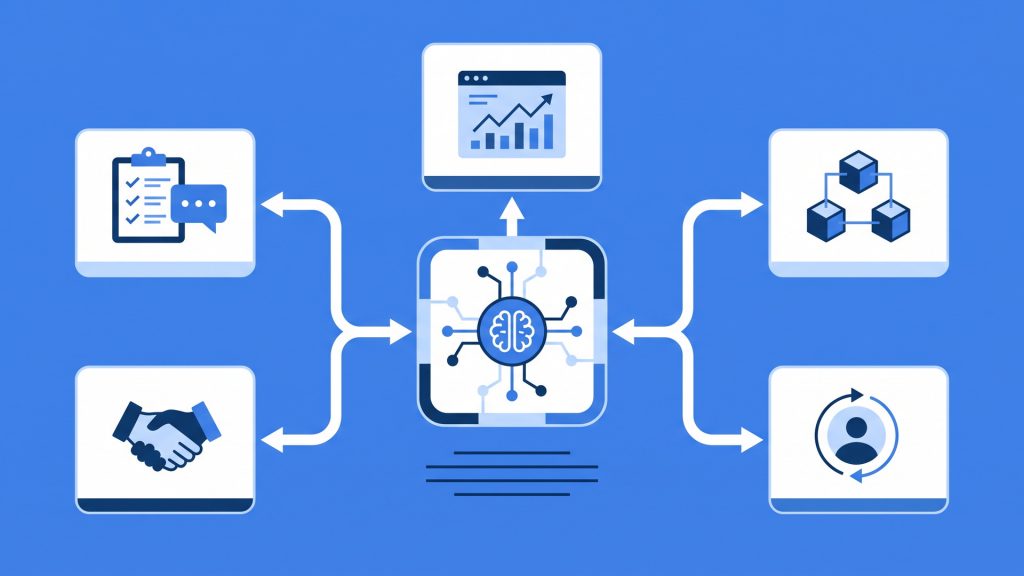
One principle runs through every role change described in this article. AI absorbs high-volume, repetitive execution work. Human roles shift toward judgment, relationship, and strategy.
This is an upgrade in what people do, not a reduction in what they contribute. The daily reality for most sales professionals today includes hours spent on tasks that do not require their expertise: manual prospecting, data entry, sequence management, template-based outreach, and administrative coordination. When AI takes over these tasks, people spend more time on the work that attracted them to sales in the first place: building relationships, solving complex problems, and closing deals.
For sales leaders, this shift also carries a talent retention benefit. High-performing salespeople who spend 60 percent of their time on administrative tasks are flight risks. Give them an environment where they spend 60 percent of their time on strategic, relationship-driven work, and you have a fundamentally more attractive role.
SDR and BDR: The Role That Changes Most
The SDR and BDR function absorbs the largest transformation because these roles have historically been defined by the activities that AI handles most effectively.
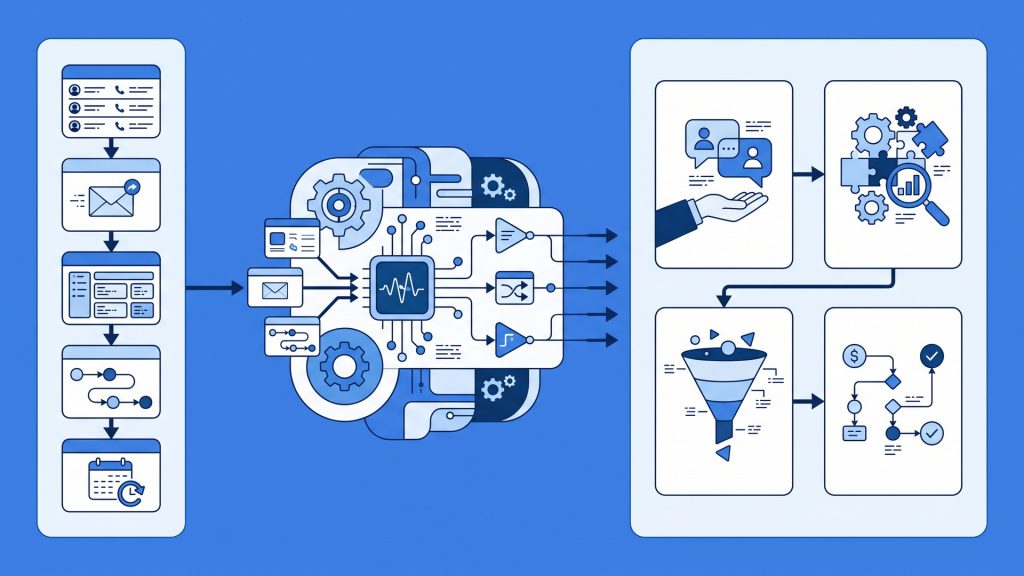
Before AI: SDRs spend their days on manual prospecting, building target lists, writing and sending cold outreach sequences, handling initial responses, qualifying inbound leads at a surface level, and logging activity in the CRM. The work is high-volume and repetitive. Performance is measured primarily by activity metrics: emails sent, calls made, meetings booked.
After AI: The AI agent handles prospecting, initial outreach, first-level qualification, and follow-up sequences. The SDR role evolves in four directions.
Quality review becomes a core responsibility. SDRs review AI-generated pipeline for qualification accuracy, flagging prospects that need different handling or do not meet the ideal customer profile. This requires deeper product knowledge and market understanding than traditional SDR work.
Escalated conversation handling becomes a daily skill. When the AI encounters a prospect response that requires human judgment, a nuanced objection, a complex technical question, or a high-value account that warrants a personalized approach, the SDR steps in. These conversations are more challenging and more rewarding than cold outreach.
Targeting refinement becomes an ongoing contribution. SDRs provide feedback on which prospect segments are producing the strongest results and where the AI's targeting parameters need adjustment. This input directly improves system performance over time.
Market intelligence becomes part of the role. With execution automated, SDRs have time to monitor competitive activity, track market trends in their assigned segments, and surface insights that inform broader sales strategy. An SDR covering the European market, for example, can spend time understanding regional buying patterns and competitive positioning rather than manually sending follow-up emails.
The net result is an SDR function that operates at a significantly higher skill level. The repetitive, process-driven aspects of the role give way to analytical, judgment-driven work that builds genuine sales expertise. For SDRs who want to advance into AE or management roles, this evolution provides better preparation than the traditional high-volume outreach model ever did.
This transformation means fewer SDRs are needed for the same pipeline volume. Some teams will reduce SDR headcount. Others will maintain headcount and redirect capacity toward new markets, higher-value account segments, or expanded outbound coverage. Both approaches are valid depending on growth targets and market opportunity.
Account Executive: More Selling, Less Preparing
The AE role changes less dramatically in scope but improves significantly in quality.
Before AI: AEs spend substantial time on pre-call research, gathering prospect context from multiple sources, reviewing interaction history, and entering data into the CRM. The preparation-to-selling ratio is often 40 percent preparation and 60 percent active selling, sometimes worse.
After AI: The AI delivers enriched prospect profiles, complete interaction histories, and context summaries before each conversation. AEs enter meetings with better context than manual research typically provides, including recent company developments, engagement patterns from the outreach sequence, and specific topics the prospect responded to.
The preparation-to-selling ratio shifts meaningfully. AEs spend less time assembling information and more time using it. The quality of conversations improves because AEs arrive with genuine context about the prospect's situation, not generic talking points assembled from a quick LinkedIn scan. For AEs handling multiple meetings per day, this time savings compounds quickly. What used to be 30 minutes of pre-call research per meeting might drop to five minutes of reviewing an AI-generated brief.
AEs also become the primary feedback loop for AI qualification quality. After each meeting, the AE signals whether the prospect was well-qualified, what the actual buying stage was, and what could have been different in the AI's initial engagement. This feedback is valuable data that improves AI performance over time. The AEs who take this feedback role seriously have an outsized impact on the entire team's pipeline quality.
The net effect for AEs is more meetings with better-qualified prospects, richer context going into each conversation, and less time spent on administrative preparation. Most AEs experience this as a significant improvement in their daily work. It also frees up capacity that allows AEs to manage more accounts or spend more time on strategic deal progression for complex opportunities.
Sales Manager and Team Lead: New Metrics, New Coaching
The management role expands in scope when AI becomes part of the team.
Before AI: Sales managers focus on SDR activity management (calls made, emails sent, meetings booked), pipeline review with AEs, coaching on outreach techniques and objection handling, hiring and onboarding, and capacity planning based on headcount.
After AI: The management skill set expands from people management to system-plus-people management. Several new responsibilities emerge.
Performance monitoring now includes AI output quality alongside human performance. Managers track meeting quality rates, AI-to-human escalation patterns, and conversion rates across different prospect segments. The metrics that matter shift from activity volume to outcome quality.
Coaching evolves. Instead of coaching SDRs on how to write better cold emails or make more effective cold calls, managers coach their team on how to handle the complex, escalated conversations that AI routes to humans. These conversations require higher-level sales skills: reading between the lines, navigating ambiguity, and making judgment calls about prospect fit. The coaching conversations become more strategically interesting for both manager and rep.
Strategy and targeting become more central to the management role. With execution automated, managers spend more time analyzing which market segments, messaging approaches, and targeting parameters produce the best results. They become the strategic layer between the AI system and business objectives, translating company priorities into system configuration decisions.
Capacity planning changes fundamentally. Headcount is no longer the primary lever for increasing outbound capacity. Managers plan around market coverage, segment prioritization, and system optimization rather than hiring timelines and ramp periods.
RevOps and Sales Operations: The Integration Layer
The operations role gains strategic importance when AI enters the sales stack.
Before AI: Ops manages tools, maintains data hygiene, builds reports, and handles the administrative infrastructure of the sales organization. The role is important but often positioned as a support function.
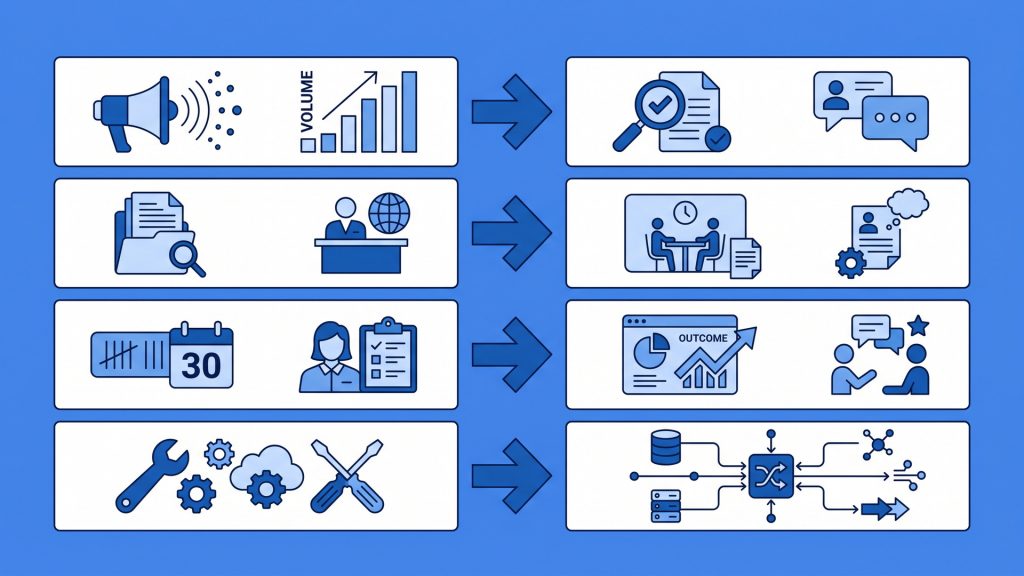
After AI: Ops becomes the critical bridge between the AI platform and the existing sales infrastructure. Data flow configuration, ensuring that prospect data, engagement history, and pipeline information move correctly between systems, becomes a core responsibility. Performance reporting evolves to combine AI-generated metrics with human performance data, giving leadership a unified view of outbound effectiveness.
Ongoing optimization of how the AI system connects to the broader sales workflow falls naturally to operations. Which data sources feed the AI, how lead routing works between AI and human team members, and how reporting reflects the blended human-AI operating model are all ops decisions that directly influence results.
This is a meaningful elevation of the ops role. In many organizations, the person or team managing the AI platform integration becomes one of the most strategically important functions in the sales organization. Their decisions about data flow, system configuration, and reporting directly shape how effectively the AI performs.
Customer Success: Better Context From Day One
The downstream impact on customer-facing roles is often overlooked during AI sales agent planning, but it is significant.
AI-generated meetings typically come with richer prospect data and more complete interaction history than human-generated ones. The AI system logs every touchpoint, captures engagement patterns, and documents the topics that resonated during the outreach sequence. This data carries forward into the customer relationship.
Customer success managers inherit better context when onboarding new clients. They know what the client responded to during the sales process, which pain points drove the buying decision, and what expectations were set during initial conversations. Onboarding becomes faster and more targeted.
Expansion conversations benefit from the same data richness. When the full interaction history is available from first outreach through post-sale engagement, CSMs can identify upsell opportunities based on patterns rather than guesswork.
This data also flows in the other direction. CS insights about which customer profiles deliver the highest lifetime value and which onboarding patterns predict strong retention can feed back into the AI system's targeting and qualification logic. Over time, the outbound process improves because it is informed by what actually happens after the deal closes.
Planning the Transition
Role changes work best when they are communicated before implementation, not discovered afterward. Four practical steps make the transition smoother.
First, communicate the plan to affected team members early. Involve SDRs, AEs, and managers in the AI evaluation process itself. People who participate in selecting the platform are far more likely to embrace the role changes that come with it.
Second, define new success metrics for each role before launch. If SDRs will be measured on qualification quality and escalation handling rather than email volume, make that clear before the platform goes live. Changing metrics after launch feels punitive. Changing them before launch feels like a fresh start.
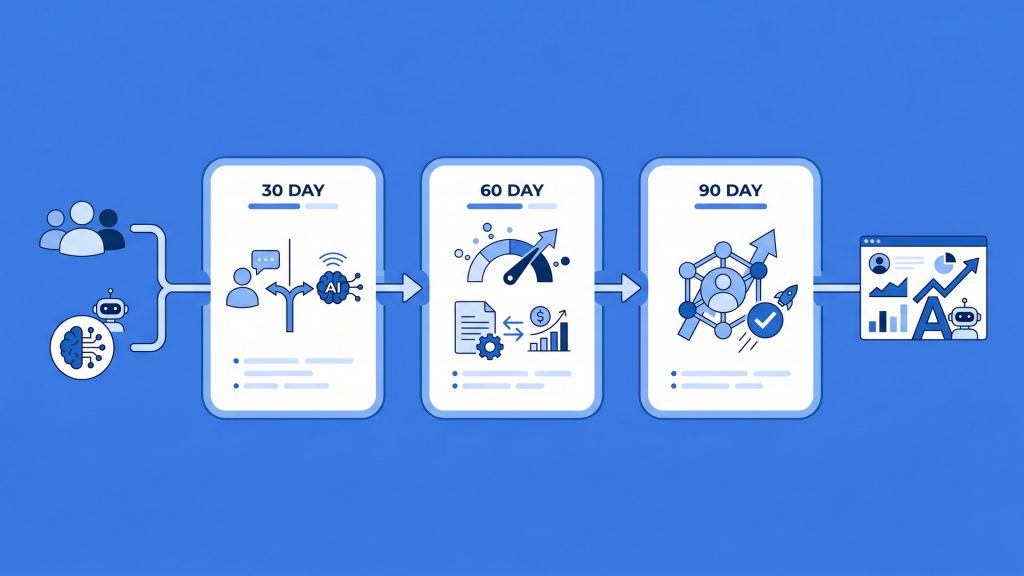
Third, create a 30-60-90 day transition plan that maps old responsibilities to new ones. Month one might run AI and human outreach in parallel. Month two begins shifting workload. Month three completes the transition to the new operating model.
Fourth, update job descriptions, performance review criteria, and compensation structures to reflect the evolved roles. This step is frequently skipped and creates long-term misalignment. People perform to how they are measured and compensated. If the measurement system does not reflect the new role, the transition stalls.
The Team on the Other Side
The sales team that emerges from this transition is leaner in execution and stronger in strategy. SDRs operate at a higher level, focused on judgment and quality. AEs are more productive with better-qualified meetings and richer context. Managers have evolved from activity supervisors to strategic operators. Ops has gained meaningful influence over sales performance. Customer success starts every client relationship with richer context.
For most teams, this is a better version of their organization. The people who remain are doing more interesting, more challenging, and more impactful work. The organization has a scalable outbound capability that grows through system optimization rather than linear headcount additions. When leadership asks how to increase pipeline by 50 percent, the answer is system configuration and market expansion rather than hiring five more SDRs and waiting three months for them to ramp.
The key is planning for this outcome deliberately. The platform decision determines what technology you adopt. The team decision determines whether that technology actually delivers its full potential. Companies that invest the same rigor in team transition planning that they invest in platform evaluation consistently see stronger results from their AI sales agent investment.
This article is part of our AI Sales Agents: Complete Buyer's Guide, which covers the full evaluation and selection process from capabilities analysis through implementation planning.