AI Sales Agent: Platform vs Custom Build Decision Framework
by Stella L
Five key variables to determine whether to buy an AI sales agent platform or build one in-house.
Before evaluating specific AI sales agent platforms, many teams face a more fundamental question: should we buy an existing platform or build our own?
The question is reasonable. Sales processes vary across companies, and the appeal of a custom-built system tailored to your exact workflow is understandable. Teams with engineering resources often assume that building in-house gives them more control, better customization, and lower long-term costs. The logic feels sound: why pay recurring platform fees when you could invest that money into something you own and control entirely?
In practice, this decision is less about technical capability and more about resource allocation. The relevant question is where your company's time, talent, and capital create the most value over a multi-year horizon. Teams that evaluate both paths rigorously almost always reach the same conclusion, but the analysis itself is valuable because it eliminates lingering "what if we had built it ourselves" doubt that can undermine platform commitment later.
This article examines five variables that determine which path makes sense for your business, along with a simple decision test you can apply to reach a clear answer.
When This Decision Actually Matters
The build vs buy choice is only a genuine decision for teams that meet certain prerequisites. A credible custom build path requires dedicated ML and AI engineering talent with available capacity, existing data infrastructure that can support model training and deployment, and ongoing maintenance resources for a system that will need continuous updates.
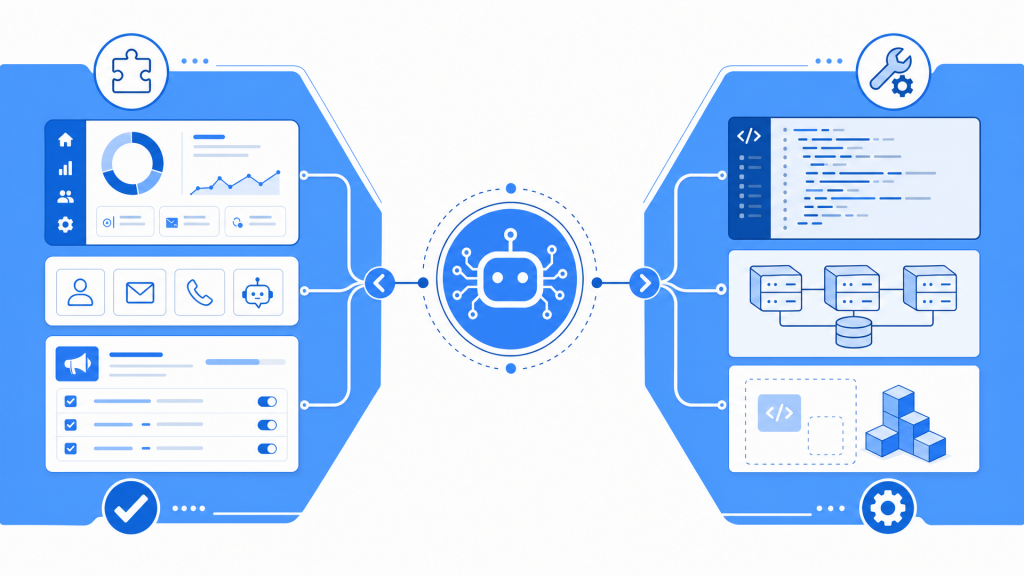
For teams without these resources already in place, hiring specifically to build an AI sales agent introduces a separate set of risks: recruiting timelines, onboarding periods, and the uncertainty of building a team around a single internal project. The total timeline from "let's hire engineers" to "first outbound campaign running" can easily stretch beyond 12 months. If your company does not currently have ML engineering capacity available for this project, the platform path is your starting point. The analysis below will still be useful for understanding why, and for responding to internal stakeholders who suggest the build route.
For teams that do have the technical prerequisites, the following five variables provide a structured way to compare both paths on the dimensions that matter most.
Variable 1: Total Cost of Ownership Over 24 Months
The cost comparison between platform and custom build is frequently underestimated because most analyses focus on Year 1 and overlook what happens in Year 2.
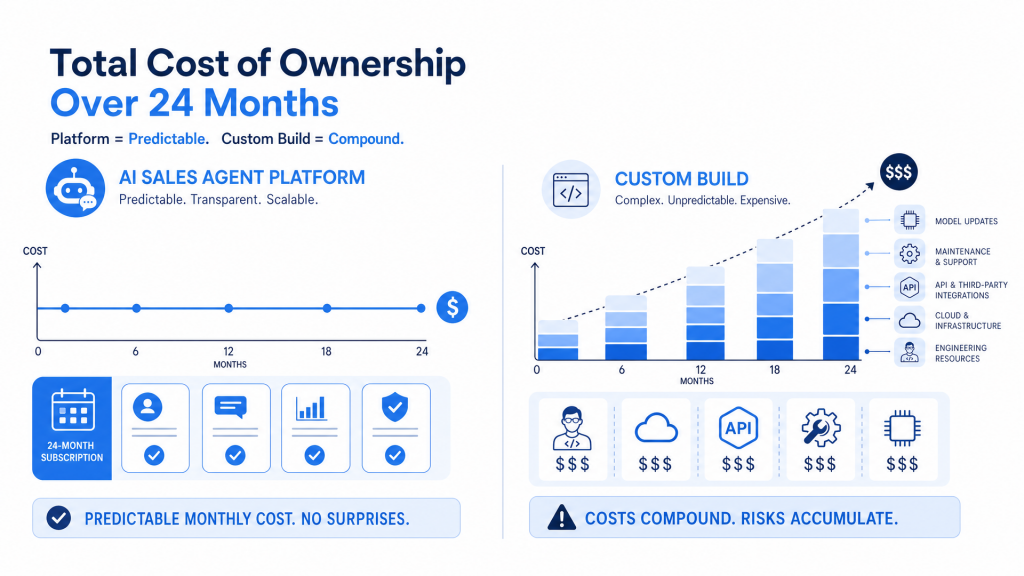
The platform path. Costs are predictable and front-loaded. Subscription fees, onboarding, and any initial configuration costs are defined before you commit. Ongoing costs scale with usage, typically tied to contact volume, number of markets, or feature tiers. For a team of 10 to 50 people, annual platform costs for a capable AI sales agent generally range from $50,000 to $200,000 depending on scale and scope.
The custom build path. Year 1 costs include engineering salaries, cloud infrastructure, data pipeline development, API costs for underlying language models, and tooling. For a minimal viable system with basic email outreach capability, this typically requires two to four engineers working for six or more months. Fully loaded, Year 1 costs for a small build team start at $400,000 to $600,000 and can exceed $1 million depending on scope and location.
Year 2 is where the comparison shifts further. Platform costs remain stable or grow predictably with usage. Custom build costs do not decrease. The system requires ongoing maintenance, model updates, bug fixes, channel API changes, and compliance adjustments. On top of routine maintenance, the underlying AI landscape moves fast. When the next generation of language models becomes available, a platform vendor integrates it across their entire product. A custom build team must evaluate, test, and migrate independently, a process that can consume weeks of engineering time and carry meaningful integration risk. Engineering time allocated to maintenance and model upgrades is engineering time unavailable for improvement, and the team often grows rather than shrinks as the system matures.
Over 24 months, the total cost of a custom build typically runs three to five times higher than an equivalent platform subscription.
Variable 2: Time to First Results
For sales teams, time has a direct pipeline cost. Every month without AI-augmented outbound is a month of unrealized pipeline potential.
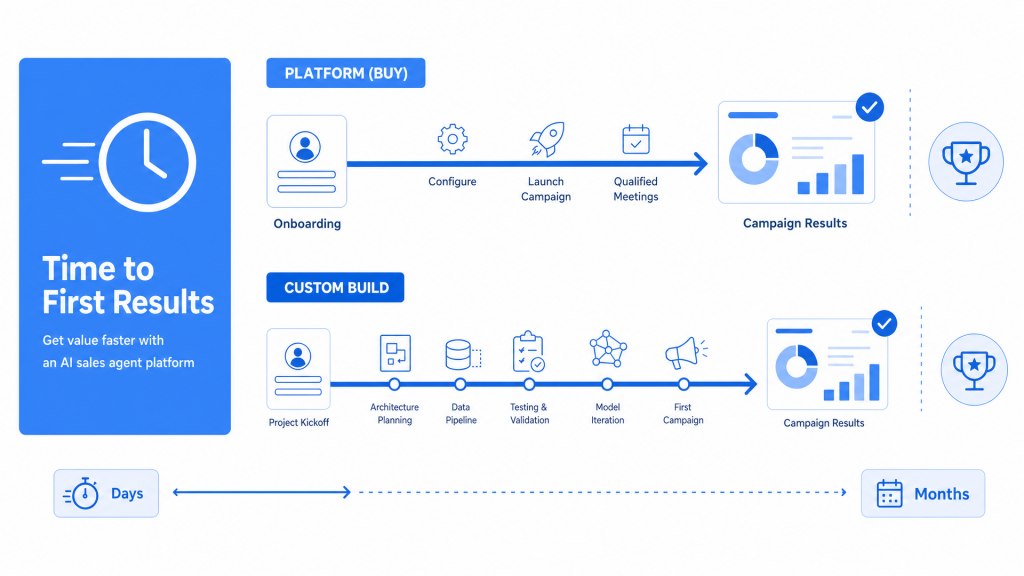
The platform path. Most established AI sales agent platforms can deliver first campaign results within one to four weeks of contract signing. Configuration, data onboarding, and initial campaign setup happen in parallel. Some platforms with strong pre-built intelligence can produce outbound results within days. By month two, optimization cycles are already improving performance metrics based on real engagement data.
The custom build path. A realistic timeline to first outbound execution is six to nine months. This includes architecture planning, data pipeline construction, core model development, initial testing, and iteration on output quality. And first results from a custom build are typically limited to a single channel with basic personalization, far from the multi-channel, multilingual capabilities that platforms deliver from day one. Reaching feature parity with a mature platform typically takes 18 months or longer, and many custom builds never reach that point.
The opportunity cost is straightforward to calculate. If your AI outbound system could generate 50 additional qualified meetings per month, and your average deal value supports a $5,000 value per meeting, every month of delay represents $250,000 in unrealized pipeline. Six months of build time carries a $1.5 million opportunity cost before the system produces anything. For most sales organizations, this pipeline gap alone outweighs any long-term cost advantage that custom build might theoretically offer.
Variable 3: Capability Breadth
Modern AI sales agent platforms represent years of development and millions of dollars in R&D investment across dozens of capability areas. A platform you can deploy today typically includes multi-channel outbound orchestration and multilingual content generation across dozens of languages. It incorporates intent signal detection, timing optimization, and personalization engines drawing from multiple data sources. Conversation handling, reply management, calendar scheduling, meeting booking, and performance optimization loops round out the core feature set. Each of these capabilities has been refined through thousands of customer deployments.
A custom build starts from zero on each of these capabilities and must prioritize aggressively. Most custom build projects focus on one or two channels with basic personalization in a single language. Adding each additional capability requires significant engineering investment.
The common argument for custom build is superior customization. In practice, the level of customization most teams require is well within what configurable platforms offer. Platform settings, workflow rules, messaging parameters, targeting criteria, and channel preferences provide substantial flexibility. The cases where platform configurability genuinely falls short are rare and typically involve highly specialized industry requirements or proprietary data assets that create unique competitive advantages.
It is also worth considering the customization trajectory. Platforms add new configuration options and capability updates continuously based on feedback from their entire customer base. A custom build only evolves as fast as your own engineering team can develop. Over 12 to 18 months, the configurability gap between a mature platform and a custom build often narrows as platforms expand their flexibility, while the capability gap widens as platforms ship features your build team cannot prioritize.
For most teams, the customization gap between a well-configured platform and a custom build is far smaller than expected, while the capability gap is far larger.
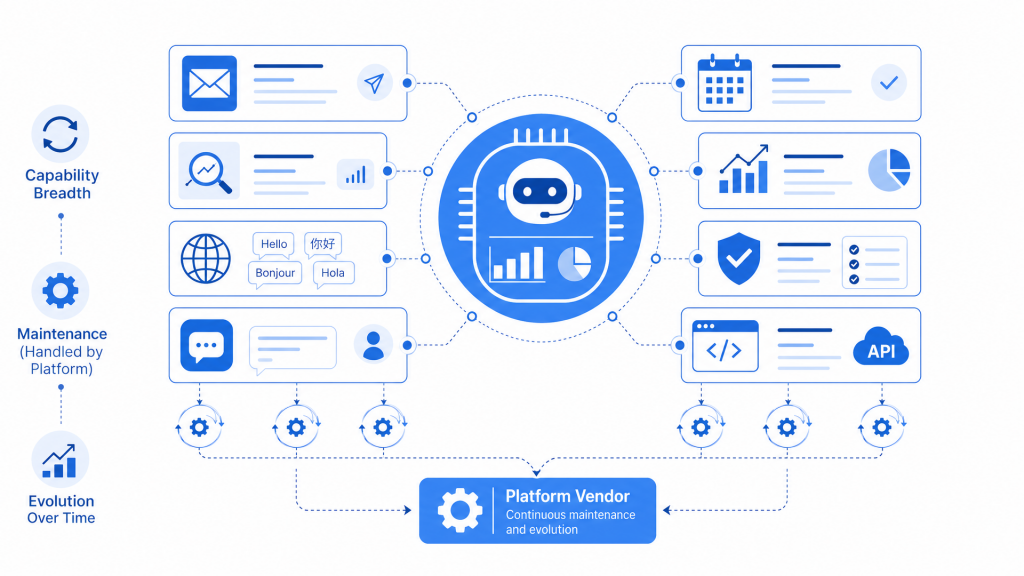
Variable 4: Maintenance and Evolution
While the previous variables focus on what you invest upfront, this variable examines what happens after launch. Specifically, it looks at how external dependencies create an ongoing maintenance burden that most teams underestimate.
This is the variable that most build vs buy analyses underweight, and the one that causes most custom build projects to stall 12 to 18 months after launch.
AI sales agent systems operate in a dynamic environment. Language models release new versions. Email deliverability standards evolve. LinkedIn API policies change. Data privacy regulations update across jurisdictions. Intent data sources shift in quality and coverage. Each of these changes requires engineering response.
A platform vendor absorbs these ongoing costs across their entire customer base. Their engineering team monitors every dependency, adapts to every change, and rolls out updates to all customers simultaneously. The maintenance burden per customer approaches zero.
A custom build team carries these costs alone. When a channel API changes, your engineers must respond. When a compliance requirement shifts in a target market, your team must adapt. When the underlying language model you depend on releases a breaking change, your system needs immediate attention.
Over time, maintenance tasks consume an increasing share of engineering capacity. The team that was hired to build innovative sales tooling gradually becomes a maintenance operation. New feature development slows, then stops, as the team struggles to keep existing functionality stable. This pattern is predictable and well-documented across internal tooling projects, and AI systems are particularly susceptible because of their dependency on external models, data sources, and channel APIs.
Variable 5: Team Focus
Every engineering hour spent building and maintaining an internal AI sales system is an engineering hour diverted from your core product or service.
For most companies, sales outbound is a critical business function but it is not the core product. A SaaS company's engineering team creates more value by improving the product that customers pay for than by building internal sales tooling that replicates what established platforms already deliver. A manufacturing firm's technical resources are better spent on production systems and supply chain optimization than on developing AI outreach capabilities from scratch.
This opportunity cost is rarely included in the initial build vs buy calculation, but it is often the most significant factor. Engineering capacity is finite. Allocating two to four engineers to an AI sales agent project means two to four engineers fewer on product roadmap priorities that directly drive revenue and customer retention.
The question is straightforward: does your company create more value by deploying engineering talent against your core product or against building a sales tool that already exists in the market?
For companies where AI sales technology is the core business, the answer may favor building. For everyone else, the math consistently favors buying.
When Custom Build Makes Sense
Custom build is the right choice in specific circumstances that represent a small minority of the market.
Companies with large dedicated ML engineering teams, typically 20 or more engineers with available capacity, can absorb the build and maintenance burden without diverting resources from core product development. Companies with proprietary data assets that create a genuine competitive advantage when integrated into a custom outbound system may find that platform data connectors cannot fully leverage their unique data. And companies where AI sales technology is itself the product being built and sold have a natural reason to develop in-house.
If your company fits one of these profiles, a deeper evaluation of the custom build path is worthwhile. For the vast majority of sales teams, particularly those in the 10 to 50 person range, the platform path delivers faster results, broader capabilities, lower total cost, and better use of team resources.
A Simple Decision Test
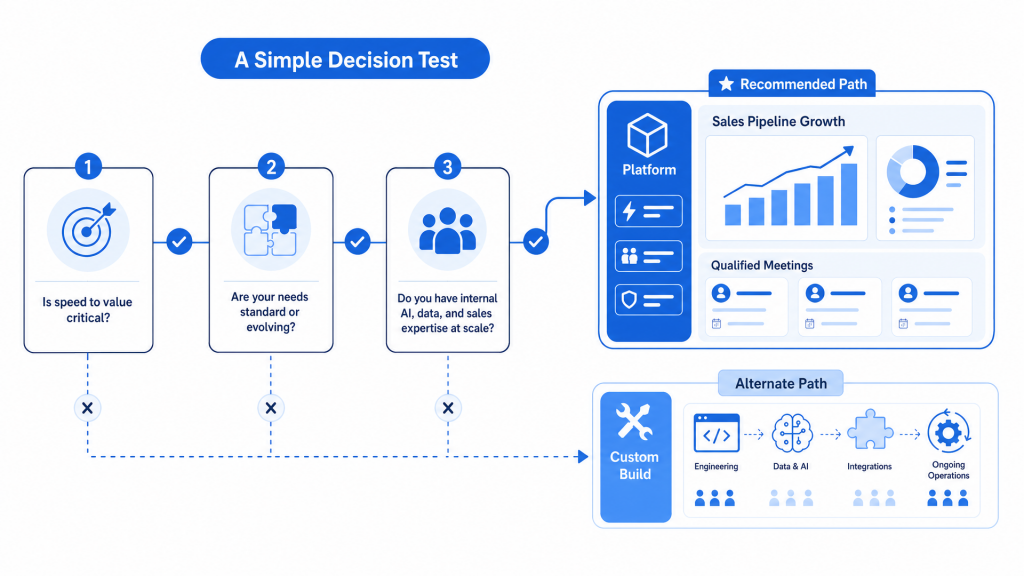
Three questions can determine your path with high reliability.
Do you have a dedicated ML engineering team with available capacity for a 12 to 18 month project? If no, the platform path is your answer. Building without existing engineering capacity means hiring, onboarding, and managing a team for a single internal project. Recruiting ML engineers in the current market takes three to six months, and a newly assembled team needs additional time to establish workflows before productive development begins.
Can you accept six or more months before your first outbound results? If no, only the platform path delivers results within weeks. Custom build timelines are measured in quarters, and first results are typically limited in scope. If your sales leadership expects pipeline impact this quarter or next, the build timeline does not align with business expectations.
Is AI sales tooling a core strategic asset for your business? If no, your engineering resources create more value elsewhere. Platform vendors have already made the investment in building and maintaining this technology across hundreds of customer deployments. Your team benefits from that cumulative investment without bearing its cost or risk.
If you answered no to any of these questions, the platform path is the stronger choice. If you answered yes to all three, custom build deserves serious evaluation, starting with a detailed technical scoping exercise and realistic 24-month budget projection.
Moving Forward
The build vs buy decision is a gate that should be resolved early in your evaluation process. Once resolved, your team can focus entirely on evaluating platforms against your specific requirements, or commit engineering resources to a custom build with a clear understanding of the investment involved.
For teams choosing the platform path, the next step is understanding how different platforms structure their pricing and what cost factors are easy to overlook during initial evaluation.