From 10 SDRs to 1 AI Agent: Total Cost Breakdown
by Stella L
Real numbers: 10 SDRs cost $1.7M-2.5M annually. AI agent: $93K-190K. Same output, 85-92% cost saving…
The real question isn't "Can AI replace SDRs?" It's "What does each actually cost when you calculate everything?"
Most teams compare base salary to platform fees and call it analysis. They miss 60-70% of the actual costs on both sides. This breakdown shows the complete picture with real numbers.
Understanding Total Cost of Ownership
What most teams calculate:
- SDR scenario: $650K (10 SDRs × $65K base salary)
- AI scenario: $100K (platform license)
- Conclusion: "AI is 85% cheaper"
What they should calculate:
- SDR scenario: $1.74M-2.48M (fully loaded with all costs)
- AI scenario: $93K-190K Year 1, $55K-130K Year 2+
- Conclusion: "AI is 92% cheaper with 2x the output"
The difference matters. Incomplete math leads to wrong decisions or missed opportunities.
The SDR Cost Model: Fully Loaded
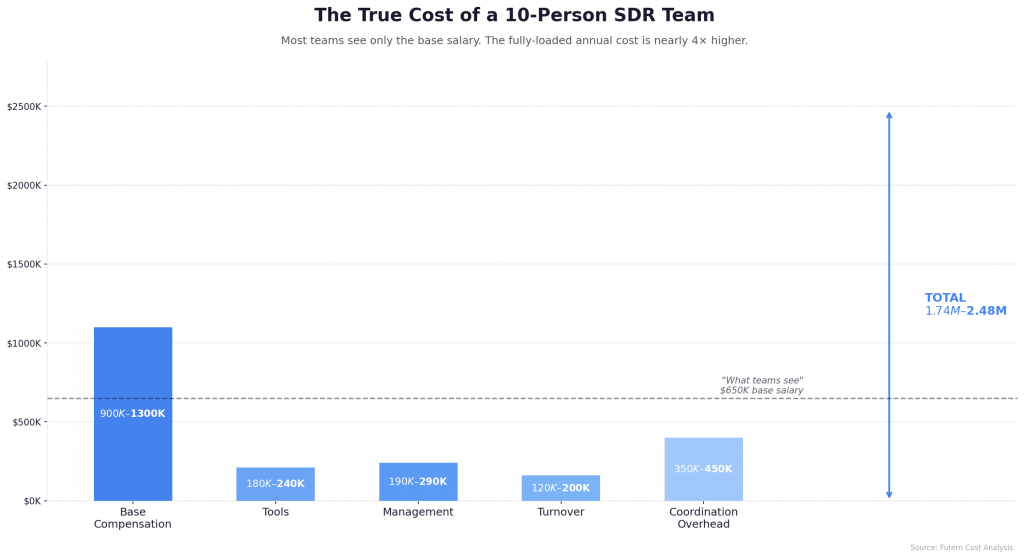
Here's what a 10-person SDR team actually costs annually:
Base compensation:
Average SDR total comp (base + variable): $65-95K 10 SDRs: $650K-950K
Fully loaded employment costs:
Benefits, taxes, insurance add 30-35% to base compensation. Workspace, equipment, and IT systems add another $5-8K per SDR. Total loaded cost: $900K-1.3M annually.
Tool stack:
- CRM licenses: $100-150 per user/month
- Prospecting tools (ZoomInfo, Apollo): $8-12K per user/year
- Engagement platforms (Outreach, SalesLoft): $100-150 per user/month
- Analytics and enablement: $50-100 per user/month
Total tools for 10 SDRs: $180-240K annually
Management overhead:
SDR Manager (fully loaded): $120-180K RevOps support allocation: $40-60K VP Sales time allocation: $30-50K Total management: $190-290K annually
Turnover and replacement:
Average SDR tenure: 14-18 months Annual turnover rate: 30-40% Cost per replacement (recruiting, onboarding, ramp): $25-40K Lost productivity during vacancy: $15-25K per seat
With 3-4 replacements annually: $120-200K in turnover costs
Hidden coordination overhead:
This is the cost most teams never calculate.
According to Outreach research, SDRs spend 35-45% of their time coordinating between tools—exporting data, importing to another platform, verifying information, manual logging, syncing systems.
If your SDRs spend 40% of their time on tool management instead of selling:
- 10 SDRs × $100K loaded cost × 40% = $400K annually in pure coordination overhead
This is work that produces zero pipeline but consumes nearly half a million dollars in labor.
Total Annual Cost (10 SDRs):
- Compensation (loaded): $900K-1.3M
- Tools: $180-240K
- Management: $190-290K
- Turnover: $120-200K
- Coordination overhead: $350-450K
Total: $1.74M-2.48M annually
Most teams think "10 SDRs = $650K." Reality: closer to $2M when you count everything.
The AI Agent Cost Model: Fully Loaded
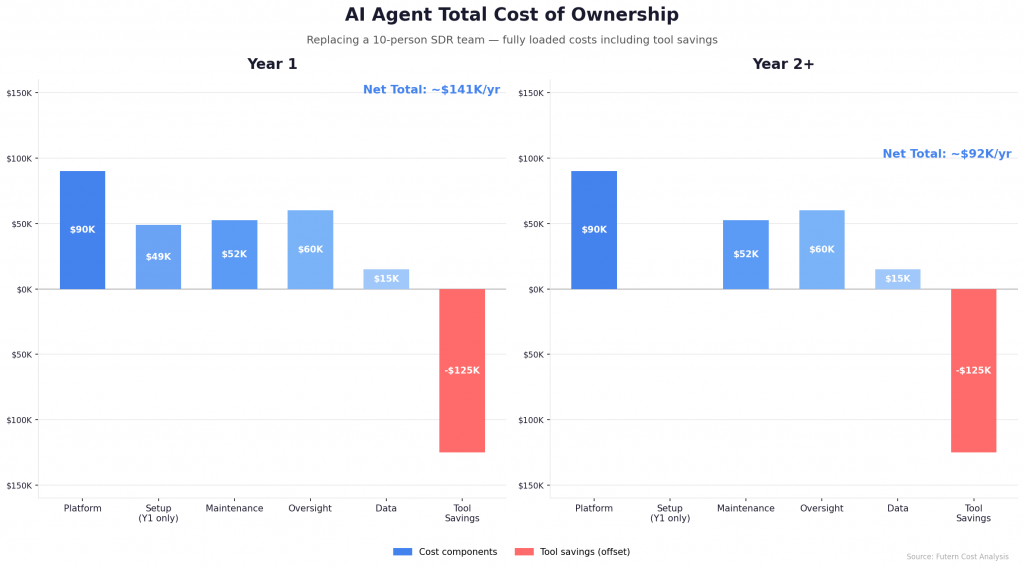
Here's what one AI sales agent costs to replace that 10-person SDR team:
Platform licensing:
Enterprise AI sales agent platform: $60-120K annually depending on volume and features. This replaces multiple tools in your SDR stack.
Setup and implementation (Year 1 only):
- Initial configuration and integration: $15-25K
- ICP refinement and signal tuning: $10-15K
- Workflow design: $8-12K
- Team training: $5-8K
Total setup: $38-60K one-time
Ongoing maintenance:
- Monthly optimization and tuning: $2-4K
- Quarterly strategic reviews: $3-5K per quarter
- Annual platform updates: $5-8K
Total maintenance: $40-65K annually
Human oversight:
Even AI requires human oversight. Sales Ops specialist allocation (30-40% time): $30-50K annually. Sales leadership review time: $15-25K annually. Total oversight: $45-75K annually.
Data and enrichment:
Most platforms include core data feeds. Additional specialized sources if needed: $10-20K annually.
Tools you no longer need (savings):
- Prospecting tools eliminated: -$80-120K
- Engagement platform seats reduced: -$12-18K
- Partial CRM optimization: -$10-15K
Total tool savings: -$100-150K annually
Total Annual Cost (AI replacing 10 SDRs):
Year 1 (includes one-time setup):
- Platform: $60-120K
- Setup: $38-60K
- Maintenance: $40-65K
- Oversight: $45-75K
- Data: $10-20K
- Less tool savings: -$100-150K
Year 1 Total: $93-190K
Year 2+ (no setup costs):
- Platform: $60-120K
- Maintenance: $40-65K
- Oversight: $45-75K
- Data: $10-20K
- Less tool savings: -$100-150K
Year 2+ Total: $55-130K annually
Side-by-Side Comparison: Three Scenarios
Scenario 1: 5-Person SDR Team
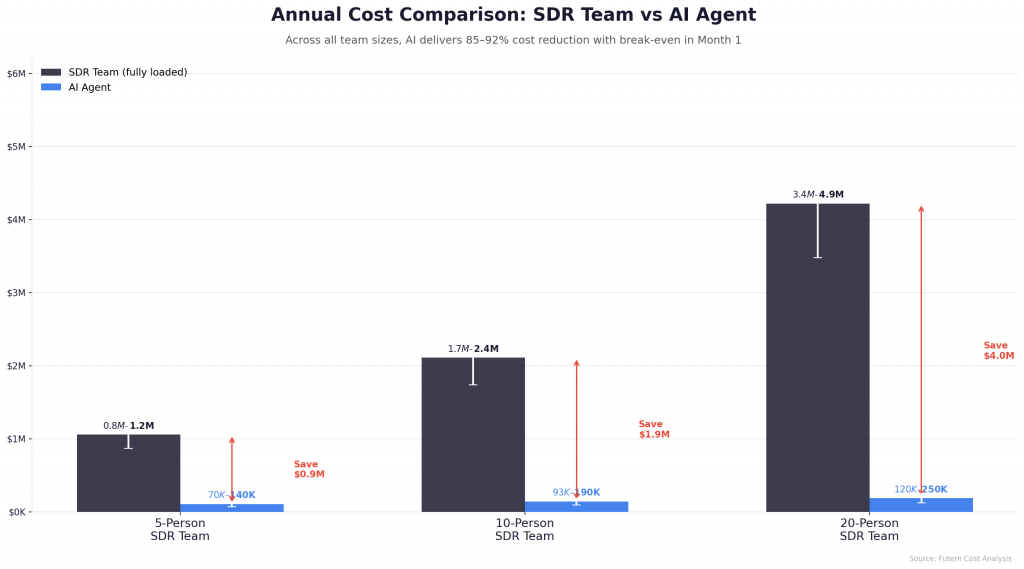
- SDR team annual cost: $870K-1.24M
- AI agent cost Year 1: $70-140K
- AI agent cost Year 2+: $40-95K
- Annual savings: $730K-1.1M (Year 1), $830K-1.15M (Year 2+)
- Break-even: Month 1
Scenario 2: 10-Person SDR Team
- SDR team annual cost: $1.74M-2.48M
- AI agent cost Year 1: $93-190K
- AI agent cost Year 2+: $55-130K
- Annual savings: $1.55M-2.29M (Year 1), $1.69M-2.35M (Year 2+)
- Break-even: Month 1
Scenario 3: 20-Person SDR Team
- SDR team annual cost: $3.48M-4.96M
- AI agent cost Year 1: $120-250K
- AI agent cost Year 2+: $75-180K
- Annual savings: $3.23M-4.71M (Year 1), $3.40M-4.78M (Year 2+)
- Break-even: Month 1
Key insight: The larger the SDR team, the more dramatic the savings. A 20-person team saves $3-4M+ annually.
The Performance Differential
Cost comparison tells only half the story. Output matters equally.
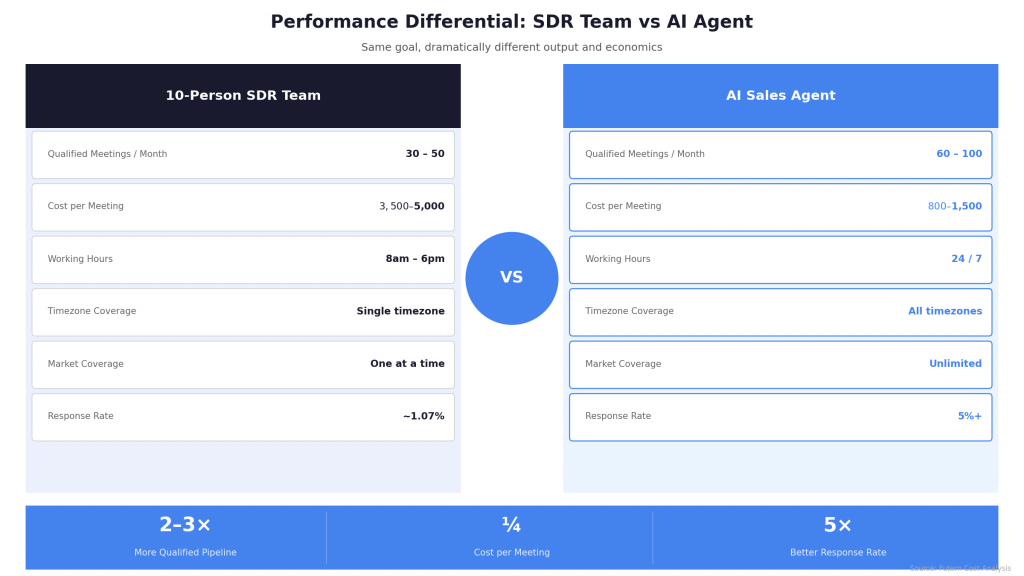
SDR team output (10 SDRs baseline):
- Average qualified meetings per SDR monthly: 3-5
- Total team output: 30-50 qualified meetings per month
- Cost per qualified meeting: $3,500-5,000
- Coverage: Single timezone, 8am-6pm
- Markets: One at a time
AI agent output (replacing 10 SDRs):
- Qualified meetings monthly: 60-100
- Cost per qualified meeting: $800-1,500
- Coverage: 24/7 across all timezones
- Markets: Unlimited simultaneous coverage
- Performance: 2-3x more pipeline at 1/4 the cost
This is the productivity paradox: you're not just saving money. You're generating 2-3x more qualified pipeline while covering global markets around the clock.
According to a Belkins study, traditional SDR approaches yield 1.07% response rates. AI-powered systematic approaches achieve 5%+ response rates—nearly 5x improvement in signal quality.
Variables That Change the Math
Market expansion plans:
Adding 5 new markets with SDRs requires hiring 5-10 more reps—linear cost increase of $800K-2M. Expanding AI coverage to 5 new markets: marginal cost increase of $5-15K. The more markets you enter, the wider the AI economic advantage.
SDR turnover rate:
If your turnover runs 50% instead of 30%, add $100-150K annually to SDR costs. AI turnover rate: 0%. High-turnover environments make the AI case even stronger.
Tool stack complexity:
If SDRs use 8+ tools instead of 5, coordination overhead increases 10-15%. AI consolidates tool sprawl, reducing total infrastructure spend.
Cost of capital:
If capital is expensive (startup, high-growth): upfront savings matter more. If capital is cheap (established): focus on 3-year cumulative ROI. Either way, AI wins—the question is whether you save $1.5M in Year 1 or $5M over three years.
Real Company Examples
Case 1: B2B SaaS Company
- Before: 8 SDRs, $1.4M annually, 25 meetings/month
- After: 1 AI agent, $180K Year 1, 55 meetings/month
- Savings: $1.22M Year 1
- Performance: 2.2x more qualified pipeline
- Outcome: Expanded to 3 new markets with same budget
Case 2: Manufacturing Company
- Before: 15 SDRs, $2.6M annually, 40 meetings/month
- After: AI + 3 SDRs hybrid model, $620K Year 1, 70 meetings/month
- Savings: $1.98M Year 1
- Performance: 1.75x more pipeline
- Outcome: Kept SDRs for enterprise deals, AI handles mid-market volume
Case 3: FinTech Startup
- Before: 5 SDRs, $890K annually, 18 meetings/month
- After: 1 AI agent, $140K Year 1, 32 meetings/month
- Savings: $750K Year 1
- Performance: 1.8x more pipeline
- Outcome: Redirected savings to product development
Pattern across all cases: 85-92% cost reduction with 1.7-2.5x output increase.
The Transition Economics
Most companies don't flip a switch. Here's a realistic transition path:
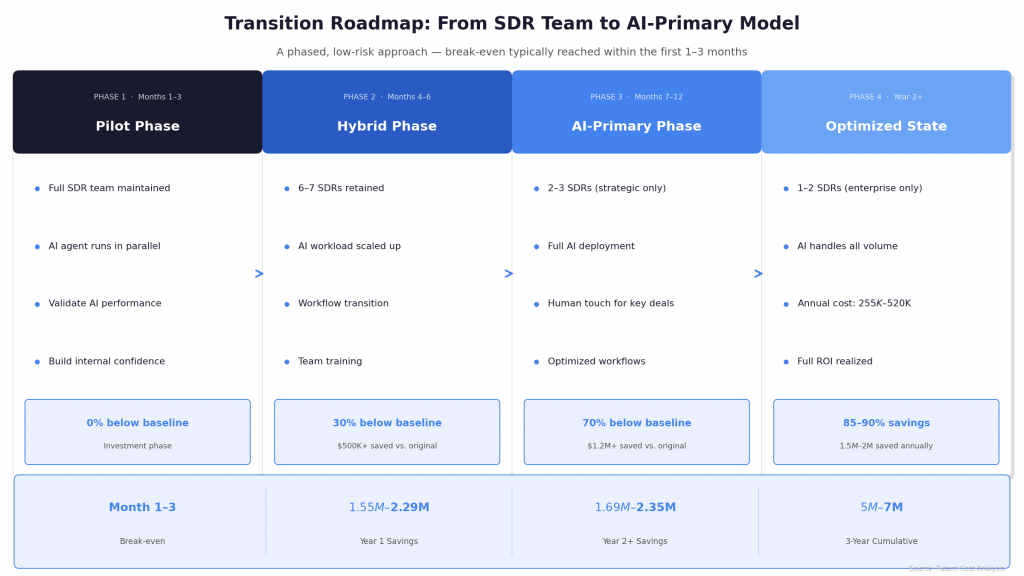
Months 1-3: Pilot Phase
Keep full SDR team ($435K-620K quarterly). Add AI agent in parallel ($23-48K). Total cost temporarily higher than baseline. Purpose: validate AI performance, build internal confidence.
Months 4-6: Hybrid Phase
Reduce to 6-7 SDRs ($310-434K quarterly). Scale AI workload ($23-48K). Total cost 30% below baseline. Purpose: transition workflows, train remaining team.
Months 7-12: AI-Primary Phase
Reduce to 2-3 SDRs for complex strategic accounts only ($130-186K quarterly). Full AI deployment ($23-48K). Total cost 70% below baseline. Purpose: maintain human touch for key relationships.
Year 2+: Optimized State
1-2 SDRs for enterprise-only ($87K-124K quarterly). AI handles all volume ($14-33K monthly). Annual cost: $255K-520K. Savings vs original: 85-90%.
Key insight: Year 1 includes pilot investment. Year 2+ delivers full ROI. Most teams reach break-even in months 1-3, not 12-24 months.
Building Your Business Case
Framework for leadership presentation:
Current State:
"We spend $1.74M-2.48M annually on our 10-person SDR function. This includes $650K-950K in compensation, $180-240K in tools, $190-290K in management overhead, $120-200K in turnover costs, and $350-450K in coordination overhead."
Proposed State:
"AI agent costs $93-190K Year 1, $55-130K Year 2+. Delivers 2x more qualified meetings at 1/4 the cost per meeting. Enables 24/7 global coverage."
Financial Impact:
- Year 1 savings: $1.55M-2.29M
- Year 2+ savings: $1.69M-2.35M
- 3-year cumulative savings: $5M-7M
- Break-even: 1-3 months
Risk Mitigation:
90-day pilot with limited investment. Keep SDRs during pilot. Clear success metrics: meeting volume and cost. Rollback option if performance doesn't meet targets. Maximum downside: $40-80K pilot cost.
Common objections addressed:
"Our SDRs do more than prospecting." True. That's why hybrid models work—keep SDRs for complex strategic accounts, use AI for volume.
"What about the human touch?" AI handles initial qualification and volume. Humans handle relationship-building once accounts are qualified. You're not eliminating human connection—you're optimizing where humans spend their time.
"What if AI doesn't work for our ICP?" The 90-day pilot tests exactly that. If performance doesn't hit targets, you stop. Limited downside, massive upside.
What This Doesn't Include
To be fully transparent, here's what this analysis doesn't account for:
Potential additional AI costs:
Custom integrations beyond standard APIs: +$10-30K one-time. Specialized data for niche industries: +$5-15K annually. These are edge cases but worth knowing.
Potential additional savings:
Reduced management burden (smaller team): $30-60K. Office space reduction: $20-40K annually. Lower recruiting costs: $50-100K annually. These often offset any additional AI costs.
Intangible benefits (not quantified):
Reduced manager stress. Improved work-life balance (AI works nights/weekends). Faster market entry (no hiring lag). Better intelligence (AI generates superior market insights). These have real value but are hard to monetize precisely.
Closing: The Cost of Waiting
The numbers are clear: AI agents deliver 85-92% cost reduction with 2x performance improvement.
But this isn't about replacing humans with machines. It's about resource optimization. SDRs are talented professionals. The question is whether high-volume cold prospecting is the highest-value use of their skills.
For most companies, the answer is no. Strategic relationship-building, complex account navigation, deal advancement—these are where human SDRs excel. Volume prospecting and initial qualification can be systematized.
The transition can be gradual, low-risk, and reversible. The math works whether you run a 5-person team or a 50-person team. The question isn't "should we do this eventually?"
The question is: what's the cost of waiting another quarter? Another year?
At $1.5M-2M annual savings, every month of delay costs $125K-165K in continued overhead.
Continue Learning
See how teams diagnose their infrastructure before making changes: How to Run Sales System Diagnostic with Your Team
Understand what systematic infrastructure looks like: What Actually Scales Global Outbound Sales in 2026
Or explore how Futern's AI Sales Agent delivers these results: See Futern in action.