First 90 Days with Your AI Sales Agent
by Stella L
A phased implementation guide for making your first 90 days with an AI sales agent productive.
The platform is selected. The contract is signed. And now the work that actually determines whether the investment pays off begins.
Underperforming AI sales agent implementations usually stem from a lack of structure during the first 90 days rather than technological shortcomings. Teams launch the AI SDR platform, run a few campaigns, check results after a month, and draw conclusions based on incomplete data. The result is either premature disappointment or premature scaling, both of which lead to outcomes that fall short of what the technology can deliver.
Teams that approach the first 90 days with a clear phased plan see faster time to value and higher long-term adoption. This article provides a month-by-month framework for making those 90 days productive. Each phase has a specific focus, clear milestones, and practical guidance on what to prioritize and what to defer.
Before Day One: Setting the Foundation
The most productive implementations begin before the platform goes live. Several decisions made in advance will shape everything that follows.
Define success metrics upfront.
What does a good outcome look like at 30, 60, and 90 days? These targets should be specific and realistic. A reasonable Month 1 target might focus on system configuration completion and baseline data collection rather than pipeline volume. Month 2 targets can introduce performance improvement expectations. Month 3 targets should reflect the steady-state contribution you expect from the system. Setting these benchmarks in advance prevents the common problem of evaluating early results against steady-state expectations.
Assign an internal owner.
Designate one person as the implementation lead. This person does not need to be a full-time role, but someone needs to be clearly accountable for driving the process forward, coordinating feedback, and communicating progress to leadership. Without a designated owner, implementation tasks get deprioritized against daily sales activities.
Prepare your data and targeting parameters.
Work with your platform vendor to define your initial targeting scope. Identify the market segments, prospect profiles, and messaging priorities for your first campaigns. Platforms with strong pre-built intelligence can begin producing results quickly, but even the fastest setup benefits from clear input on who you want to reach and how you want to position yourself.
Align your team.
If you have not already planned how team roles will evolve, do that before launch. The shift from execution-heavy SDR work to quality review and escalation handling requires advanced communication. Update KPIs and success metrics to match the evolved roles before the platform goes live. If your AI SDR workflow means human SDRs shift to quality review, their performance metrics should reflect that from day one. Team members who understand how their role improves with AI and how they will be measured in the new model are far more likely to engage constructively with the new system than those who encounter changes unexpectedly.
Set expectations with leadership.
Month 1 is calibration, not peak performance. Make this explicit with anyone who will be reviewing results. Early AI output is functional but not yet optimized. The optimization cycles that produce strong performance need real engagement data to work with, and that data only comes from running live campaigns.
Days 1-30: Calibration
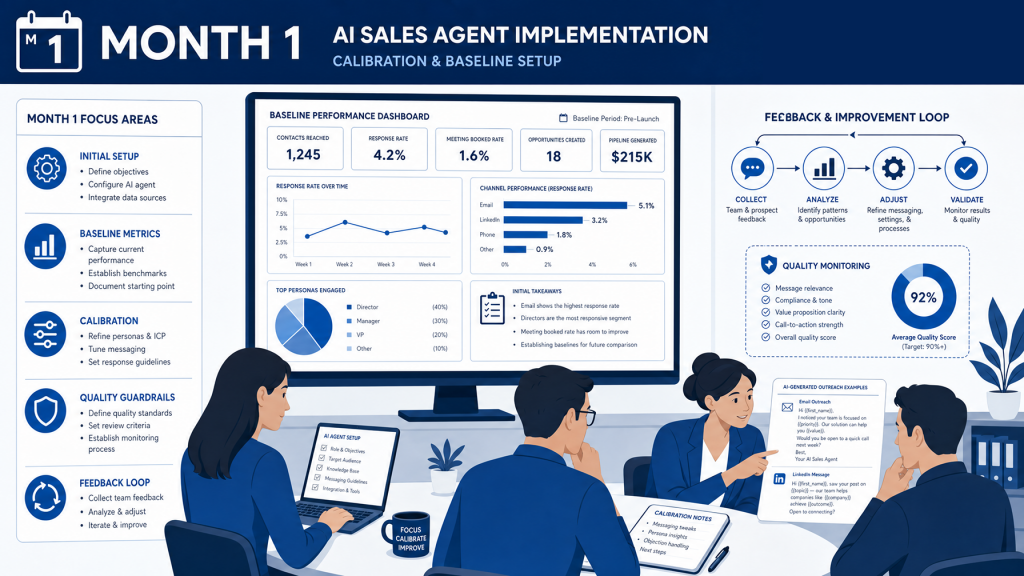
The first month is about getting the system running, establishing baselines, and building the feedback habits that drive improvement.
Launch with focused scope.
Start with one or two market segments, your primary outreach channel, and your core ideal customer profile. Resist the temptation to activate every market and every channel simultaneously. A focused launch lets you evaluate output quality clearly and build confidence in the system's performance before expanding. Going too broad too early makes it difficult to diagnose what is working and what needs adjustment.
Monitor output quality actively.
In the first two weeks, review outreach messaging daily. Check personalization accuracy, evaluate whether response handling is appropriate, and note any patterns where the system's output does not match your expectations. This level of attention feels intensive, but it is temporary. The feedback you provide during this period directly shapes the system's optimization trajectory.
Establish a feedback rhythm.
Define who reviews AI output, how often, and how feedback gets recorded. The people closest to the output, typically SDRs and AEs who see the messages and interact with prospects, are the most valuable feedback sources. Focus feedback on three areas: messaging quality (does the tone and content match your brand voice), qualification accuracy (are the right prospects being engaged), and response handling (are replies being categorized and handled appropriately). Create a simple, consistent process for logging these observations. A weekly 30-minute review session where the implementation owner collects structured feedback from the team is often sufficient. This input is what drives the AI SDR system's optimization cycles, so consistency matters more than volume.
Track baseline metrics.
By the end of Month 1, you should have clear baseline data on open rates, reply rates, positive response rates, and meetings booked. These numbers are your starting point, not your success criteria. Their value is in providing a reference against which you measure improvement in Month 2 and beyond.
Month 1 milestone: The system is running consistently, baseline performance data is collected, the team has a functioning feedback rhythm, and you have a clear picture of where the system performs well and where it needs refinement.
Days 31-60: Optimization
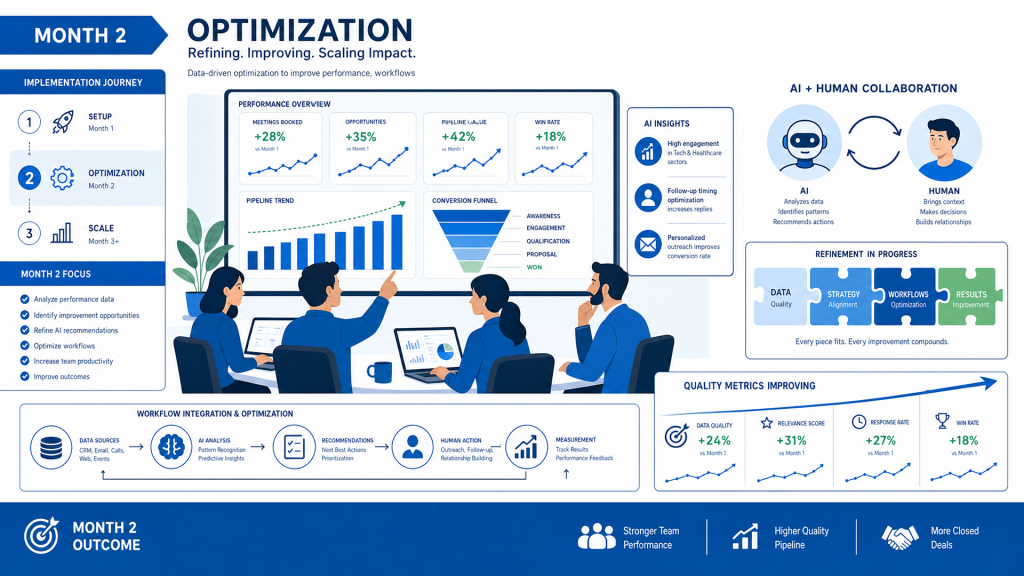
With baseline data established, Month 2 shifts to systematic improvement. This is where the investment starts compounding.
Expand based on data.
Use Month 1 performance data to decide where to expand. If email outreach performed well in your initial segment, consider adding a second market segment using the same channel. If response rates were strong with one ICP but weaker with another, investigate whether the issue is targeting precision, messaging relevance, or market timing. Expansion decisions grounded in data produce better outcomes than expansion based on schedules.
Refine messaging and personalization.
Review which subject lines, opening angles, and value propositions generated the strongest engagement. Feed these insights back into the system's messaging parameters. Adjust personalization depth based on where it added measurable value versus where simpler approaches performed equally well. This is the phase where the AI's optimization loops begin producing visible improvement as they accumulate enough data to identify patterns.
Integrate AI pipeline into team workflows.
AEs should now be receiving AI-sourced meetings regularly and providing structured qualification feedback after each conversation. This feedback is critical data that improves the system's qualification accuracy over time. AEs who flag which meetings were well-qualified and what the actual buying stage was contribute directly to pipeline quality improvement.
SDRs should be settling into their evolved roles. The daily work is shifting from outreach execution to quality review, escalated conversation handling, and targeting refinement. With the AI SDR handling the volume-driven execution work, human SDRs can focus on the judgment-driven tasks that improve overall pipeline quality. If the transition feels bumpy, revisit whether success metrics and expectations were clearly communicated before launch.
Diagnose if needed.
If performance metrics have not improved over Month 1 baselines by day 60, this is the right time to diagnose. The issue typically falls into one of three categories. Configuration problems mean the system's targeting or messaging parameters need adjustment. Data quality problems mean the prospect data feeding the system is incomplete or inaccurate. Market timing problems mean the segment you are targeting is not responsive right now, which is an external factor rather than a system issue. Identifying which category applies guides the right corrective action.
Month 2 milestone: Performance metrics show measurable improvement over Month 1 baselines. AI-sourced pipeline is flowing into your team's regular workflow. The team is operating in their evolved roles with increasing confidence.
Days 61-90: Scaling
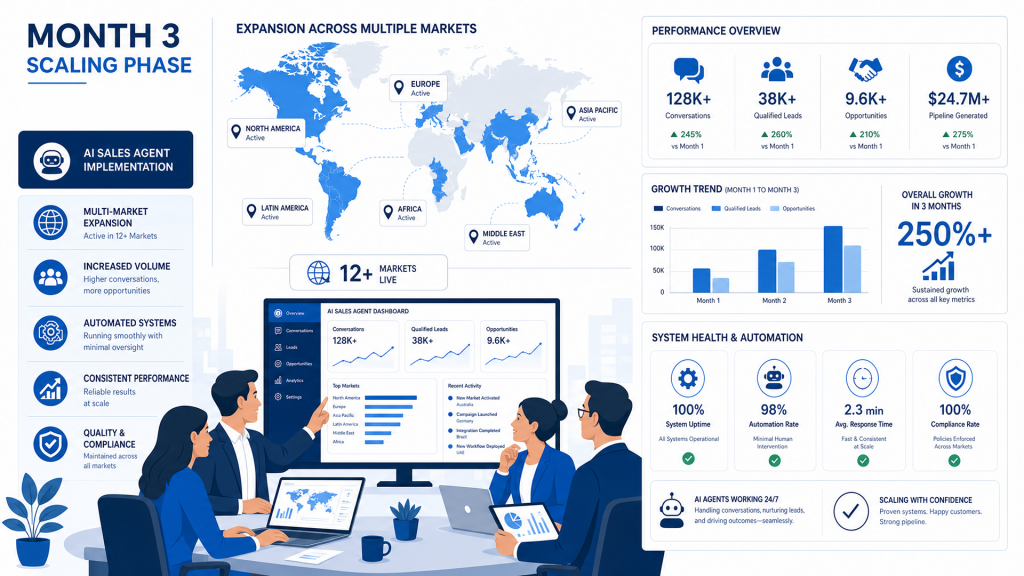
Month 3 moves from optimization to scale. The foundation is proven, and the goal is to expand the system's contribution.
Expand coverage deliberately.
Add new markets, languages, or prospect segments based on the configurations that proved successful in Month 2. Each expansion should be treated as a smaller version of the Month 1 calibration process: focused launch, quality monitoring for the first week, then integration into the broader workflow. The difference is that each subsequent expansion moves faster because the team and the system have established patterns. A configuration that took two weeks to calibrate in Month 1 might take three to four days when applied to a new market segment in Month 3.
Increase volume.
With proven configurations and a team comfortable with the new operating model, increase outbound volume. Monitor whether quality metrics hold steady as volume scales. A well-configured system should maintain consistent performance at higher volume. If quality drops as volume increases, the issue is typically targeting dilution, which means you are reaching into less well-matched prospects, and the targeting parameters need tightening. Address this by reviewing your prospect criteria rather than reducing volume.
Reduce daily oversight.
As the system demonstrates consistent quality, shift from daily output review to weekly or bi-weekly review cycles. The team's attention should increasingly focus on strategic decisions: which segments to prioritize, how to respond to market changes, and how to leverage the insights the AI generates rather than monitoring its basic output quality.
Build your reporting framework.
Establish the performance dashboard you will use for ongoing management. Combine AI system metrics (output volume, engagement rates, optimization trends) with business metrics (meetings booked, pipeline generated, revenue influenced). This dashboard becomes the tool your implementation owner and sales leadership use for ongoing performance management beyond the 90-day window.
Month 3 milestone: The system is producing a consistent, qualified pipeline at scale. The team has fully transitioned to their evolved roles. Daily oversight has decreased to periodic strategic review. Leadership has visibility into AI-driven pipeline contribution through a structured reporting framework.
Common Pitfalls
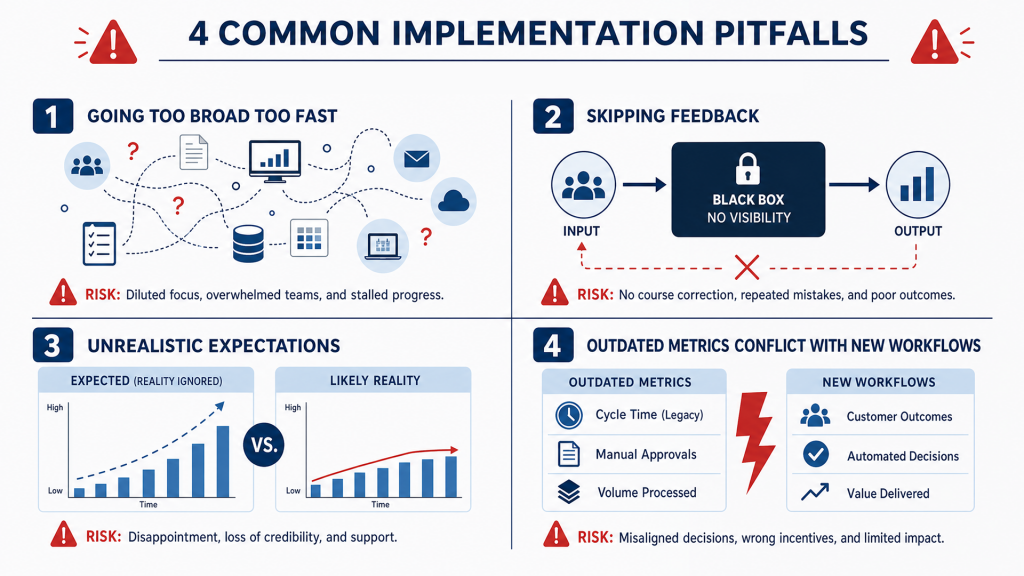
Four patterns consistently derail otherwise sound implementations.
Going too broad too fast.
Launching across multiple markets, channels, and segments simultaneously in Month 1 creates noise that makes it impossible to evaluate what is working. Start narrow, prove the configuration, then expand. Speed comes from confidence in what works, not from activating everything at once.
Skipping the feedback loop.
AI SDR systems improve through structured feedback, not just time. Teams that treat the platform as a black box and wait for it to improve on its own see slower optimization than teams that actively provide quality feedback, meeting outcome data, and targeting refinements. The 30 minutes per week invested in feedback during the first 60 days pays compound returns in system performance.
Measuring too early against peak expectations.
Month 1 is calibration. Evaluating calibration-phase results against steady-state performance targets creates false disappointment and sometimes leads to premature decisions about the platform's value. Set Month 1 expectations appropriately and communicate them to anyone reviewing results.
Not updating team metrics.
If your SDRs are still being measured on emails sent and calls made after the AI is handling outreach execution, the measurement system is fighting the transition. Update KPIs, job descriptions, and performance review criteria to match the evolved roles before or during Month 1, not three months later.
What Good Looks Like at Day 90
A successful 90-day implementation produces a recognizable outcome.
The system is generating qualified meetings consistently, with performance metrics showing a clear improvement trajectory from Month 1 baselines through Month 3. The team has transitioned into their evolved roles and can articulate how their daily work has changed. SDRs are operating as quality reviewers and escalation handlers. AEs are entering conversations with richer context and providing feedback that improves pipeline quality. Managers are tracking blended AI-human performance metrics and making strategic decisions about targeting and expansion.
The operational rhythm has shifted from intensive daily oversight to periodic strategic review. The implementation owner is spending hours per month on system management, not hours per day. Leadership sees a clear, quantified picture of AI-driven pipeline contribution and can compare it against pre-implementation baselines with confidence.
Most importantly, the foundation is set for continued growth. The configurations that work are documented. The expansion playbook is proven through at least one successful market or segment addition during Month 3. The team knows how to scale outbound coverage without scaling headcount. Day 91 is about building on a solid base, not starting over. The question shifts from "is this working" to "where do we expand next."
This article is part of our AI Sales Agents: Complete Buyer's Guide, which covers the full evaluation and selection process from capabilities analysis through implementation planning.
Read More: Global Outbound Sales in 2026: What Actually Scales and What Doesn't
Explore more AI & Automation insights here.