Why Most Global Outbound "Systems" Are Just Tools Stacked Together
by Stella L
Most teams think they have a sales system. They actually have 6-10 tools that reps manually coordina…
Introduction
Quick test: How many different tools did your reps touch in their last complete outbound sequence?
If the answer is more than five, you probably don't have a system. You have a tool stack held together by human coordination.
Here's what that looks like in practice: Rep finds lead in ZoomInfo, exports to CSV, imports to Outreach, verifies email in Hunter, enriches data in Clearbit, launches sequence, then manually logs everything in Salesforce. Six tools. Sixty-nine minutes. High error rate.
Leadership sees the annual bill, often $400K+ for mid-sized teams, and assumes the organization has sophisticated infrastructure. After all, they've invested in best-in-class tools: enterprise CRM, premium data providers, leading engagement platforms, conversation intelligence software.
Reps know the truth: they spend 40-50% of their day managing tools instead of selling. The other 50-60% gets fragmented across so many context switches that deep work becomes nearly impossible.
This isn't a training problem. It's not a discipline problem. It's an architecture problem.

The difference between tool stacks and systems determines whether you scale exponentially or replicate linearly. One path leads to decreasing costs per opportunity as you expand globally. The other leads to rising costs, frustrated teams, and competitors with better infrastructure gradually winning deals you should close.
This article provides a 10-question diagnostic to reveal which path you're on, what your score means, and specific next steps based on where you are today.
The 10-Point Diagnostic
For each question, score yourself:
- Tool Stack = 0 points (manual coordination required)
- Hybrid = 1 point (partial automation)
- System = 2 points (fully systematic)
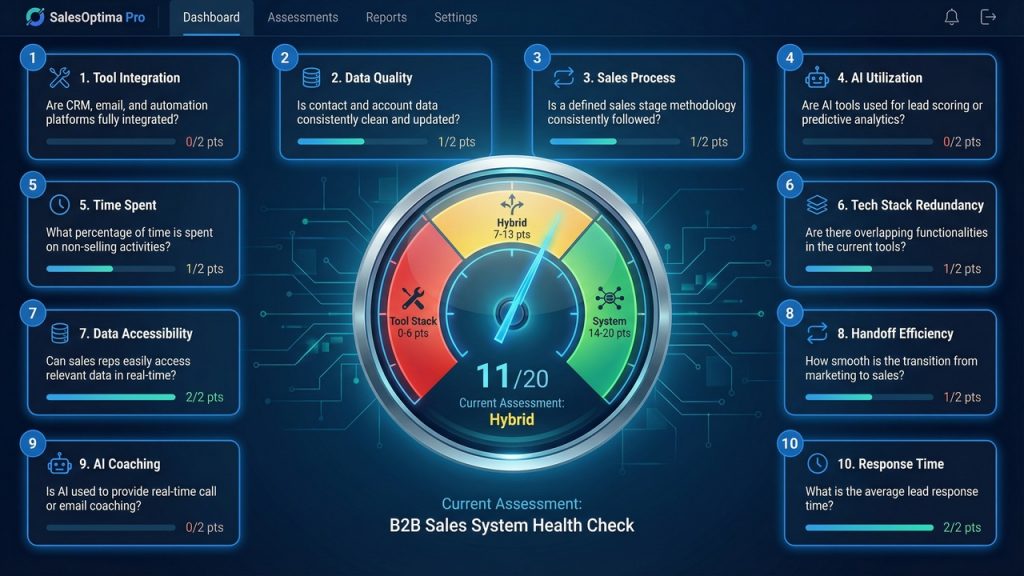
Question 1: How many tools does a rep touch for one complete outbound sequence?
0 pts: 6-10 tools (find leads, verify emails, enrich data, send outreach, log activity—all separate)
1 pt: 3-5 tools (some consolidation, still significant switching)
2 pts: 1-2 platforms (unified workflow from prospecting through qualification)
Question 2: When you add a new data source, how long does integration take?
0 pts: Weeks or months—requires IT project, custom development
1 pt: Days—configuration needed but mostly straightforward
2 pts: Hours—new sources plug into existing data model automatically
Question 3: Where does prospect engagement history live?
0 pts: Fragmented—emails in one tool, calls in another, LinkedIn in a third
1 pt: Mostly centralized but with gaps—manual copy-paste still needed
2 pts: Unified—complete interaction history in single view, auto-updated
Question 4: Can a rep in a different timezone pick up where another left off?
0 pts: No—context trapped in tools or rep's memory, handoffs lose information
1 pt: Partially—some documentation exists but incomplete
2 pts: Yes—complete context preserved, AI maintains continuity 24/7
Question 5: What percentage of rep time goes to selling vs. tool management?
0 pts: Less than 40% on selling—majority spent on data entry, tool coordination
1 pt: 50-60% on selling—still significant overhead
2 pts: 70%+ on selling—system handles execution, humans focus on judgment
Question 6: When launching a new market, how long until it reaches baseline efficiency?
0 pts: 6-9 months—rebuild workflows, retrain team, restart learning curve
1 pt: 3-4 months—some transfer but significant rework needed
2 pts: 2-4 weeks—system inherits all prior learning, immediate efficiency
Question 7: How often do your tool integrations break?
0 pts: Monthly—updates break connections, require IT intervention
1 pt: Quarterly—mostly stable with occasional issues
2 pts: Rarely—native integration designed to work together, updates improve rather than break
Question 8: Where does knowledge about "what works" live?
0 pts: In top performers' heads—when they leave, knowledge leaves
1 pt: Documented but static—playbooks exist but don't adapt
2 pts: Codified in system—AI learns from every interaction, applies automatically
Question 9: How is multi-channel outreach coordinated?
0 pts: Manually—rep sends email, manually schedules call, separately reaches out on LinkedIn
1 pt: Email automated, other channels manual
2 pts: Fully orchestrated—AI manages email, phone, social, adapting based on responses
Question 10: What happens to data entered in one tool?
0 pts: Stays there—reps re-enter same data in 3-4 different places
1 pt: Some auto-sync but requires verification and manual fixes
2 pts: Entered once, automatically available everywhere with single source of truth
Your Score: What It Means
0-6 Points: Tool Stack (You're Replicating, Not Scaling)
What's happening:
Your reps spend the majority of their time coordinating between disconnected tools. Each new market requires rebuilding workflows from scratch. Knowledge walks out the door when people leave. Costs scale linearly—or worse—with headcount.
According to research from Outreach, traditional B2B sales teams spend only 33% of their time on actual selling activities. You're likely in this range or lower.
What to do:
First, calculate your true cost. Add annual tool spend plus the opportunity cost of rep time spent on tool management. For a 20-person team spending 40% of their time on tools at $100K average salary, that's $800K annually in wasted capacity—before counting the actual tool bills.
Second, evaluate your options. You can optimize the stack (hire integration consultants, build custom connectors, train reps on workarounds) or replace it with an integrated system. If your revenue exceeds $5M, replacement typically delivers better ROI than optimization.
Third, act quickly. Every month in tool stack mode costs you 40% of rep productivity, delayed market entry, and rising per-opportunity costs. Competitors with systems are gaining ground.
Timeline: Staying here costs you 6-12 months of efficiency and market opportunity.
7-13 Points: Hybrid (Systematic in Parts, Manual in Others)
What's happening:
You have some automation but significant manual coordination remains. Partial integration creates frustration—things "almost work" but require constant workarounds. You're better than pure tool stack but not truly systematic.
This is the dangerous middle ground. You've invested in tools but haven't achieved systematic capability. Scaling typically stalls at 20-30 reps because coordination overhead overwhelms marginal gains.
What to do:
Identify which workflows are systematic versus manual. Focus on systematizing your highest-volume workflows first—usually prospecting, enrichment, and initial outreach.
Evaluate whether your current tools can become truly integrated or need replacement. Run a pilot: systematize one workflow completely, measure time saved and quality improvement, then decide whether to expand or migrate.
Timeline: Hybrid mode is sustainable short-term but won't support 2x growth without breaking.
14-20 Points: System (You're Genuinely Scaling)
What's happening:
Reps focus on judgment while your system handles execution. New markets launch quickly with high baseline efficiency. Learning compounds across regions. Cost per opportunity decreases as volume increases—the definition of scale.
Research from B2B sales firm Belkins shows single-touch outreach converts at 1.07%, while coordinated multi-channel sequences achieve 5%+ conversion. Your systematic approach makes this executable without burying humans in operational work.
What to do:
Document what's working—this is competitive moat. Identify remaining bottlenecks and systematically remove them. You're positioned to scale aggressively; your infrastructure supports it.
Share your best practices with the industry. Thought leadership from this position establishes authority and attracts talent.
Timeline: You can 10x coverage without 10xing headcount. Maintain and optimize.
Why Tool Stacks Happen (And Persist)
Tool stacks aren't intentional. They accumulate through rational point-in-time decisions that create irrational long-term architecture.
The typical evolution:
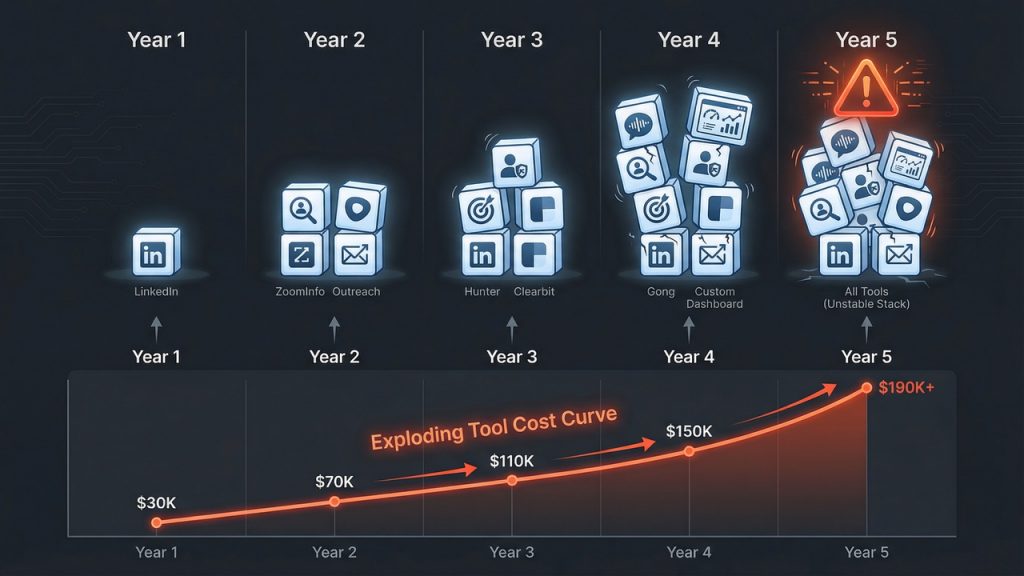
Year 1: Sales team uses LinkedIn and personal email. It works until you hire rep number three. "We need a real prospecting database" → Buy ZoomInfo ($30K/year). Problem solved.
Year 2: Email response rates decline. "We need sequences and templates" → Add Outreach ($50K/year). New problem: ZoomInfo and Outreach don't sync smoothly. Solution: Reps export/import manually. Only takes 15 minutes per day. Seems manageable.
Year 3: Data quality degrades. Bounce rates climb. "We need email verification" → Add Hunter ($10K/year). Also add Clearbit for enrichment ($35K/year). Now reps use four tools per sequence, but each tool is best-in-class.
Year 4: Leadership can't see what's working. "We need conversation intelligence" → Add Gong ($40K/year). Plus a custom dashboard because data lives in five places ($25K implementation).
Year 5: New VP of Sales arrives. Sees the complexity. Asks: "Why is everything so fragmented?" Answer: "This is just how sales tech works."
Each purchase solved a real problem. Each vendor delivered on their promise. But no one designed the architecture. The result: $190K in annual tool spend, plus the hidden cost—reps spending 3+ hours daily on tool coordination instead of selling.
For a 20-person team at $100K average fully-loaded cost, that 40% time waste equals $800K annually in lost productivity. Total cost of the "sophisticated" tool stack: nearly $1M per year.
Three reasons tool stacks persist despite this cost:
Sunk cost fallacy: "We've invested $300K migrating to these tools—can't abandon them now." The migration cost is sunk. The ongoing waste isn't.
Departmental ownership: Marketing owns the MAP and data tools, Sales owns the engagement platform, RevOps owns the CRM, IT owns integrations. No single owner for end-to-end workflow. Coordination happens in Slack threads and forwarded email chains.
Incremental thinking: "Can we afford another $20K tool?" gets approved in 48 hours. "Can we afford to redesign our entire go-to-market infrastructure?" gets deferred indefinitely. Strategic overhaul feels risky. Incremental tool additions feel safe—even when they compound the core problem.
What Makes a Real System Different
True systems have three requirements:
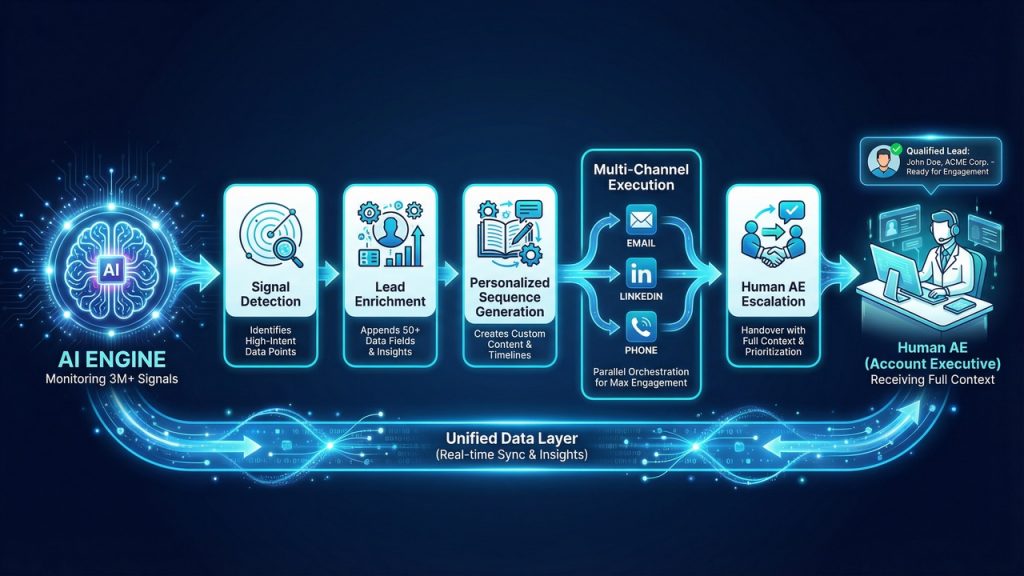
Unified data foundation: Not integrations connecting separate databases. A shared data model where all components read and write to the same source. Single source of truth.
Workflow orchestration: Not task automation. End-to-end process management that coordinates across stages without human intervention. Humans intervene only at decision points.
Intelligence layer: Not if-then rules. AI that adapts workflows based on signals, context, and outcomes. Learning that accumulates and transfers automatically.
Example of systematic workflow:
AI monitors 3M+ daily signals across markets → Detects champion change-of-role at target account → Enriches with new company, role, pain points → Generates personalized multi-channel sequence → Executes across email, LinkedIn, phone, adapting based on responses → Escalates to human AE with full context when prospect qualifies.
No rep touching eight tools. No data re-entry. No context loss. No manual coordination.
Your Next Step
Run this diagnostic with your team today. If you scored below 10, you have a tool stack that won't scale.
Every month you stay in tool stack mode costs you:
- 40% of rep productivity lost to tool coordination
- 3-6 months delayed entry per new market
- Rising cost per opportunity as you expand
- Frustrated team watching competitors with better infrastructure win
The good news: transitioning from tool stack to system takes 90 days, not 12 months. The infrastructure exists. The question is how long you'll tolerate the coordination tax.
Measure your score. Share it with leadership. Calculate the true cost. Then decide: optimize the stack or build a real system.
The teams that move from tools to systems gain 6-12 months of competitive advantage. The teams that don't fall further behind every quarter.
Continue Learning
Explore how this connects to scaling challenges: