Data Enrichment for Sales Teams: What It Adds and Why It Matters
by Stella L
What enrichment layers matter for outreach and how to set the right depth without over-collecting.
Somewhere between identifying a prospect and reaching out to them, there is a step that most sales teams either rush through or misunderstand. That step is data enrichment — the process of filling in the information that turns a basic record into something a salesperson can actually work with.
In its simplest form, a prospect record might contain a company name, a contact name, and an email address. That is enough to send a generic message, but not enough to send a relevant one. Without knowing the contact's role in the organization, the company's size and growth stage, the technology they already use, or the context behind why they were flagged as a prospect in the first place, outreach is essentially a guess dressed up as a conversation.
Most teams equate enrichment with "finding more contact information." In practice, the enrichment that actually moves conversion rates happens in layers — from baseline contact accuracy all the way up to organizational and market context that shapes how a message is framed, who receives it, and when it gets sent. This article examines each of those layers, explains what they contribute to outreach quality, and addresses where the boundary between useful enrichment and diminishing returns actually falls.
What Data Enrichment Actually Means
Before going further, it is worth distinguishing enrichment from two related processes that often get conflated with it: data verification and data cleansing.
Verification confirms that existing information is correct. Does this email address still work? Is this person still at this company? Is this phone number active? Verification does not add new information; it validates what is already in the record. Cleansing fixes errors — correcting misspelled names, standardizing company name formats, removing duplicate entries, merging fragmented records for the same contact. Cleansing improves the quality of existing data without expanding its scope.
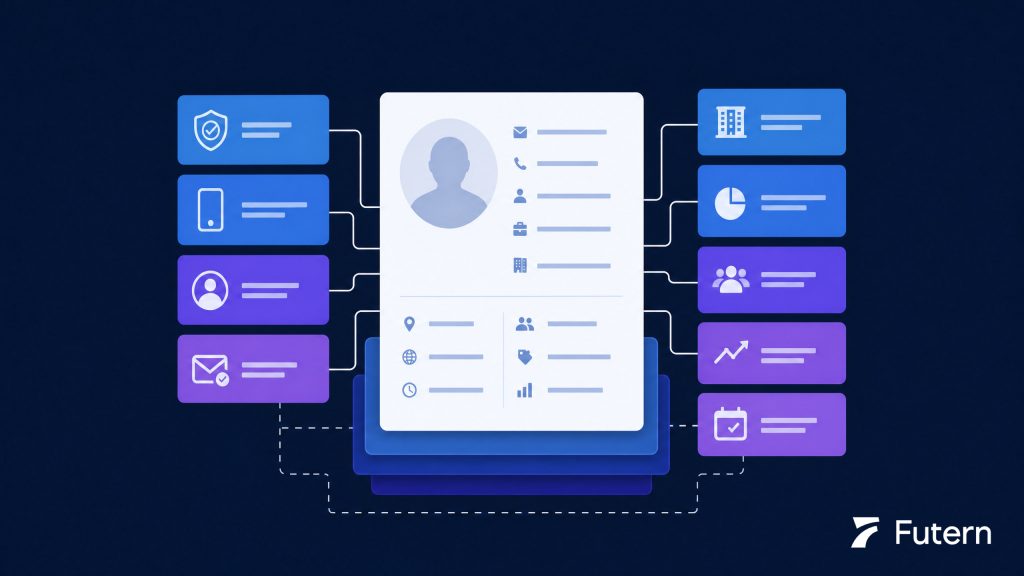
Enrichment is different. It adds information that was not in the record before: a direct phone number where only a company switchboard existed, a LinkedIn profile URL, the contact's reporting relationship, the company's technology stack, recent funding history, or industry classification. The record gets richer — more fields populated, more context available — in ways that create new options for how the sales team approaches the prospect.
The reason these distinctions matter operationally is sequencing. Enriching a record that contains incorrect data compounds the error rather than fixing it. If the email address is wrong, appending a phone number and LinkedIn profile to the same record does not make the record more useful; it makes it more confidently wrong. Effective enrichment starts with clean, verified data and builds from there. Teams that skip verification and jump directly to enrichment often end up with large databases that look comprehensive but perform poorly in practice.
Contact-Level Enrichment — Reaching the Right Person
The most fundamental layer of enrichment is contact information itself. Not just whether an email exists, but whether it is the right kind of email for the outreach channel being used.
A generic company email address (info@company.com) is functionally useless for personalized outreach. A personal work email is better but insufficient if the team plans to run multi-channel sequences. Reaching a prospect through only one channel means the entire engagement depends on that channel performing — and email response rates for cold outreach have been declining for years. Adding a direct phone number, a verified LinkedIn profile, and where relevant a WhatsApp or messaging contact creates multiple paths to the same person.
Contact information also decays faster than most teams realize. People change roles, companies restructure, email domains migrate, and phone numbers get reassigned. A record enriched in January may be partially inaccurate by June. This is not a one-time data quality issue but a structural characteristic of B2B contact data. Research across the industry consistently estimates annual decay rates around 30%, which means that roughly a third of the contact information in any static database becomes unreliable within a year.
This decay rate has direct implications for how often contact data should be refreshed and what enrichment model a team adopts — a question this article returns to below. The baseline takeaway is that contact-level enrichment cannot be treated as a one-time investment. A record enriched once and never revisited is a record on a countdown to inaccuracy.
Organizational Context — Understanding Where the Contact Sits
Knowing how to reach someone is the first problem. Knowing what to say to them is the second. Organizational context is the enrichment layer that bridges the gap between deliverability and relevance.
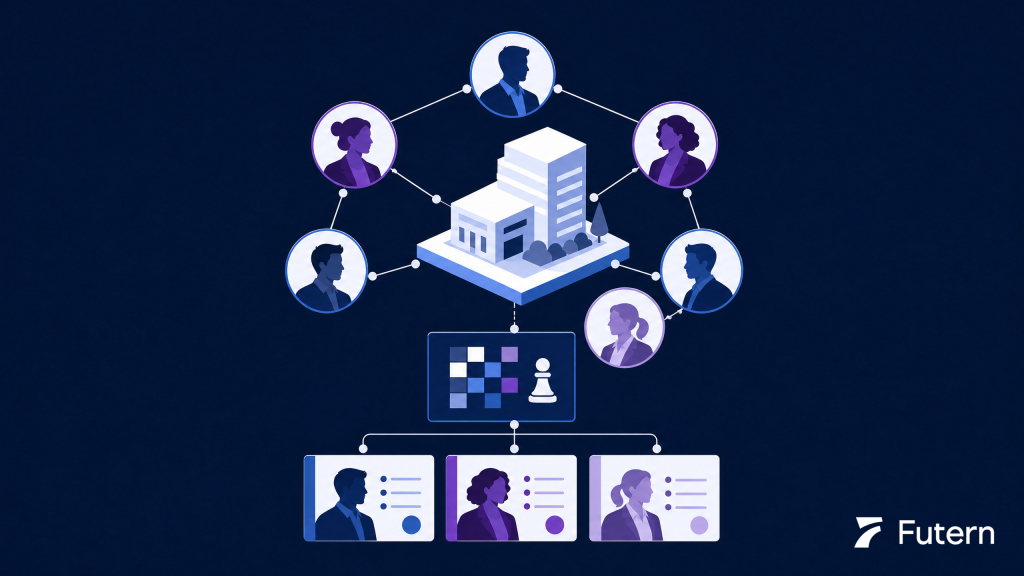
At minimum, this means understanding the contact's position within their company: their job title, department, seniority level, and reporting relationships. These details determine what the contact cares about and what language resonates with them. A VP of Sales evaluating a new prospecting tool thinks about pipeline velocity and team productivity. A CTO evaluating the same tool thinks about integration complexity and data security. A Head of Revenue Operations thinks about process standardization and reporting accuracy. The product being discussed may be the same, but the conversation that earns a meeting is fundamentally different for each.
Beyond individual role context, organizational enrichment includes mapping other relevant contacts within the same company. Enterprise deals rarely involve a single decision-maker. Understanding the buying committee structure — who influences, who evaluates, who approves — allows the sales team to coordinate outreach across multiple stakeholders rather than relying on a single thread. When one contact goes silent, having enriched records for parallel contacts in the same organization provides alternative paths into the account.
This layer of enrichment is also where many teams stop too early. Job titles alone are unreliable proxies for decision-making authority. A "Director of Operations" at a 30-person company has a fundamentally different scope of authority than a Director of Operations at a 3,000-person enterprise. Effective organizational enrichment goes beyond the title string to capture structural information about how the company is organized, how decisions get made, and where the contact sits within that structure.
Firmographic and Technographic Context — Understanding the Company
Individual contact data, no matter how accurate, exists in a vacuum without company-level context. Firmographic and technographic enrichment provides the background that makes prospect-level information actionable.
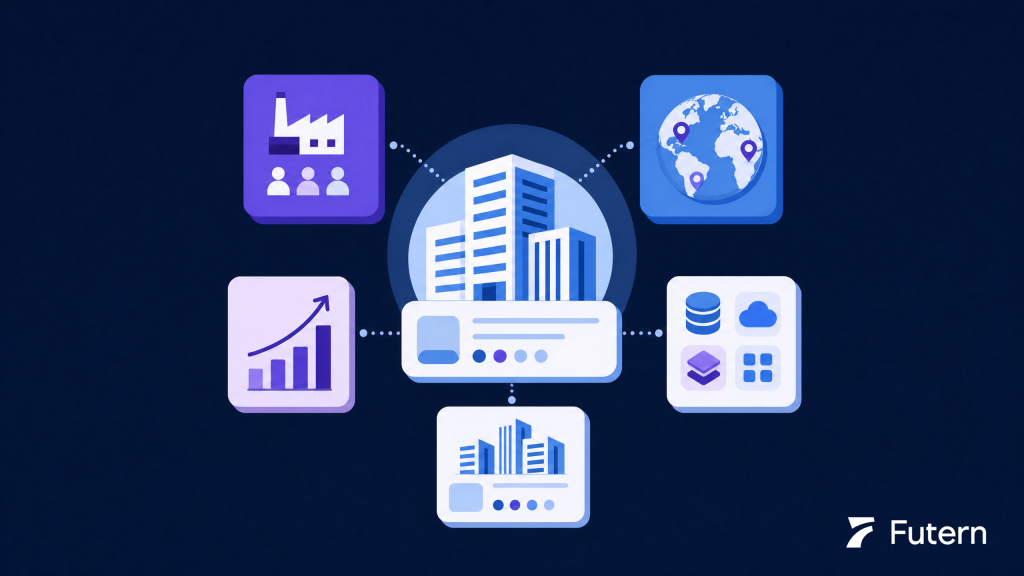
Firmographic data covers the basics that every outreach message needs to reflect: industry, sub-industry, company size, revenue range, geographic footprint, growth stage, and ownership structure. These are not just CRM fields to populate; they are the variables that determine whether a prospect is a realistic fit and how the value proposition should be framed. A scaling mid-market SaaS company expanding into international markets faces different challenges than a family-owned manufacturer supplying regional distributors. The same product might help both, but the messaging angle, the urgency drivers, and the success metrics that matter to each are completely different.
Technographic enrichment adds a layer that has become increasingly important as B2B purchasing decisions involve more technology interdependencies. Knowing what tools a prospect already uses reveals several things at once. Compatibility becomes assessable — does the prospect's existing stack work well with your product, or would adoption require a painful migration? Competitive positioning becomes clearer — if they already use a competitor, you know they have budget for the category and understand the problem space. Technology maturity becomes visible — a company running sophisticated marketing automation and analytics is a different conversation from a company still managing outreach through spreadsheets.
When firmographic and technographic data are combined, they produce a company profile that goes beyond static demographics. A mid-market fintech company that just expanded to three new countries and recently adopted a new CRM is a meaningfully different prospect from a mid-market fintech company of the same size that has been stable for five years with no recent technology changes. Both match the same firmographic filter, but the enriched picture reveals that only one is in a moment of change where new tool adoption is likely.
When Enrichment Happens and How Often It Should Refresh
One of the most consequential decisions in an enrichment strategy is timing. Most teams treat enrichment as a batch process — a periodic project where records are sent to a data provider, enriched, and returned to the CRM. The enriched data is then treated as current until the next batch cycle, which might be quarterly or even annual.
This approach creates a predictable pattern: enrichment quality is high immediately after a batch run and degrades steadily until the next one. During the degradation window, the team is working with information that looks complete but may no longer be accurate. Contacts have changed roles. Companies have shifted strategy. Technology stacks have evolved. The record still has data in every field, but the data increasingly reflects a past state rather than the current one.
Continuous enrichment operates on a different model. Rather than enriching all records on a schedule, the system enriches and re-verifies records based on triggering events: when a prospect enters an active outreach sequence, when a deal reaches a new pipeline stage, when engagement activity suggests renewed interest, or when external signals indicate a change at the account level. This event-driven approach concentrates enrichment effort where it creates the most value — on records that are about to be used — rather than refreshing the entire database uniformly regardless of whether anyone is going to contact those prospects soon.
The practical difference is significant. Batch enrichment treats all records as equally important and refreshes them on the same cycle. Event-driven enrichment allocates resources based on proximity to action. A prospect entering an outreach sequence tomorrow needs current data today. A prospect sitting in a monitoring pool with no immediate outreach planned can tolerate slightly older data without operational impact. Recognizing this difference allows teams to maintain high data quality where it matters most without the cost of refreshing every record at the same frequency.
The Diminishing Returns of Over-Enrichment
More data is not always better data. There is a point at which additional enrichment stops improving outreach outcomes and starts creating friction instead.
The friction shows up in several forms. Sales reps facing a record with forty populated fields do not read all of them. They scan for what seems relevant and ignore the rest. When the most actionable information is buried among fields that rarely matter, reps default to the same surface-level scan they would have performed with a less enriched record. The enrichment investment is real, but the usage rate on many of those fields approaches zero.
From a compliance perspective, over-enrichment also carries increasing risk. Data protection regulations like GDPR operate on a principle of data minimization — organizations should collect and process only the personal data necessary for a specific, stated purpose. Enriching prospect records with information that has no clear connection to a legitimate outreach objective creates regulatory exposure that may not justify the marginal value of having that data available.
The more productive framing is "enrichment to action threshold." For any given outreach motion, there is a level of enrichment below which the team cannot personalize effectively and above which additional data does not change the approach. Identifying that threshold — the point where the team has enough information to make a relevant, well-timed contact — prevents both under-enrichment (where generic messaging leads to low response rates) and over-enrichment (where data collection becomes an end in itself).
This threshold varies by segment. A high-value enterprise account might justify deep enrichment across multiple contacts, organizational mapping, and detailed technographic profiling. A mid-market prospect being engaged through a more standardized outreach sequence might need accurate contact details, basic firmographic context, and one or two technographic signals. Applying the same enrichment depth to both wastes resources on the mid-market segment and may under-invest in the enterprise segment.
What Enrichment Makes Possible
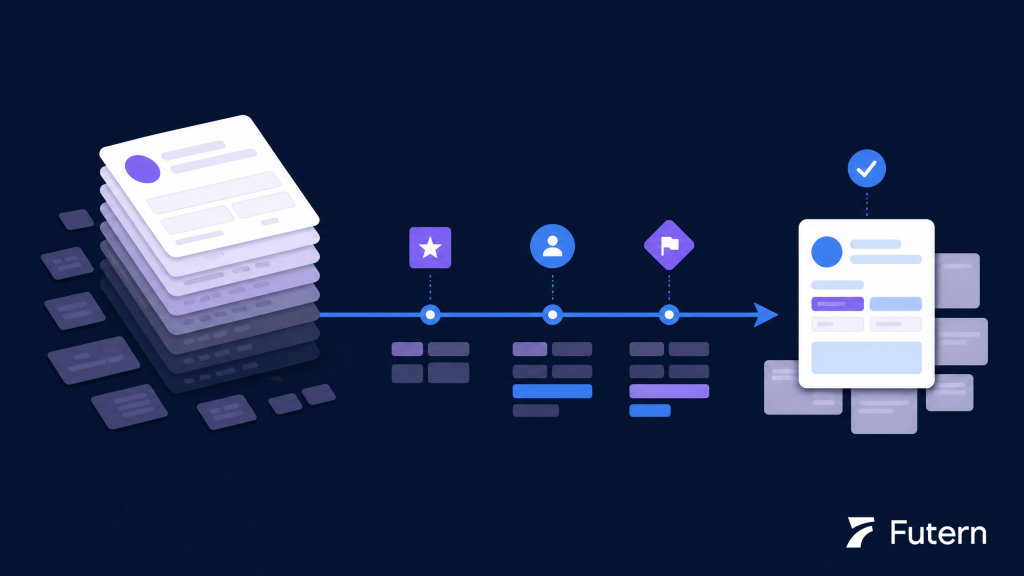
Data enrichment occupies a specific position in the prospecting workflow: after the prospect has been identified and prioritized, but before the first outreach message is sent. Its function is to close the gap between "this prospect is worth contacting" and "here is enough context to make the contact relevant."
When enrichment works well, the sales team enters every conversation with a foundation that manual research would have taken hours to assemble. The right contact is identified within the target organization. Multiple channels are available for reaching them. The message reflects what the contact cares about based on their role, seniority, and organizational context. The framing reflects the company's situation — its size, industry, growth stage, and technology environment. And the timing accounts for recent signals that suggest the prospect may be receptive.
When enrichment is absent or poorly executed, none of these advantages exist. Outreach defaults to generic messaging through a single channel, aimed at contacts who may or may not be relevant, with no basis for personalization beyond the prospect's name and company. The cost of this default compounds across every message the team sends and every quarter of low conversion rates that follows.
The next stage of the process — executing multi-channel outreach — depends directly on what enrichment provides. Channel selection, message personalization, sequence design, and engagement timing all draw on the data layers described in this article. Enrichment does not determine whether outreach happens; it determines whether outreach has a realistic chance of working.