Pittsburgh Manufacturing Companies: Where Robotics and Automation Fit
by Yu T
Compare 20 Pittsburgh manufacturers by process, facility role, automation fit, and buying influence.
Pittsburgh's robotics reputation describes the technology supply side of the region. Its manufacturing base presents a different question: where do robotics and automation fit inside operating plants? Pittsburgh Region reported 2,864 manufacturing companies, 92,164 manufacturing jobs, and more than $17.8 billion in manufacturing gross regional product in 2025. Those companies span steel, chemicals, turbomachinery, electrical equipment, medical devices, batteries, safety products, food, and precision manufacturing.
A single automation message will not work across that range. Continuous plants prioritize uptime and process safety. Specialty-metal producers care about traceability, inspection, and qualified process stability. Engineered-equipment manufacturers need flexible systems for low-volume, high-value work. Medical, safety, and food plants add validation, sanitation, and product-control requirements.
Research information and company signals were reviewed on August 27, 2026. The companies below are research examples selected for their regional operations, facility roles, scale, and possible automation relevance. Inclusion does not indicate confirmed demand, an active project, or purchasing intent. Sales teams should verify facility details, current operations, technical requirements, investment timing, and decision-maker roles before outreach.
This guide organizes 20 Pittsburgh-area manufacturers around five production environments. The objective is to connect each company to an automation use case, supplier qualification issue, and facility-level reason for research.
How the Pittsburgh Manufacturing Map Changes the Search
Pittsburgh's process industries follow the rivers: U.S. Steel's Mon Valley sites, Calgon Carbon on Neville Island, Tenaris in Ambridge and Koppel, and Shell in Monaca form a capital-intensive corridor. Northern and eastern nodes add ATI, Coherent, Penn United, Curtiss-Wright, MSA, Re:Build, Ebara Elliott, and Carpenter; southwestern sites include Universal Stainless, Perryman, GE Vernova, Sarris, Bayer MEDRAD, Eos, and Turner Dairy. Record each facility's function because a test center, mature plant, and ramping line signal different timing and purchasing authority.
Continuous Processes Put Uptime Before Robot Count
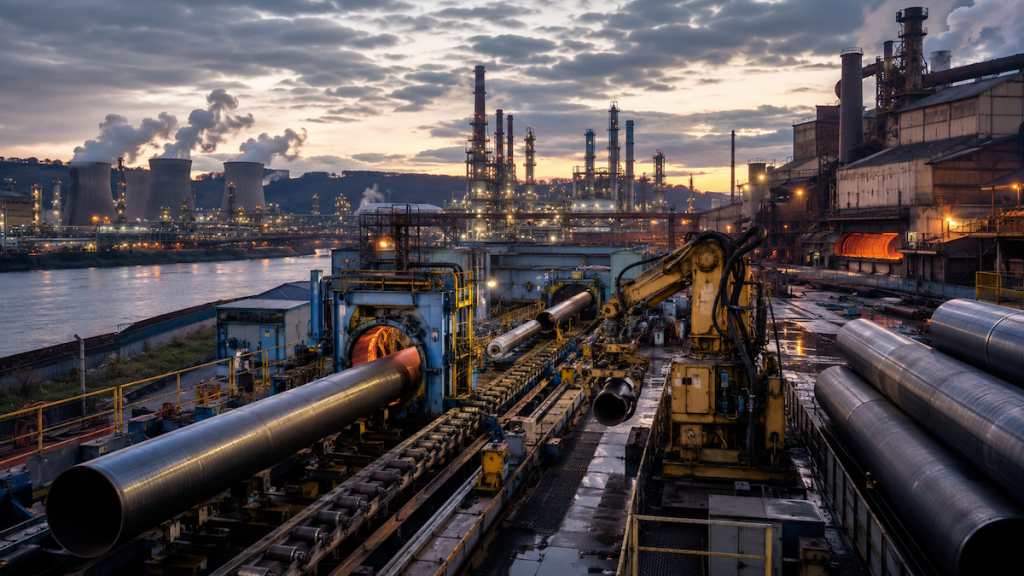
In steel, carbon, and petrochemicals, automation usually supports reliability, inspection, handling, sampling, maintenance, and hazardous-task reduction.
U.S. Steel – Mon Valley Works
Mon Valley Works connects coke production at Clairton, steelmaking at Edgar Thomson, and rolling and finishing at Irvin, supporting more than 3,000 regional jobs. U.S. Steel's investment tracker places a proposed $2 billion to $2.5 billion hot-strip-mill program in engineering. Existing operations present separate angles around surface inspection, coil tracking, reliability, emissions monitoring, and hot-area handling. Engineering, maintenance, EHS, operations, sourcing, and project teams may divide authority.
Tenaris – Koppel and Ambridge
Tenaris links Koppel's electric-arc-furnace billet and finishing operations with seamless-pipe rolling at Ambridge. In June 2026, it announced more than $90 million in automation and equipment upgrades at both sites, following January's $2.1 million line reactivation, 80-plus hires, and over $150 million invested since 2020. Automated pipe handling, ultrasonic inspection, serialization, heat-treatment controls, and predictive maintenance are focused angles. First confirm utilization and site-level process ownership.
Calgon Carbon – Neville Island
Calgon Carbon's Neville Island operations cover activated-carbon reactivation, final processing, and nearby equipment fabrication. A $13.2 million expansion announced in December 2025 is expected to retain 405 positions and add 23, with 11,000 square feet planned for the recycling plant and 35,000 for equipment fabrication. Supplier fit includes furnace controls, dust-contained handling, sampling, bagging, palletizing, maintenance analytics, and lot traceability. The construction stage and the responsible plant function need confirmation before outreach.
Shell Polymers Monaca – Potter Township
Shell's $14 billion Monaca complex has design capacity of about 1.6 million metric tons of polyethylene per year and remained operational in August 2026. Recent reporting placed it within a potential sale process for Shell's broader U.S. chemicals portfolio, but Shell had not announced a transaction. Reliability, pellet handling, packaging, laboratory automation, equipment monitoring, and emissions data remain plausible angles. The reported process makes ownership, production status, permits, and supplier-onboarding authority essential checks.
Lead with one reliability, safety, quality, or environmental outcome backed by comparable operating evidence.
Specialty Metals Make Inspection Part of Automation
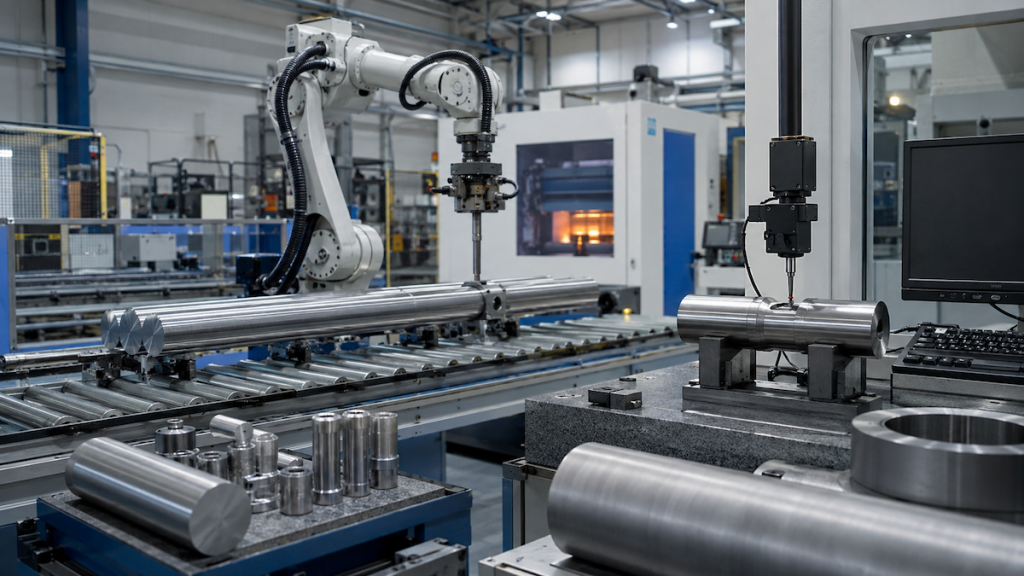
Specialty-alloy plants qualify automation through traceability, inspection, calibration, and process records required by aerospace, medical, and energy programs.
ATI – Specialty Rolled Products
ATI's Brackenridge-area operations include a $1.2 billion Hot-Rolling and Processing Facility serving titanium, nickel-based alloys, and specialty products. ATI reported roughly 7,600 employees and $4.6 billion in 2025 sales, mostly from aerospace and defense. Surface inspection, material handling, robotic finishing, laboratory automation, and predictive maintenance fit the production logic. Suppliers should map the process to the correct Pennsylvania plant before approaching engineering, quality, maintenance, or sourcing.
Universal Stainless (Aperam) – Bridgeville
Universal Stainless operates its Bridgeville headquarters and plant with EAF and AOD melting, ESR and VAR remelting, rolling, heat treatment, machining, and testing. Aperam acquired the business in January 2025 for an enterprise value of about $537 million; Universal brought more than 750 employees across its U.S. operations. Automation angles include ingot handling, surface conditioning, NDT, process control, and maintenance. The Bridgeville laboratory's ISO/IEC 17025 accreditation is valid through September 12, 2026, so renewal status should be checked if qualification begins after that date.
Carpenter Technology – Latrobe Operations
Carpenter Technology's Latrobe operation produces and tests premium specialty alloys for aerospace and other critical applications. Its 2025 filing identified 461 represented production employees in Latrobe, within a company workforce of about 4,500. Carpenter then reported record fiscal 2026 operating performance. Automated sample preparation, ultrasonic inspection, bar handling, melt and heat-treatment controls, and maintenance systems fit this environment. Local manufacturing, quality, NDT, maintenance, and corporate sourcing roles may each influence qualification.
Perryman Company – Washington County
Perryman integrates titanium melting at Coal Center with rolling, finishing, testing, and fabrication in Houston. Company materials place melting capacity above 26 million pounds, supported by two electron-beam and three vacuum-arc-remelt furnaces. Pennsylvania DEP records show that a further plan-approval extension for the Coal Center titanium melt shop was issued in August 2026. A related modification remained under review as of August 27, making the site's current approval scope a time-sensitive qualification point., so subsequent approval status should be confirmed before the expanded operation is treated as fully qualified. Perryman also documents a robotic forging cell and common CMM platform. Further fit may sit around melt control, NDT, material handling, inspection, and traceability. Contact selection should follow the campus and product family.
Proposals should explain accuracy, data retention, change control, environmental tolerance, and quality-system integration.
Engineered Equipment Needs Flexible Automation
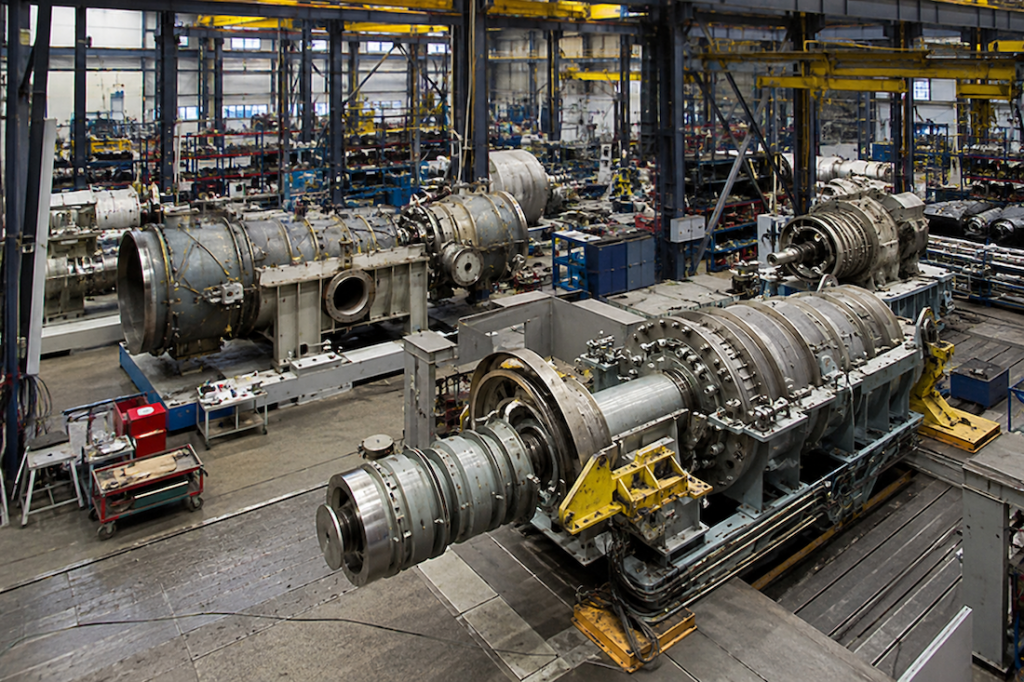
Large forgings, compressors, nuclear components, and switchgear favor flexible handling, machining, welding, inspection, and test-data capture over maximum unit volume.
Ellwood Group – Ellwood City Forge
Ellwood City Forge runs open-die presses rated at 1,500, 4,500, and 5,000 tons and produces forgings weighing as much as 70,000 pounds. Existing equipment includes manipulators and automated die-change capability, so the strongest angles extend the current production system through NDT automation, condition monitoring, heat-treatment tracking, robotic conditioning, and scheduling. Heavy-part safety and defense-grade documentation shape qualification. Operations, metallurgy, quality, maintenance, EHS, and procurement are likely influence points.
Ebara Elliott Energy – Jeannette
Ebara Elliott Energy's Jeannette headquarters and flagship plant manufacture and test large compressors, turbines, and related systems. An electrical upgrade completed in 2025 enabled full-speed, full-load testing of equipment up to 100 megawatts. That scale points toward heavy-lift positioning, large-part metrology, machine tending, balancing, test instrumentation, and production-data integration. A proposal should identify one machining, assembly, or test bottleneck and determine whether manufacturing engineering, test engineering, quality, operations, or sourcing owns it.
Curtiss-Wright – Cheswick
Curtiss-Wright's 118-acre Cheswick campus manufactures and qualifies pumps, motors, generators, and control-rod-drive mechanisms for naval and commercial nuclear applications. An $80 million expansion announced in July 2026 is expected to retain more than 860 positions and add about 150 over three years. Robotic welding, machining, inspection, test-data capture, and traceability are credible areas for research. Nuclear requirements make quality, program, engineering, procurement, and site leadership central to qualification.
GE Vernova – Speers (Charleroi Facility)
GE Vernova's 332,000-square-foot factory in Speers, which the company describes as its Charleroi facility, manufactures high-voltage switchgear, circuit breakers, and instrument transformers. In July 2026, GE Vernova announced a $138 million site investment expected to create about 275 jobs through 2028. The broader $166 million Western Pennsylvania program also includes a 700,000-square-foot Rostraver property. Assembly assistance, controlled bolting, vision checks, material flow, traceability, and test automation fit the workflow. Suppliers must distinguish the products and purchasing authority that remain at Speers from those moving to Rostraver.
Proposals should quantify fixture strategy, programming effort, test integration, and changeover economics.
Advanced Manufacturing Rewards Traceability and Ramp Support
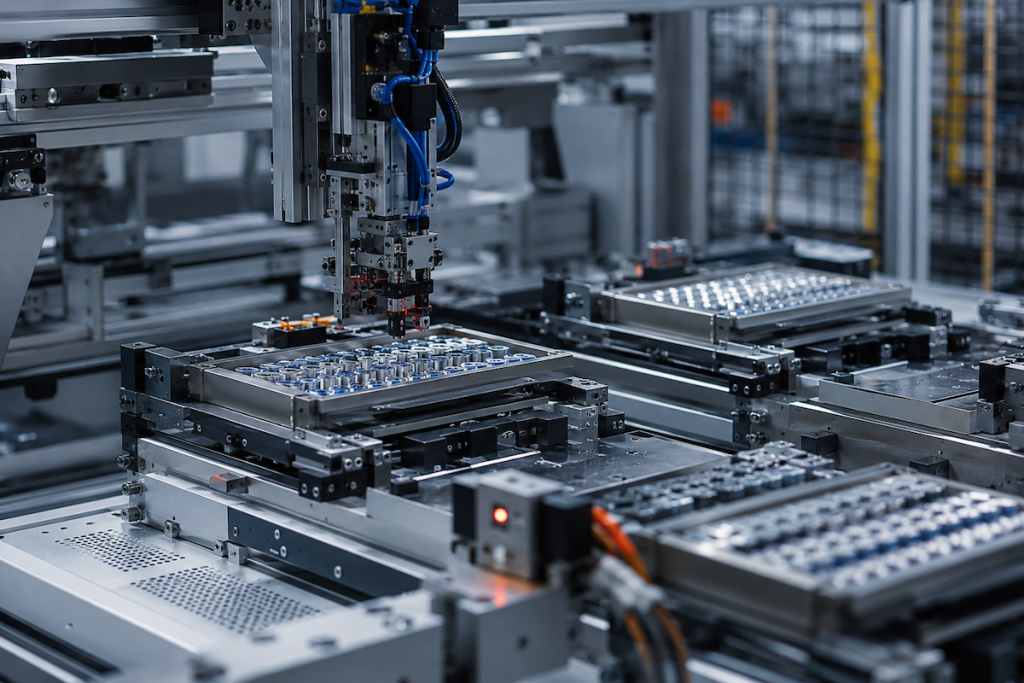
Precision machining, optics, batteries, and contract production need automation that preserves flexibility while controlling throughput, traceability, and ramp risk.
Penn United Technologies – Cabot
Penn United operates a 250,000-square-foot Cabot campus with about 700 employee-owners. Its capabilities include precision machining, grinding, EDM, stamping, additive manufacturing, automated assembly, and multi-sensor inspection. The company reported record monthly shipments in March 2026. Machine tending, automated inspection, stamping feeds, additive post-processing, and material flow offer practical next-step angles. Tooling, manufacturing engineering, quality, operations, and procurement may evaluate different parts of a proposal.
Re:Build Manufacturing – New Kensington
Re:Build's New Kensington facility provides 175,000 square feet of machining, welding, assembly, and battery-pack production, with expansion capacity to 750,000 square feet. In July 2026, the company confirmed that its NDAA-compliant drone battery packs were designed and assembled there. Flexible assembly, laser or robotic welding, machine tending, inspection, digital traceability, and intralogistics suit the site's high-mix model. Suppliers should qualify the exact program, volume stage, customer requirements, and local versus centralized purchasing responsibility.
Coherent – Saxonburg
Coherent's Saxonburg headquarters and plant employ more than 500 people locally and support engineered materials, optics, assembly, and testing. Its June 2026 ISO 9001 recertification and automation-engineering recruitment confirm an active production environment. Precision handling, vision-guided alignment, crystal-growth controls, clean manufacturing, metrology, and test automation are plausible fit areas. With about 51,000 employees worldwide, Coherent requires facility- and business-unit-level qualification.
Eos Energy Enterprises – Turtle Creek and Thorn Hill
Eos began commercial production at its 432,000-square-foot Thorn Hill facility in June 2026. Its August update said Battery Line 2 was operating one partial shift, with full capacity still targeted for the fourth quarter; the wider Pennsylvania program represents about $353 million in investment. Full automation was online across subassembly operations. Supplier research should therefore focus on ramp execution, yield, cycle time, test automation, maintenance, traceability, and material flow rather than treating the line as a greenfield concept.
Prioritize unresolved constraints around yield, cycle time, inspection, or material flow.
Safety, Medical, and Food Plants Change the Proof
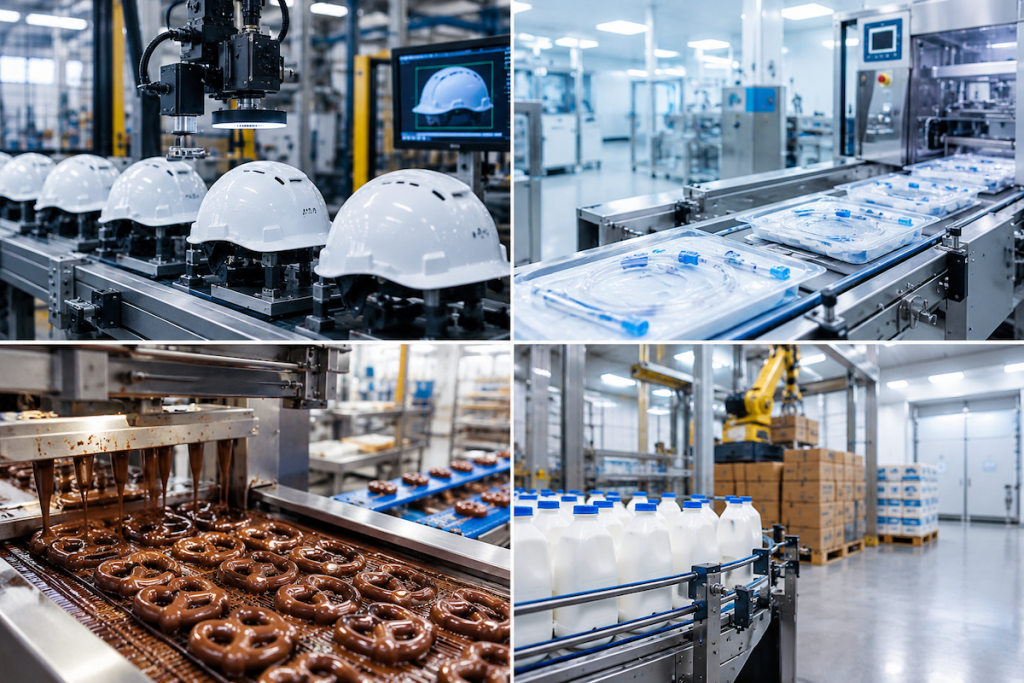
Medical, safety, and food plants add validation, hygiene, allergen control, and lot traceability to assembly and packaging decisions.
MSA Safety – Murrysville
MSA lists Murrysville among its primary Americas manufacturing locations for head and respiratory protection. The company generated about $1.9 billion in 2025 revenue and employed roughly 5,300 people globally. A 2026 case study documented a collaborative-robot and AI-vision leak-test pilot. Suppliers should confirm whether it entered production. Inspection, molding support, assembly, packaging, and traceability belong with advanced manufacturing, plant engineering, quality, and operations roles.
Bayer MEDRAD – Indianola
Bayer's Indianola facility remains active in medical-device manufacturing, supported by current 2026 production hiring and FDA device records. A 2023 regional figure placed about 1,900 employees across Bayer's Indianola, O'Hara, and Saxonburg operations, with a separate 60,000-square-foot material hub serving the network. Clean assembly, vision inspection, packaging, test automation, and device traceability offer relevant angles. Any change must fit current quality-system and validation procedures, so facility boundaries and manufacturing authority need careful confirmation.
Sarris Candies – Canonsburg
Sarris Candies operates a roughly 135,000-square-foot Canonsburg factory with more than 350 employees reported in 2025 and distribution through over 1,200 retail locations. Its current production includes an automated pretzel-enrobing flow alongside hand-finished products. Selective automation around gentle handling, vision inspection, case packing, palletizing, wrapper checks, and seasonal throughput fits that mix. Food safety, allergen control, cleaning access, product appearance, and rapid changeover will shape technical acceptance.
Turner Dairy Farms – Penn Hills
Turner Dairy's Penn Hills campus combines processing, bottling, cold storage, and distribution, with about 215 employees reported in 2024. A $750,000 grant announced in 2025 supports cold storage and automated palletizing; a further $1.32 million award followed in July 2026. Palletizing, case handling, fill-level inspection, cold-chain monitoring, traceability, and cleaning controls are grounded angles. Sales teams should verify completion, selected equipment, and remaining authority.
Lead with compliance and cleaning evidence before cycle-time gains.
How Automation Suppliers Should Prioritize the First List
Begin with a proven use case. Surface-inspection and reliability suppliers have stronger reasons to study U.S. Steel, Tenaris, ATI, and Universal Stainless. Flexible robotics, welding, metrology, and test specialists align more closely with Ellwood, Ebara Elliott Energy, Curtiss-Wright, GE Vernova, Penn United, and Re:Build. Vision and traceability providers have clearer hypotheses for Coherent, Eos, MSA, and Bayer. Packaging specialists can start with Calgon Carbon, Shell, Sarris, and Turner while accounting for environmental or hygienic constraints.
Then score each facility on process fit, visible timing, local authority, qualification burden, and existing automation. A documented pilot or funded expansion is a useful signal, although it does not establish an open purchase. Shell's reported sale process, U.S. Steel's engineering-stage mill, Eos's partial-shift ramp, and GE Vernova's facility split all require different outreach timing.
The first prospect list should contain three tiers: operating sites with an immediate process hypothesis, expansion or ramp sites requiring project verification, and strategic plants with longer qualification cycles. This keeps corporate size from crowding out better technical fit.
What Sales Teams Must Verify Before Outreach
Confirm the operating name, address, facility role, and production status. Identify the affected process, installed controls, integrator or OEM relationships, qualification requirements, approved-vendor route, and interruption cost. Determine whether engineering, operations, quality, EHS, maintenance, procurement, a program team, or corporate sourcing owns the decision. Construction, ramp, certification, permit, ownership, and employment signals should carry a current date. Connect one proven result to one local production issue.
Turning Pittsburgh Research Into a Futern Workflow
Futern helps B2B sales teams divide a broad Pittsburgh search by production environment, facility function, scale, ownership, and automation use case. Teams can enrich company records, review websites and LinkedIn profiles, track expansion or hiring signals, and identify likely engineering, operations, maintenance, quality, EHS, program, and procurement roles.
The workflow begins with a narrow supplier hypothesis, such as reducing inspection time on specialty metal or improving pallet flow in a food plant. Comparable facilities can then be grouped, local authority checked, and outreach angles shaped around the outcome each role influences. Futern supports research organization and enrichment; final qualification still depends on current facility evidence and direct confirmation.
Conclusion
Pittsburgh manufacturing offers more than a list of possible automation users. It contains distinct production systems with different economics, risks, and approval routes. Continuous plants reward reliability proof, specialty metals demand process evidence, engineered products require flexibility, scaling factories value traceability, and regulated or food plants add validation and hygiene.
The strongest prospect list connects a supplier's proven capability to one facility-level process. Sales teams that verify timing, technical fit, and decision authority before outreach will have a more credible path into the region's manufacturing base.
Pittsburgh Robotics Companies: A Supplier Research Guide
Houston Petrochemical Plants: A Supplier Research Guide
Data Enrichment for Sales Teams: What It Adds and Why It Matters
Explore more company and industry insights here.