Houston Specialty Chemical Market: Buyer Segments Worth Researching
by Yu T
Research Houston specialty chemical buyer segments with examples, signals, and sales notes.
Introduction
Houston is one of the strongest U.S. markets for specialty chemical sales research, but it is also one of the easiest markets to oversimplify.
A sales team can search for chemical companies in Houston and quickly find refiners, petrochemical plants, oilfield service providers, water treatment firms, coatings manufacturers, polymer producers, toll blenders, cleaning chemical companies, agricultural input distributors, and advanced manufacturing businesses. On paper, they all seem connected to chemicals. In practice, they buy, use, formulate, resell, or influence specialty chemicals in very different ways.
That difference matters for B2B sales teams. A refinery may care about uptime, corrosion control, catalysts, and turnaround support. A water treatment provider may care about compliance, treatment performance, and local service reliability. A toll blender may care about raw material consistency and supply flexibility. An aerospace manufacturer may care about high-purity materials, qualification standards, and technical documentation.
This article breaks the Houston specialty chemical market into several buyer segments, grouped by buying logic and sales research value. The goal is to help specialty chemical suppliers, manufacturers, distributors, and sales teams build a more useful account list instead of treating Houston as one broad chemical market.
This article is designed as a market research guide, not a confirmed procurement list. The companies mentioned below are included as research examples based on public information, Houston-area relevance, operating model, company size, product categories, and possible specialty chemical use cases. Sales teams should verify facility details, purchasing needs, supplier requirements, and decision-maker roles before outreach.
Why Houston Should Not Be Treated as One Chemical Market
Houston’s chemical demand is shaped by several overlapping industrial systems. The Houston Ship Channel, Baytown, Deer Park, La Porte, Pasadena, Channelview, The Woodlands, Texas City, Conroe, Cypress, Waller, and the broader Gulf Coast all contribute to different forms of specialty chemical demand.
Some demand comes from large industrial assets that need process chemicals, catalysts, water treatment chemicals, corrosion inhibitors, and maintenance support. Some demand comes from companies that formulate products for oilfield, coatings, cleaning, agriculture, or polymer applications. Some opportunities sit inside service providers that buy chemicals to support their own customers. Other accounts are more useful as channel partners, toll blending partners, or ecosystem references.
For sales teams, the first step is segmentation. A better question than “Which companies in Houston use specialty chemicals?” is: “Which type of buyer matches our product, sales cycle, technical strength, and ability to support the customer?”
The segments below help structure that research.
Core Industrial and Energy Chemical Users

The first group includes companies closest to Houston’s heavy industrial and energy base. These accounts often represent large or recurring demand, but they are technical, structured, and harder to enter without a clear use case.
Oil Refiners and Petrochemical Plant Operators
Oil refiners and petrochemical plant operators are some of the most visible specialty chemical buyers in the Houston area. Their operations may involve catalysts, process additives, water treatment chemicals, corrosion inhibitors, antifoulants, desalting chemicals, biocides, solvents, emissions-control chemicals, and maintenance-related products across different units.
This group looks attractive because of scale. The challenge is access. Large refining and petrochemical sites usually have established supplier qualification processes, safety requirements, technical standards, and procurement systems. A general supplier introduction is unlikely to work well. Sales teams need to connect the product to a specific plant-level problem, such as corrosion control, cooling water treatment, fouling reduction, turnaround support, catalyst performance, process reliability, or environmental compliance.
ExxonMobil Baytown Complex gives sales teams a clear view of how large integrated refining and petrochemical sites create several specialty chemical angles. The Baytown complex has around 7,000 employees, while ExxonMobil has roughly 62,000 employees globally. That scale matters because a site like Baytown may involve specialty chemical use across refining, chemicals, lubricants, utilities, maintenance, and environmental compliance. For sales teams, the value of this example is less about quick supplier access and more about understanding large-site buying logic.
LyondellBasell is a strong reference point for studying petrochemical and polymer-related accounts with both Houston presence and Gulf Coast operating relevance. The company operates at global scale, with around 14,000 employees and roughly $39 billion in 2024 revenue. Its business in polyolefins, petrochemicals, advanced polymer solutions, and recycling technologies points suppliers toward polymerization catalysts, antioxidants, UV stabilizers, process antifoulants, and water treatment chemicals.
Chevron Phillips Chemical helps illustrate how headquarters presence and Gulf Coast plant operations both matter in specialty chemical sales research. With around 5,000 employees globally and estimated revenue of about $12 billion, the company gives suppliers a useful reference point for olefins, polyolefins, aromatics, alpha olefins, and specialty chemical production. The strongest supplier angles are likely to sit around catalysts, process aids, cooling water chemicals, fouling inhibitors, and hydrogenation-related chemicals.
Valero Houston Refinery offers a more site-specific view of refining demand. The Houston refinery has about 400 employees, while Valero has more than 10,000 employees across the company. The refinery processes crude and intermediate oils into gasoline, jet fuel, diesel, LPG, propylene, and related products. For suppliers, this account profile is useful for studying desalting chemicals, corrosion inhibitors, FCC-related chemicals, cooling tower treatment, and amine treating chemicals.
For refiners and petrochemical operators, timing often matters more than company size alone. Turnarounds, maintenance cycles, capacity projects, emissions-related upgrades, and process-unit investments all help sales teams decide whether an account belongs in a current outreach list or a longer-term watchlist. These signals do not prove active demand. They simply give sales teams a better reason to prioritize one account over another. Procurement may be involved, but technical influence often comes from process engineers, plant operations leaders, reliability teams, environmental managers, catalyst specialists, and maintenance leaders.
Oilfield Services and Upstream Production Companies
Houston is also a global center for oilfield services. This part of the market is different from refining because many oilfield service companies are both chemical buyers and chemical sellers. They may purchase raw materials, develop formulations, supply chemical programs to oil and gas operators, and provide technical support in the field.
That makes these accounts useful for specialty chemical suppliers, especially those selling surfactants, biocides, corrosion inhibitors, scale inhibitors, demulsifiers, friction reducers, drilling fluid additives, cement additives, chelating agents, hydrate inhibitors, acids, solvents, or specialty intermediates.
The sales opportunity depends heavily on company type. A global oilfield services company is often a long-cycle strategic target. A mid-sized oilfield chemical formulator may be a more practical first research target because the connection between raw material supply, formulation needs, and customer applications is easier to see.
Halliburton Multi-Chem represents the specialty chemical service model inside a major oilfield services company. Halliburton has around 48,000 employees globally, while Multi-Chem is a significant specialty chemicals business line within the company. Its product context points suppliers toward surfactants, biocides, scale inhibitors, corrosion inhibitors, demulsifiers, friction reducers, and other production or stimulation chemicals.
Baker Hughes gives sales teams a view of a broad energy technology company where chemical use may sit across multiple product lines and technical applications. The company has around 54,000 employees globally and reported roughly $26 billion in 2024 revenue. Supplier fit is most likely to depend on a specific product line, region, or technical application, such as drilling fluid additives, cement additives, specialty surfactants, chelating agents, hydrate inhibitors, or production optimization chemicals.
Houston Chemical gives suppliers a more focused view of the mid-market oilfield chemical space. With an estimated workforce of 50–100 and annual revenue in the $10–50 million range, it sits much closer to formulation and customer-specific oilfield applications than the global oilfield service companies above. Its work around drilling, completion, and production chemicals helps suppliers study raw material and formulation needs in shale-related markets.
Centrium Energy Solutions shows how the oilfield chemical supply chain is also shaped by sourcing, raw materials, and intermediates. Operating at an estimated 50–150 employees and $20–100 million in annual revenue, the company sits closer to the sourcing and formulation side of the market than a traditional direct end user. It is a useful example for suppliers studying how raw materials move into oil and gas chemical applications.
Oilfield service accounts are usually easier to research when the product is tied to a field application. Drilling activity, completion work, Permian Basin demand, new service contracts, raw material sourcing changes, and product-line expansion all raise the priority of an account. The first conversation may start with supply chain, technical directors, formulation chemists, chemical product managers, regional operations leaders, or business development teams. A message built around field performance, formulation support, raw material reliability, or supply flexibility will usually be stronger than a general product introduction.
Plastic Compounders, Polymer Processors, and Rubber Manufacturers
Houston’s polymer and elastomer market creates another layer of specialty chemical demand. These companies often rely on additives and raw materials that influence processing, durability, flame resistance, UV stability, color, flexibility, sealing performance, or regulatory compliance.
This area should be handled carefully because not every polymer-related company buys the same type of chemicals. A large polypropylene producer, a specialty elastomer manufacturer, a plastic additive company, and a toll blender all sit in the polymer ecosystem, but their purchasing logic is very different.
Braskem America’s La Porte operation provides a clear example of large-scale polymer production in the Houston area. The La Porte plant has around 500 employees, while Braskem America has more than 1,500 employees. The facility produces polypropylene and has ultra-high molecular weight polyethylene capability. Its production profile gives suppliers a way to study Ziegler-Natta catalysts, metallocene catalysts, antioxidants, slip agents, antistatic additives, nucleating agents, and process chemicals.
Zeon Chemicals in Pasadena represents a specialty elastomer manufacturing profile rather than a general plastics account. Its Texas operations are estimated at roughly 500–1,000 employees, with revenue above $500 million, giving suppliers a larger and more technical research target within the elastomer space. Its specialty elastomers and C4/C5 chemistry point to monomers, curatives, fillers, vulcanizing agents, accelerators, antidegradants, and processing aids.
Phoenix Plastics is a focused plastic additive manufacturer in the Houston-area market. A smaller operation of roughly 50–100 employees and $10–30 million in estimated revenue, the company offers a clearer look at additive formulation because raw materials are closely tied to product performance. Its product mix includes purging compounds, chemical foaming agents, vapor corrosion inhibitors, flame retardants, UV stabilizers, color concentrates, and custom additive blends.
Economy Polymers & Chemicals sits in the custom blending and toll manufacturing side of the chemical market. At roughly 100–300 employees and $20–80 million in estimated revenue, the company gives suppliers a practical way to study formulation, blending, and oilfield chemical input demand. Its activity in guar gum derivatives, oilfield stimulation chemicals, and custom additives points toward polymers, surfactants, friction reducers, crosslinkers, and related inputs.
Polymer and rubber-related accounts should be researched through the lens of product performance. New additive requirements, product launches, quality certifications, regulatory changes, capacity expansion, trade show activity, and downstream demand from automotive, packaging, healthcare, or oilfield markets all help sales teams judge timing. Buying influence often sits with plant managers, polymer technology leaders, compounding specialists, raw material procurement teams, R&D chemists, and technical sales leaders.
Process-Driven and Formulation Buyers
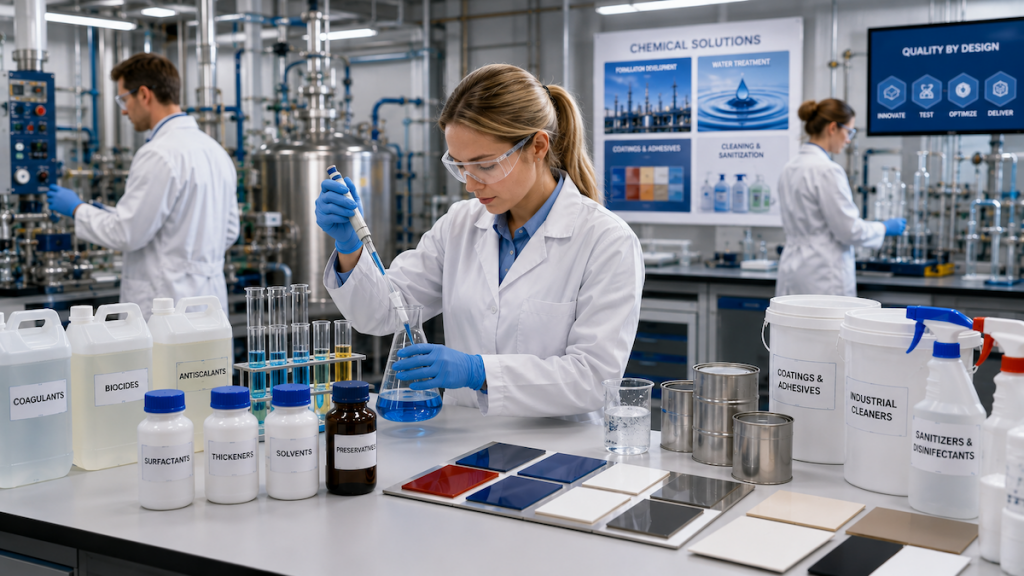
The next group includes companies where specialty chemicals sit close to service delivery, formulation, quality control, cleaning performance, compliance, or customer-specific applications. These segments are often more approachable than the largest industrial operators because the product use case is easier to explain.
Water Treatment and Environmental Services Companies
Water treatment is one of the most practical specialty chemical segments to research in Houston. The region’s refining, petrochemical, power generation, manufacturing, municipal, and commercial infrastructure creates recurring demand for coagulants, flocculants, biocides, antiscalants, corrosion inhibitors, boiler chemicals, cooling water treatment, membrane cleaners, pH adjusters, and wastewater treatment products.
This category includes both large national providers and local or regional treatment specialists. The difference matters. A global company often has structured sourcing and technology platforms. A regional treatment provider may be more accessible and may value local supply, responsive delivery, technical support, or custom solutions.
USALCO represents the manufacturing side of the water treatment chemical market. With more than 1,000 employees across 27 plants and estimated revenue above $500 million, it operates at a scale that connects production, distribution, and municipal or industrial water applications. Its products include polyaluminum chloride, aluminum sulfate, ferric chloride, specialty coagulants, and digital water quality technologies.
AOS Treatment Solutions gives sales teams a more regional view of water and wastewater treatment demand. With an estimated team of 50–100 people and annual revenue in the $10–30 million range, it represents the type of local treatment provider that may value responsive delivery, technical support, and flexible chemical supply. Its work in consulting, chemical supply, technical support, and treatment systems points toward coagulants, flocculants, pH adjusters, biocides, corrosion inhibitors, and scale inhibitors.
Culligan Water Texas Commercial & Industrial shows how water treatment demand also appears through service and franchise-style models. The Houston commercial and industrial division is estimated at around 100–200 employees, while Culligan’s global business is estimated at about $4 billion. Sales teams should separate local service relevance from corporate-level procurement, especially when researching water softening, filtration, reverse osmosis, boiler treatment, cooling water treatment, and recurring chemical programs.
Nalco Water, an Ecolab company, represents the premium global water and process management segment. Ecolab has around 44,000 employees globally and reported roughly $16 billion in 2024 revenue. Its Houston Technology Center adds local relevance for industrial customer support and technical research. Supplier fit may sit around advanced polymers, chelating agents, biocides, antiscalants, dispersants, corrosion inhibitors, wastewater treatment chemicals, or digital monitoring programs.
Water treatment companies often become more relevant when regulation, infrastructure, or customer service pressure increases. Municipal water contracts, industrial plant expansions, wastewater treatment projects, regulatory changes, service contract renewals, and new monitoring technologies are useful signs to review. The buying conversation may involve technical services leaders, industrial account managers, plant managers, regional sales managers, water treatment program directors, and supply chain teams.
Paints, Coatings, Adhesives, and Sealants Manufacturers
Houston’s coatings and adhesives demand is closely tied to the region’s oil and gas, petrochemical, marine, construction, transportation, and industrial maintenance markets. Companies in this space may need resins, pigments, solvents, fillers, rheology modifiers, wetting agents, defoamers, plasticizers, adhesion promoters, curing agents, corrosion inhibitors, and fireproofing-related materials.
The buyer profile is not always the same. Some companies formulate or manufacture coatings, adhesives, and sealants. Others apply coatings or provide industrial services. A manufacturer often cares about raw material performance, batch consistency, formulation support, cost stability, and regulatory requirements. A service provider may care more about project timing, product availability, field performance, certifications, and technical support.
Seal Bond is a strong mid-market example of a Houston-area formulator and manufacturer. A company of about 50–150 people with estimated revenue of $20–60 million, Seal Bond gives suppliers a more practical research path into adhesives, sealants, coatings, toll manufacturing, and private-label formulation. Its operating model points toward silane-terminated polymers, isocyanates, epoxy resins, fillers, solvents, plasticizers, and adhesion promoters.
PPG’s Houston facility gives sales teams a large-scale coatings manufacturing reference point. PPG has around 50,000 employees globally and reported roughly $18 billion in 2024 revenue. The Houston facility is estimated at about 100–200 employees and manufactures architectural coatings, primers, waterproofers, concrete products, stucco products, and elastomeric coatings. Sales teams should verify whether purchasing decisions for resins, pigments, solvents, defoamers, wetting agents, and rheology modifiers are handled locally, regionally, or centrally.
US Coatings is a more focused industrial protective coatings example. With roughly 50–100 employees and estimated revenue of $10–30 million, the company gives suppliers a narrower but clearer view of high-performance coatings demand in oil and gas, petrochemical, marine, and industrial maintenance applications. Its products include high-temperature coatings, corrosion-resistant coatings, tank linings, marine coatings, and other protective coating systems.
G&C Coatings belongs closer to the application and industrial service side of the coatings market. Operating at an estimated 50–150 employees and $10–40 million in revenue, it is less about raw material formulation and more about project-based coatings procurement, surface preparation, fireproofing, and field application needs. This type of account still matters for suppliers whose products support surface preparation, protective coating systems, or project execution.
Coatings and adhesives companies require a slightly different research path. Sales teams should first understand whether the company is a formulator, manufacturer, applicator, or project contractor. Industrial maintenance cycles, tank projects, pipeline work, construction activity, marine demand, new coating systems, quality certifications, and oil and gas capital spending all shape timing.
Industrial and Institutional Cleaning and Sanitization Companies
The industrial and institutional cleaning market is easy to overlook because it does not sound as heavy as refining or petrochemicals. In practice, it creates steady specialty chemical demand through cleaning products, disinfectants, degreasers, sanitizers, floor care, hand hygiene, food processing sanitation, healthcare hygiene, and industrial maintenance solutions.
Houston’s food processing activity, healthcare facilities, industrial plants, commercial buildings, hospitality sector, and the Texas Medical Center all support this area. Specialty chemical demand may involve surfactants, disinfectants, solvents, fragrances, thickeners, acids, alkalis, chelating agents, enzymes, preservatives, quaternary ammonium compounds, peracetic acid, chlorine dioxide, and biocides.
The Clorox Company’s Houston plant gives sales teams a manufacturing-focused example in the cleaning products category. The Houston plant is estimated at around 100–200 employees, while Clorox has around 9,000 employees globally and reported roughly $7.5 billion in 2024 revenue. The plant manufactures bleach and cleaning products, which points suppliers toward sodium hypochlorite, surfactants, fragrances, thickeners, chelating agents, and related inputs.
Royal Chemical is one of the more practical research examples in this category because its business is built around custom blending and toll manufacturing. At roughly 100–300 employees and $30–100 million in estimated revenue, the company connects raw chemical ingredients with customer-specific formulations across cleaning, agriculture, automotive, oil and gas, and water treatment markets. That makes it especially useful for suppliers researching surfactants, acids, alkalis, solvents, preservatives, fragrances, thickeners, and other cleaning-related inputs.
Zep helps illustrate the national I&I cleaning brand model. The company has more than 2,000 employees nationally and estimated revenue above $500 million. It produces and distributes maintenance and cleaning solutions for industrial, institutional, food and beverage, retail, and vehicle care customers. Supplier angles may include solvents, surfactants, chelating agents, alkalis, acids, biocides, fragrances, and colorants.
I&I cleaning and sanitization accounts are often worth reviewing when demand is tied to customer programs rather than one-time purchases. New product lines, food safety regulation changes, healthcare hygiene requirements, contract manufacturing activity, distribution growth, and industrial maintenance demand all create useful research signals. The outreach path may involve raw material procurement managers, R&D chemists, manufacturing leaders, food and beverage segment directors, regional operations managers, and business development teams.
Channel, Distribution, and Specialized Growth Opportunities
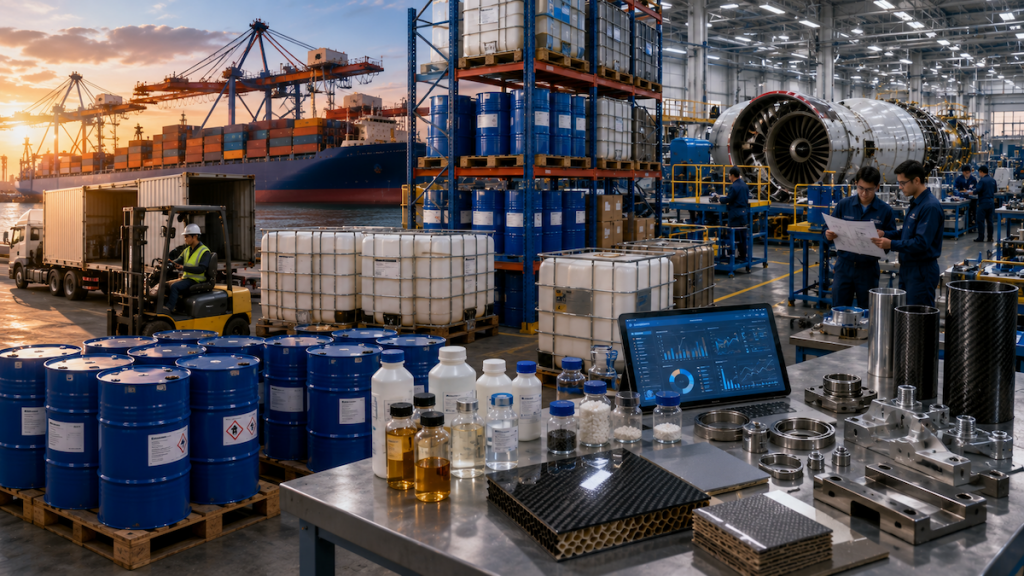
The final group includes accounts that may not always be the largest direct end users, but they matter for channel access, custom formulation, seasonal demand, specialized applications, or long-term market positioning.
Agrochemical and Agricultural Input Distributors
Agrochemicals may not be the first area people associate with Houston, but the region has distribution, formulation, export, and Gulf Coast logistics advantages. Houston-area companies may connect to fertilizer additives, crop protection inputs, adjuvants, biostimulants, micronutrients, neem oil products, enhanced-efficiency fertilizer inputs, and specialty formulation ingredients.
The buyer logic here is often seasonal, regulatory, and channel-driven. A sales team needs to understand whether the company is a formulator, manufacturer, distributor, retail location, agricultural service provider, or logistics-connected supply chain player.
Houston Specialty Chemicals LLC gives sales teams a small-to-mid-sized example of an agrochemical and specialty formulation company in Houston. With an estimated 20–50 employees and $5–20 million in revenue, it represents a focused research path for custom blends, enhanced-efficiency fertilizer additives, and agrochemical formulation inputs. Its market coverage includes agrochemical, oil and gas, mining, water treatment, and plastics.
Gulf Coast Ammonia provides a Gulf Coast ammonia production reference rather than a typical crop-input distributor example. The Texas City facility is expected to operate at roughly 100–200 employees at full scale, with a facility value above $1 billion. Its relevance depends on the supplier’s product category. A company selling process chemicals, catalysts, water treatment products, emissions-control chemicals, or plant operations support would research it differently from a company selling crop-input ingredients.
Nutrien Ag Solutions’ Houston location helps show how large agricultural input companies may have local distribution relevance without local procurement control. Nutrien has around 27,000 employees globally and reported roughly $30 billion in 2024 revenue. The Houston location represents regional distribution and retail activity rather than a full corporate procurement center. Sales teams should verify whether decisions for fertilizers, crop protection products, micronutrients, adjuvants, and seed treatments are made locally, regionally, or through broader Nutrien procurement channels.
Helena Agri-Enterprises’ Houston/Waller specialty location gives suppliers another view of how national agricultural input companies manage specialty products in regional markets. Helena has more than 4,000 employees nationally and estimated revenue above $8 billion. The local specialty facility helps sales teams understand regional product support, manufacturing, distribution, or technical services around crop protection products, adjuvants, plant nutrition, and application technology.
Agrochemical and agricultural input companies should be researched with seasonality and channel structure in mind. Crop cycles, fertilizer pricing shifts, product registrations, biological product launches, enhanced-efficiency fertilizer demand, distribution expansion, export activity, and agricultural partnerships all affect timing. The buying conversation may start with specialty product managers, formulation plant managers, supply chain directors, agronomy managers, procurement managers, or technical services teams.
Aerospace and Advanced Manufacturing Companies
Aerospace and advanced manufacturing is the most strategic and least obvious part of this article. These accounts may not buy the same chemical volume as refiners, oilfield service providers, or water treatment companies, but the technical requirements are often much higher.
Possible specialty chemical use cases include precision cleaning solvents, high-purity chemicals, space-grade adhesives, specialty coatings, composite materials, corrosion inhibitors, thermal protection materials, lubricants, life-support-related chemicals, propellant-related materials, and advanced manufacturing inputs.
This area requires a careful approach. A general supplier pitch is unlikely to work. Sales teams need to research quality systems, documentation requirements, aerospace standards, supplier qualification, contractor networks, and technical fit.
NASA Johnson Space Center should be treated more as an ecosystem anchor than a standard commercial buyer. The center supports around 15,000 civil service and contractor employees, and its annual budget is estimated at roughly $4 billion to $5 billion. Its relevance comes from human spaceflight, mission control, research, contractor networks, space systems, and materials-related programs. For specialty chemical suppliers, NASA is most useful for mapping the Houston aerospace ecosystem and contractor base before building a target list.
Axiom Space gives sales teams a view of Houston’s commercial space infrastructure market. At roughly 300–500 employees and a valuation above $1.5 billion, the company represents a technically demanding account type where outreach should be tied to manufacturing needs, quality standards, program milestones, or specialized material requirements. The strongest supplier angles are likely to sit around space-grade adhesives, thermal protection coatings, composite materials, life-support chemicals, and high-purity solvents.
Intuitive Machines represents another Houston-based commercial space manufacturing and engineering account type. With an estimated 300–500 employees and 2024 revenue in the $100–300 million range, it gives suppliers a way to study lunar systems, aerospace components, precision cleaning, thermal protection, composite materials, and specialty lubricants. Its work in lunar landers, spaceflight systems, navigation, communication systems, and aerospace engineering makes technical fit especially important.
Solugen stands apart because it is itself an innovative specialty chemical producer. At roughly 200–400 employees and a valuation above $2 billion, the company may function as a potential customer, partner, competitor, or market signal depending on the supplier’s product category. Its bio-based chemistry platform and aerospace, defense, industrial, and coatings applications point toward sustainable corrosion inhibitors, coatings, metal protectants, industrial cleaning agents, hydrogen peroxide alternatives, and advanced specialty chemicals.
Aerospace and advanced manufacturing accounts usually require the most careful qualification. Contract awards, mission milestones, Houston Spaceport expansion, funding rounds, facility buildouts, quality certifications, defense-related projects, and new material partnerships all make an account more worth reviewing. The most useful contacts may include supply chain leaders, materials and process engineers, manufacturing directors, quality assurance managers, procurement directors, heads of manufacturing, and technology leaders.
How Sales Teams Can Prioritize the Houston Market
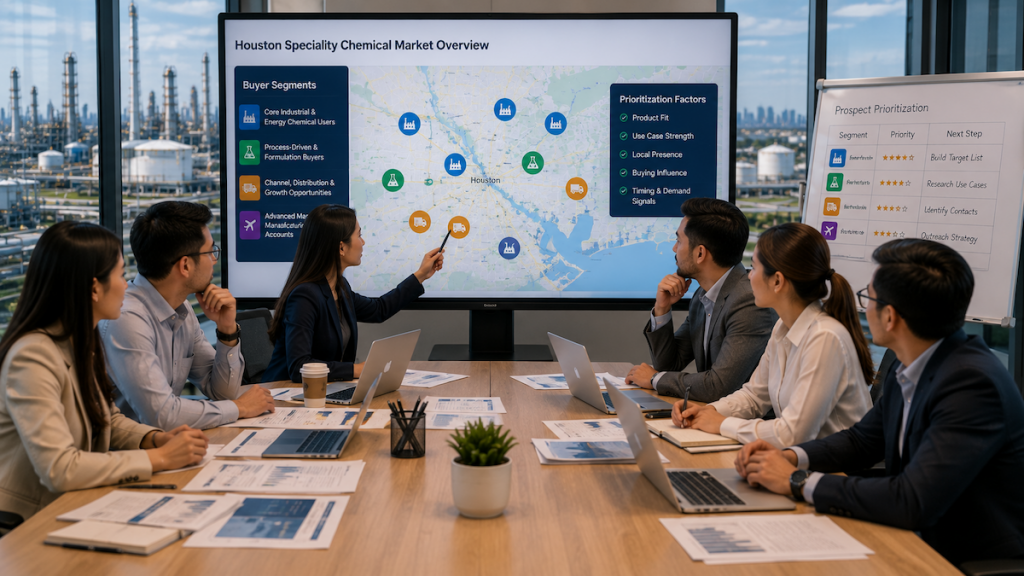
The largest companies are not always the best first targets.
Refiners and petrochemical operators represent some of the biggest chemical demand in Houston, but they are usually longer-cycle accounts. They are better suited for suppliers with technical proof, existing references, safety documentation, and the patience to work through plant-level or corporate qualification.
Oilfield service companies are attractive because chemical use is close to field performance. Large companies such as Halliburton and Baker Hughes may require a longer path, while mid-market formulators, sourcing companies, and regional chemical suppliers are often more practical for early outreach.
Water treatment providers, coatings manufacturers, I&I cleaning formulators, plastic additive companies, and toll blenders are especially useful for suppliers that want clearer use cases and more accessible buyer conversations. These companies often connect raw materials directly to product formulation, service delivery, or customer-specific programs.
Agrochemical distributors and aerospace companies need more careful qualification. Agrochemical demand is seasonal and channel-driven. Aerospace demand is technical and standards-driven. Both are valuable, but they may not be the right first area for every supplier.
A practical first account list should be built around product fit. A corrosion inhibitor supplier might research refineries, oilfield production chemical companies, coatings manufacturers, water treatment firms, and aerospace metal protection applications. A surfactant supplier might research oilfield service companies, I&I cleaning formulators, agrochemical companies, and toll blenders. A polymer additive supplier might focus on plastic compounders, elastomer manufacturers, coatings companies, and specialty formulators.
What to Verify Before Outreach
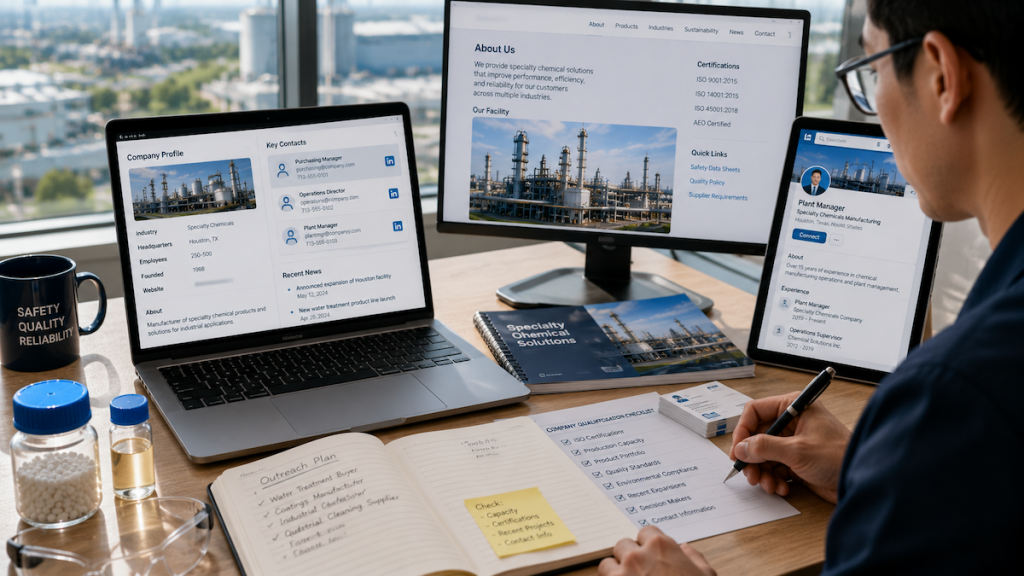
Before reaching out, sales teams should confirm the company’s Houston-area relevance, role in the chemical value chain, and likely decision path. A headquarters, plant, technology center, warehouse, branch office, franchise location, or regional service operation can all matter, but they do not create the same sales opportunity. A direct plant operator, formulator, toll blender, distributor, service provider, equipment contractor, and ecosystem anchor should not receive the same message.
The next step is to connect the product to a specific use case. Specialty chemical outreach works better when it is tied to corrosion control, water treatment, process reliability, cleaning performance, additive formulation, polymer modification, crop input performance, surface protection, or high-purity manufacturing. Procurement is important, but technical buyers often shape supplier decisions. Process engineers, formulation chemists, plant managers, R&D leaders, technical directors, environmental managers, quality leaders, and operations teams may all influence evaluation.
The biggest mistake is building a broad Houston chemical list without segmentation. A list that includes a refinery, a water treatment provider, an agricultural distributor, a coatings applicator, and a space technology company may look impressive, but it will be hard to act on unless the buyer logic is clear. Sales teams should also avoid assuming that large accounts are always the best starting point, confusing local presence with local procurement relevance, or using the same message across all segments.
How Futern Helps Turn Market Research Into Outreach
A broad category like Houston specialty chemical buyers quickly becomes too wide for manual research.
Futern helps B2B sales teams separate a broad market into clearer account groups. One list might focus on refiners and petrochemical operators. Another might focus on oilfield chemical service companies. A third might cover water treatment providers, coatings manufacturers, toll blenders, cleaning chemical formulators, or advanced manufacturing companies.
After the market is segmented, Futern helps teams enrich company information, check Houston-area relevance, review websites and LinkedIn profiles, identify likely decision-maker roles, and shape outreach angles by use case.
This matters because specialty chemical sales usually depend on context. The same product may need a different message depending on whether the account is a plant operator, formulator, distributor, service provider, or technical manufacturer.
The goal is to move from a broad market idea to a focused prospecting workflow. Sales teams can identify relevant buyer groups, find company examples, verify local relevance, enrich company details, research contacts, adjust messaging by segment, and turn research into outreach that is easier to test.
Conclusion
Houston is a strong specialty chemical market because demand appears across energy, petrochemicals, oilfield services, water treatment, coatings, plastics, cleaning, agriculture, and advanced manufacturing.
Finding chemical-related companies is usually the easy part. The harder work is deciding which companies match the supplier’s product, sales cycle, technical strengths, and outreach strategy.
For B2B sales teams, the best starting point is usually a focused segment rather than a large mixed list. Once buyer groups are separated by use case, facility relevance, chemical demand type, and decision-maker roles, the Houston market becomes easier to research and easier to act on.
Specialty Chemical Innovators in Houston
Futern AI Engage Update: Now It Reads, Remembers, and Rewrites