Southern California Handbag Manufacturers: A B2B Supplier Guide
by Yu T
Map Southern California handbag manufacturers for leather, hardware, and packaging suppliers.
Searching for handbag manufacturers in Southern California sounds like a straightforward way to build a B2B prospect list. The results quickly become complicated. A search might surface a Downtown Los Angeles workshop, an Orange County handbag factory, a Long Beach development business, a San Diego leather-goods studio, a component wholesaler, an importer, or a fulfillment provider. All have a connection to the regional handbag industry, yet they influence different commercial decisions.
The most useful way to read this market depends on what the supplier sells. A leather producer needs to know who selects material grades, finishes, colors, and minimum quantities. A zipper or hardware vendor needs to follow the specification from sample development into production. A packaging provider needs to look beyond the factory and identify where finished goods are labeled, stored, distributed, and prepared for retail or e-commerce.
Each supplier category therefore requires a different company list, research method, decision-maker path, and set of timing signals.
This guide examines Southern California through those three supplier views. Most company examples are local handbag or leather-goods manufacturers. A smaller group consists of component suppliers, importers, wholesalers, or fulfillment providers that influence the wider supply chain. The distinction matters because local relevance does not automatically indicate local manufacturing.
The companies below are research examples selected from information reviewed in July 2026, including public company materials, business directories, local activity, and potential relevance to different supplier categories. Their inclusion does not indicate current purchasing demand, active supplier relationships, or buying intent.
Before outreach, verify facility locations, production responsibilities, purchasing ownership, product fit, and decision-maker roles. Employee and revenue figures are directional estimates from Futern, business databases, or public records rather than confirmed factory headcounts or audited financials. Their company-wide or facility-level scope should be checked separately. Where reliable estimates remain unavailable, this guide uses production minimums, facility size, inventory levels, years in business, and other operating-scale signals.
What Does “Manufacturer” Mean in This Market?

The focus keyword covers several operating models. Some companies run local factories or workshops. Others manage product development in Southern California while dividing production between local and international facilities. Brand manufacturers often control design, material approval, component selection, and packaging while selling directly to consumers. Contract manufacturers work behind other brands. Wholesalers, importers, and fulfillment providers enter after production or support the production base with materials and services.
Each model matters to a different supplier.
A company with cutting, skiving, sewing, embossing, assembly, and quality-control capabilities is a direct production prospect for leather, hardware, machinery, tools, adhesives, thread, and related inputs. Development businesses may consume less material while holding substantial influence over the bill of materials. Brand manufacturers frequently approve visible materials, finishes, hardware, packaging, and sustainability standards. Wholesalers and fulfillment operators have less influence over product construction but often control labels, cartons, protective materials, and warehouse processes.
Geography adds another layer. Los Angeles County has the strongest concentration of contract production, development, material supply, wholesale, and logistics activity. Orange County and San Diego add smaller but distinct manufacturing and workshop nodes, while Valencia and City of Industry extend the map into fulfillment and wholesale operations.
Instead of asking whether every search result is a handbag manufacturer, sales teams can ask a more useful question:
Does this company influence the decision connected to our offer?
Supplier View One: A Leather Producer Looking for Specification Influence

Imagine a leather producer entering Southern California with full-grain hides, specialty finishes, traceable sourcing, or lower-impact tanning options. The obvious target is a factory, but material decisions often begin before full production.
Designers choose hand feel and color. Development teams test thickness, skiving behavior, edge finishing, folding, and stitch performance. Contract manufacturers evaluate whether a material performs consistently on their equipment. Brands set documentation, origin, and sustainability requirements. Local leather dealers influence what smaller workshops are able to sample quickly.
The leather supplier therefore needs to map specification influence as well as physical consumption.
LTHR WRKS: Material Sourcing and Private-Label Production
LTHR WRKS is a small artisanal leather manufacturing facility and brand in East Hollywood. It specializes in private-label leather goods and offers product development from material sourcing and sampling through finished production. This operating model places the workshop close to both early material decisions and production feasibility.
A third-party company profile places LTHR WRKS in the 1–10 employee range and lists 2018 as its founding year. The workforce figure is directional, while the company's own description of a small facility supports a workshop-scale profile. Its craftsmen are reported to have more than 25 years of experience each, adding production context without implying a large factory team.
For a leather producer, LTHR WRKS provides a route into projects where material selection, sample execution, and private-label manufacturing overlap. Relevant discussions could cover hide availability, special finishes, sample quantities, yield, skiving and stitching behavior, lot continuity, and replenishment once a design moves beyond development.
Before prioritizing LTHR WRKS, suppliers should verify whether it buys leather directly, sources on behalf of clients, or works with client-nominated materials. Founder, product-development, and production contacts are likely to influence different parts of the approval process.
McCabe DTLA: Where Material Becomes a Production Sample
McCabe DTLA identifies itself as a handbag design and manufacturing business in Downtown Los Angeles. Its stated capabilities include concept development, specification and pattern creation, cutting, skiving, splitting, assembly, sewing, embossing, and quality control across leather, canvas, vegan leather, exotic materials, and other textiles.
McCabe DTLA appears in the estimated 1–10 employee range, consistent with a focused independent development and manufacturing operation. The figure describes company scale rather than an exact production headcount.
For a leather supplier, McCabe’s processes raise concrete questions about skiving consistency, finish performance during folding and sewing, thickness suitability, and lot repeatability when a sample advances into production.
McCabe is worth studying because it can influence both material feasibility and sourcing decisions. Sales teams need to establish whether the company recommends materials to clients, purchases on their behalf, or receives completed specifications. Owners and production managers guide supplier approval, while pattern makers and product-development staff shape material feasibility.
CASUPO: Sustainability and Cross-Border Production
CASUPO is a founder-led leather-goods business based in Long Beach. It sells its own products and offers design, development, consulting, corporate-gift, and recurring production services. Its public materials point to production activity in the United States and Mexico.
With an estimated team of 1–10, CASUPO has the profile of a compact core business coordinating development and cross-border production. The figure may not include all workers or production partners involved outside Long Beach.
This profile changes the leather pitch. General claims about premium quality are unlikely to be enough. A credible approach requires traceability, tanning documentation, restricted-substance information, yield consistency, origin details, and evidence supporting environmental claims. Cross-border production also raises questions about delivery location, approval authority, and material availability across facilities.
Start by confirming how work is divided between Long Beach, other U.S. production resources, and Mexico. Founder-level direction establishes the sourcing approach, while development and production teams evaluate material fit.
Mascorro Leather: An Established Los Angeles Manufacturer
Mascorro Leather is a domestic leather-goods manufacturer located in the Los Angeles area. Its CFDA listing describes approximately 50 years in business, production minimums of 50–100 pieces, and services including material sourcing, pattern making, sample making, cutting, and sewing for handbags, belts, bags, wallets, key fobs, and other leather goods.
With an estimated workforce of 51–200, Mascorro Leather has a broader organizational profile than the smaller workshops in this group. The range is company-level and does not represent a confirmed count at one production site.
Its long operating history, company-size range, and stated production minimums point toward a more structured supplier conversation. Relevant factors include lot consistency, lead time, commercial terms, defect tolerance, documentation, replenishment, and the proportion of production devoted to handbags.
Priority depends on current capacity, sourcing practices, material requirements, and category volumes. Purchasing and material-sourcing roles guide supplier selection, while production and operations teams evaluate performance.
Prioritizing Leather Prospects by Specification Influence
An initial leather list should contain both specification influencers and production users. McCabe DTLA and CASUPO illustrate development-stage influence. Mascorro represents established domestic production. LTHR WRKS offers a workshop-scale route combining material sourcing, development, and private-label production.
Useful timing signals include a new collection, a shift toward domestic or nearshore production, new sustainability language, expansion into leather accessories, or hiring connected to sourcing and development. These signals provide outreach context without establishing current purchasing intent.
The relevant decision-makers vary by operating model. Owners often control sourcing in small workshops, while established manufacturers divide responsibility among production, purchasing, operations, quality, and development. Understanding the approval process is more useful than applying one job title to every company.
Supplier View Two: A Hardware Vendor Following the Sample
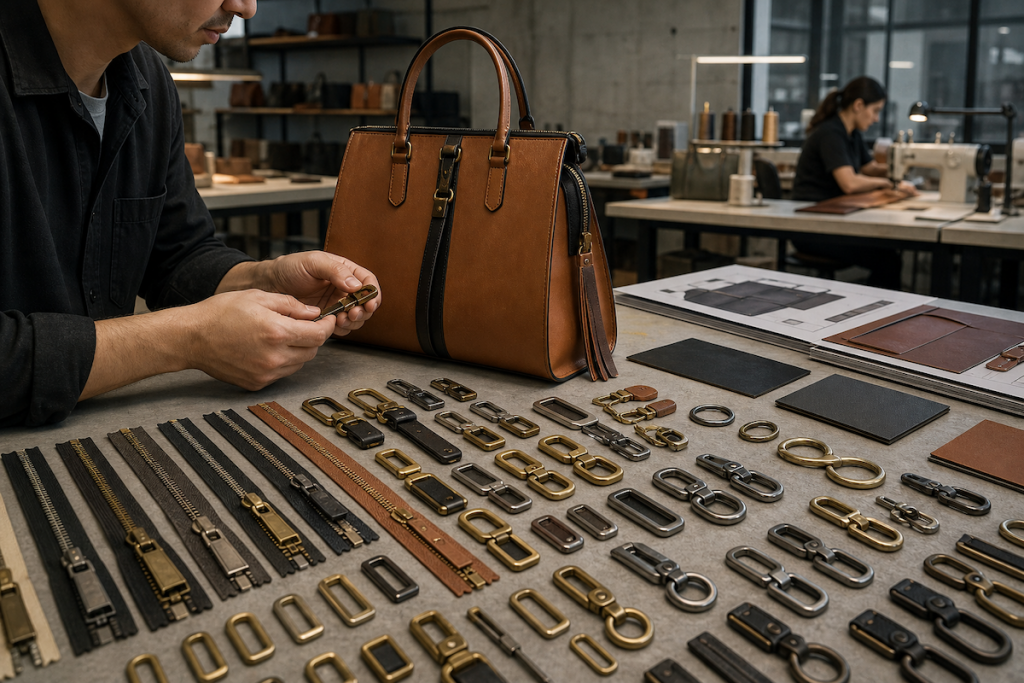
A supplier of zippers, zipper pulls, magnetic closures, D-rings, clasps, buckles, rivets, chains, or custom metal components should begin with the sample-development process.
A component might be selected for appearance, rejected for manufacturability, changed to meet cost targets, and replaced again when production volume rises. Creative teams care about shape, finish, color, and brand identity. Development teams focus on dimensions and compatibility. Factories evaluate assembly speed, consistency, breakage, and replenishment. Quality teams often require testing for plating, corrosion, pull strength, or repeated use.
The hardware vendor needs to identify who controls the specification at each stage.
Viva Bags of California: Small-Batch Handbag Production
Viva Bags of California is a downtown Los Angeles handbag and belt manufacturer that has operated since 1981. It produces its own Viva Bags line and works for other designers, using leather, vinyl, and additional fabrics. Its services include pattern making, sample making, cutting, and sewing.
The CFDA production directory lists nine employees, prototype and sample minimums of 1–10 pieces, and production minimums of 10–50. Those figures indicate a compact production team suited to sample development and limited runs. They also give suppliers a practical basis for discussing low minimums and project-level component requirements.
Hardware decisions may enter during pattern development, sampling, and preparation for production. Relevant supplier angles include zippers, buckles, closures, rivets, coordinated finish families, and quick access to components for prototype revisions. A small-batch workflow places particular weight on sample availability and manageable order quantities.
Before outreach, suppliers should confirm whether Viva Bags sources components directly, follows specifications from designer clients, or uses both approaches. Ownership and production roles may guide commercial selection, while pattern and sample staff evaluate fit, finish, and construction feasibility.
Lefty Production Co.: Hardware Through a Full-Service Project
Lefty Production Co. provides design, development, sourcing, production, and packaging for soft leather and fabric bags, wallets, passport holders, luggage tags, apparel, uniforms, swimwear, activewear, and other sewn products.
Operating in the estimated 11–50 employee range, Lefty has the profile of an independent full-service manufacturer whose category mix extends beyond handbags.
For hardware suppliers, the product variety matters. A zipper suited to a soft pouch has different performance requirements from a closure for a structured handbag or travel accessory. Lefty’s full-service model introduces both the manufacturer and the brand client into the specification process.
Supplier angles include low development quantities, coordinated finish families, rapid sample delivery, custom pulls, branded components, and stable replenishment. The first qualification question is whether Lefty maintains preferred component sources or follows hardware specifications supplied by brand clients.
Zip-Up Zipper Unlimited: A Local Component Channel
Zip-Up Zipper Unlimited is a Los Angeles supplier of zippers, buckles, buttons, snaps, hooks, webbing, trims, and related hardware. It is a specialist component business rather than a handbag manufacturer.
Reliable employee and revenue data are unavailable, but the company states that it holds more than 100,000 zippers in stock, including products from brands such as YKK, Riri, and Lampo. Inventory breadth is a more relevant scale indicator for this business than an unsupported workforce estimate.
Its role belongs in the regional supply-chain map because manufacturers and development teams often depend on nearby component availability during sampling and short-run production. For an upstream hardware producer, the commercial discussion centers on assortment gaps, wholesale terms, special orders, brand positioning, stock availability, and demand across the distributor’s customer base.
Before outreach, confirm the brands already carried, main customer groups, volume discounts, custom-order capabilities, and the process for adding product lines. Ownership and wholesale management guide assortment decisions, while sales staff provide insight into customer demand.
KILLSPENCER: Brand Identity and Local Workshop Production
KILLSPENCER combines a premium leather-goods brand with a Los Angeles workshop. The company describes products as designed in California and continues to document items handcrafted in its Los Angeles workshop.
Available company profiles place KILLSPENCER in the 11–50 employee range overall, while a separate headquarters profile appears in the 1–10 range. The workshop team itself may therefore be smaller than the company-wide estimate.
Here, hardware supports brand identity as well as function. Finish, tactile quality, durability, and visual consistency matter alongside production efficiency. Custom buckles, premium zippers, technical closures, and coordinated metal finishes offer a more relevant story than a broad commodity catalog.
Qualification should cover the product categories produced locally, specification process, testing expectations, production quantities, and use of direct or distributor-based sourcing. Founder and design roles shape appearance, while product-development, production, and sourcing teams evaluate feasibility and continuity.
Where Hardware Outreach Should Start
Viva Bags and Lefty provide routes into client projects during design and development. KILLSPENCER represents a brand-led workshop where components contribute to product identity. Zip-Up Zipper provides channel access to a broader local production base.
Outreach should reflect the company’s role. Development and manufacturing businesses often respond to sample access, finish choices, technical compatibility, and replenishment. Brand workshops weigh differentiation and consistency. A distributor needs a commercially viable assortment, reliable stock, and evidence of downstream interest.
Relevant timing signals include new handbag categories, changes in metal finishes, product-development hiring, new collaborations, wholesale expansion, or a move into travel and performance bags. Suppliers still need to verify whether the local company controls the specification or follows instructions from another party.
Supplier View Three: A Packaging Provider Starting After Production

The third supplier enters after the bag is made. It sells protective sleeves, tissue, dust bags, labels, hangtags, branded inserts, retail cartons, shipping boxes, return packaging, or warehouse packing materials.
For this supplier, a factory-only list leaves out much of the market. Packaging decisions often sit with manufacturers, brands, importers, wholesalers, distribution centers, or fulfillment providers. Product presentation and shipping protection can also be controlled by different organizations. A brand might specify the premium dust bag while a warehouse or fulfillment provider chooses the outbound carton and packing process.
The packaging supplier needs to trace where finished goods become inventory and where orders are prepared for the next destination.
Fashion Distribution Center: Import and Wholesale Flow
Fashion Distribution Center Inc. operates through the La Terre Handbags business in City of Industry. Public company information describes a wholesale-only handbag operation specializing in vegan leather products distributed from a Los Angeles-area warehouse.
The business has operated since 2010. A third-party company estimate places the La Terre brand profile in the 1–10 employee range, with estimated revenue below $5 million. These figures should be treated as external estimates because the brand and its operating company may be recorded separately.
It belongs in the regional distribution map rather than the local manufacturing group.
Its operating model still makes it relevant to packaging suppliers. Imported finished goods often require labeling, inspection, protective packaging, master cartons, warehouse supplies, or repacking for wholesale customers. Each workflow creates a different supplier conversation.
Before prioritization, determine import volumes, local warehouse functions, customer requirements, supplier countries, and where packaging specifications originate. Import and purchasing teams guide commercial requirements, while warehouse and operations roles control local execution.
Harveys: Manufacturing, Brand Presentation, and Fulfillment
Harveys has manufactured handbags and accessories in Southern California since 1997. The company states that its bags are made in its workshop near Downtown Santa Ana, with design, production, and retail functions under one roof.
At an estimated 11–50 employees, Harveys operates on a larger scale than the region's smallest workshops while keeping design, production, and retail closely connected.
Harveys gives packaging suppliers a locally manufactured, brand-controlled example. Its product releases, direct-to-consumer model, collaborations, retail activity, and in-house operations connect packaging decisions to both product presentation and fulfillment execution.
Potential angles include protective materials, branded inserts, limited-edition packaging, labels, shipping cartons, and sustainable alternatives. Product and brand teams shape presentation, while e-commerce, warehouse, and operations teams influence shipping materials.
Tops Handbag: Wholesale Inventory and Private-Label Flow
Tops Handbag is a Vernon-based manufacturer and wholesaler of vegan-leather handbags. Established in Los Angeles in 2004, the company combines in-house design and private-label development with production through its own factory in China. It also operates the Alyssa, Kayla Ava, and A.O.T.A. handbag brands.
The company's LinkedIn profile lists 11–50 employees and reports an 80,000-square-foot Los Angeles warehouse holding 300,000–400,000 units of inventory. It also states that the China factory can produce more than 200,000 handbags per month. These company-reported figures provide useful indicators of packaging throughput, although current capacity and inventory should still be verified before outreach.
Packaging priorities center on protective bags, labels, shipping cartons, inspection or repacking materials, branded inserts, retailer-compliance labels, and specifications tailored to private-label customers.
Qualification should establish which packaging specifications are set at the China factory and which materials are selected or added at the Vernon warehouse. Operations, warehouse, purchasing, and private-label development contacts may each influence different requirements, from case packing and relabeling to branded presentation.
AMS Fulfillment: Packaging at Operational Scale
AMS Fulfillment is a large third-party logistics provider headquartered in Valencia, with an estimated 501–1,000 employees.
The company reports more than one million square feet of warehouse capacity across its national network and serves e-commerce, retail, wholesale, apparel, and fashion-accessory clients. Its value here comes from fulfillment and packaging operations rather than handbag manufacturing.
Its scale shifts the discussion toward repeatable warehouse execution. Packaging fit depends on packing speed, storage efficiency, product protection, sustainability, barcode workflows, retail compliance, brand-specific instructions, and compatibility with manual or automated processes.
The key checks are whether relevant handbag or accessories clients are handled at its Southern California facilities, who owns the packaging specification, and whether brands nominate materials. Operations and warehouse management oversee execution, while procurement, client services, and packaging specialists influence selection.
Packaging Priorities by Operating Role
Fashion Distribution Center and Tops Handbag illustrate importer and wholesale logic. Harveys combines local manufacturing, brand control, retail, and direct fulfillment. AMS represents a service-provider route where packaging performance affects daily warehouse execution.
Premium boxes, dust bags, branded inserts, and limited-edition presentation materials align more closely with brand and product teams. Shipping cartons, void fill, labels, and packing-station supplies fit warehouse and fulfillment operations. Compliance labeling and case-pack solutions are more relevant to importers and wholesale distributors.
Signals worth monitoring include a new product collaboration, fulfillment partner, e-commerce expansion, retail-channel growth, warehouse hiring, packaging redesign, or sustainability commitment. These developments can explain why a conversation is timely without establishing current demand.
Manufacturers That Influence More Than One Supplier Map
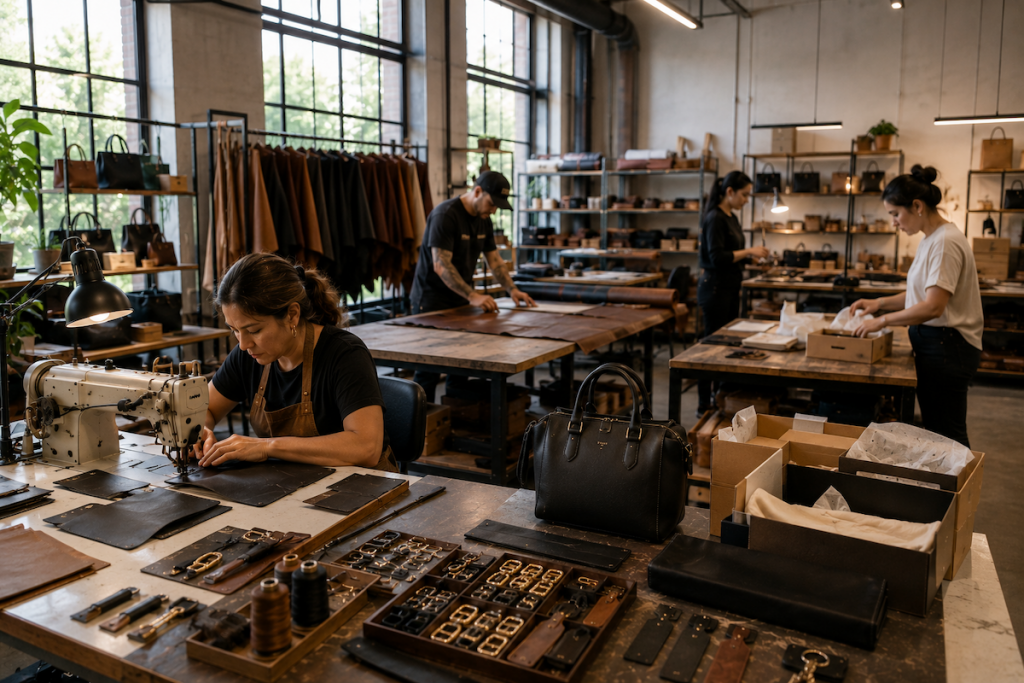
Some Southern California businesses perform several functions. A company can influence leather, hardware, packaging, and fulfillment decisions for different reasons.
Lalaland Production & Design
Lalaland Production & Design is a Los Angeles manufacturer of handbags, footwear, and small leather goods. Its estimated 11–50 employees support product development and production across several categories.
Its public company information describes more than 25 years of industry experience, while supplier directories identify a Los Angeles production facility covering more than 60,000 square feet. Its services include product development, pattern making, sample production, leather-goods manufacturing, footwear manufacturing, and local production for designers and established fashion businesses.
The facility size and employee range describe different aspects of the operation. The 60,000-square-foot figure reflects physical production capacity, while the employee range provides only a broad company-level estimate.
Leather vendors can study its material standards, hardware suppliers its technical approval process, and packaging suppliers its finished-product presentation. Supplier research must isolate the relevant service, production location, capacity, client relationship, and decision authority.
Leatherock
Leatherock designs and handcrafts leather belts, bags, bracelets, and accessories in San Diego. An estimated workforce of 11–50 places it between the region's smallest workshops and larger structured manufacturers.
The business was established in 1983, giving it more than four decades of operating history. Its product range includes leather bags, belts, decorative accessories, stones, conchos, and embellished products.
Its bag and accessory range creates possible angles for leather, decorative hardware, stones, conchos, straps, labels, and retail packaging. Suppliers need to verify which processes remain in-house, typical production quantities, seasonal collection timing, and whether material decisions sit with design, production, or ownership.
Coronado Leather Co.
Coronado Leather Co. was established in 1981 and operates a leather-goods factory in the San Diego area alongside artisan production in Mexico.
Coronado Leather's estimated 1–10 employee range is consistent with its description of the U.S. operation as a small, dedicated team. The figure may not capture production workers or partners based in Mexico.
The company produces luggage, duffels, backpacks, messenger bags, wallets, belts, jackets, and other leather goods.
Leather suppliers can study local production use, hardware vendors can investigate durability and design standards, and packaging companies can examine premium presentation and direct-to-consumer shipping. The correct contact depends on the offer and the location responsible for the relevant product category.
Seam Reap
Seam Reap is a San Diego leather-bag brand that states its bags are made in-house. Its operating model emphasizes handcrafted, small-batch production.
With an estimated team of 1–10, Seam Reap has a workshop-scale profile. Its products are sold through its own e-commerce operation and selected independent retail stockists.
The company gives suppliers a view of workshop-scale manufacturing where design, material selection, hardware, customization, production, and brand presentation remain closely connected. Leather, lining, decorative component, packaging, and small-quantity service providers each have a different research angle.
These hybrid manufacturers require precise qualification. Sales teams need to document the function relevant to the product, the location where that function occurs, current production scale, and the person likely to influence the decision before assigning a company to a prospect group.
How to Read the Southern California Map
Los Angeles County contains the widest range of reviewed roles: leather supply, product development, contract manufacturing, component distribution, handbag wholesale, and fulfillment. Downtown Los Angeles remains especially important because suppliers and production services operate in close proximity.
Long Beach contributes leather-goods development and cross-border production management through CASUPO. City of Industry adds handbag import and wholesale activity. Valencia extends the map into large-scale fulfillment and packaging operations.
Orange County contributes Harveys, an established Santa Ana handbag manufacturer with design, production, retail, and direct-to-consumer operations under one roof.
San Diego adds Coronado Leather, Leatherock, and Seam Reap. These businesses represent different forms of leather-goods manufacturing, from an established company with cross-border production to smaller in-house workshops and brand manufacturers.
The companies reviewed for this guide do not provide enough evidence to describe Riverside or San Bernardino as established handbag-manufacturing clusters. Those counties could still matter for logistics or individual workshops, but additional facility-level evidence is needed before assigning them a larger role.
Southern California works best as a supply-chain research boundary. Manufacturing density varies substantially across the region.
Three Starting Lists From the Same Research Set

An initial prospect list can remain small. Twelve well-qualified companies offer more sales value than a mixed list of every handbag-related business in the region.
A leather or alternative-material supplier could begin with LTHR WRKS, McCabe DTLA, CASUPO, and Mascorro Leather. The group covers material sourcing, development influence, sustainability positioning, cross-border production, and established Los Angeles manufacturing.
For zippers, closures, and hardware, Viva Bags of California, Lefty Production Co., Zip-Up Zipper, and KILLSPENCER provide four different routes into the market. They represent small-batch handbag manufacturing, client-led development, local component distribution, and brand-controlled workshop production.
Packaging and fulfillment suppliers could initially review Fashion Distribution Center, Harveys, Tops Handbag, and AMS Fulfillment. These businesses sit at different points in the finished-goods flow, including local manufacturing, importing, wholesale distribution, warehousing, and order fulfillment.
These companies provide research starting points. Final priority depends on facility type, operating role, product fit, production scale, and decision-maker influence.
Suppliers with flexible minimums often start with smaller studios and workshops. Vendors built for large repeat orders spend more time qualifying established manufacturers and logistics operations. A technically differentiated product can justify outreach to development teams even when immediate volume appears modest because specification influence begins early.
Five Questions Before Sending Outreach
1. What Is the Southern California Location?
Determine whether it is a factory, workshop, design studio, headquarters, showroom, store, warehouse, or branch. A local address confirms presence without establishing local production or purchasing authority.
2. Who Controls the Specification?
The factory often chooses production consumables while the brand controls visible materials and hardware. A development business often recommends both. A fulfillment provider typically controls shipping supplies while following brand instructions for presentation packaging.
3. Where Does Production Occur?
Some companies manufacture entirely in Southern California. Others divide work between local facilities and Mexico or use outside production partners. The answer determines whether outreach belongs with a local product team, a production partner, or another sourcing function.
4. Which Role Influences the Offer?
Relevant titles include owner, founder, product developer, sourcing manager, production manager, purchasing manager, materials buyer, operations director, warehouse manager, quality lead, and client-services director. Company scale and operating model guide the contact search.
5. What Makes the Outreach Timely?
A new product category, collaboration, facility change, sourcing statement, sustainability initiative, job opening, wholesale expansion, or fulfillment development provides a relevant reason to write. The signal needs a direct connection to the supplier’s offer and clear separation from assumptions about purchasing intent.
Answering these questions prevents common list-building mistakes: treating every brand as a factory, assuming every Southern California address represents local manufacturing, prioritizing the largest companies by default, and sending identical messages to workshops, manufacturers, distributors, and logistics providers.
How Futern Builds Different Views of the Market
Futern helps B2B sales teams turn a broad regional search into supplier-specific prospect groups. Teams review company descriptions, employee ranges, locations, websites, LinkedIn profiles, product categories, and manufacturing details.
Role and location mapping separates local manufacturers from development businesses, material suppliers, wholesalers, and fulfillment providers while documenting justified overlap. It also distinguishes factories from headquarters, showrooms, warehouses, stores, and service offices, helping teams trace where production and purchasing influence sit.
Company size adds context without revealing exact factory headcount, production capacity, or purchasing volume. MOQ, inventory depth, facility size, warehouse networks, and production structure often provide stronger qualification signals.
This evidence guides decision-maker research and outreach by use case. Leather producers lead with sample access, consistency, documentation, or traceability; hardware vendors address finishes, custom specifications, testing, and replenishment; packaging suppliers focus on presentation, protection, labeling, compliance, or fulfillment efficiency. The result is a focused prospect list whose assumptions remain clearly marked for verification.
Conclusion
Southern California has meaningful handbag and leather-goods manufacturing depth, especially in Los Angeles County, with additional production in Santa Ana, Long Beach, and San Diego. Component suppliers, importers, wholesalers, and fulfillment providers extend the opportunity across the wider supply chain.
Supplier priority should follow the product being sold. Leather producers trace material approval, hardware vendors follow specifications into production, and packaging providers locate where finished goods become inventory and orders. Company role, facility type, operating scale, production location, and decision authority then determine which businesses deserve deeper research and how outreach should begin.
Handbag Companies Specialists in Miami
B2B Lead Generation: From Prospecting to Qualified Pipeline
The Real Cost of Low-Quality Leads in B2B Sales
Explore more company and industry insights here.