Clothing Manufacturers NYC: How B2B Suppliers Should Read the Market
by Yu T
Map NYC apparel companies by role, supplier fit, and outreach priority.
Searching for clothing manufacturers in NYC looks simple at first. New York has a recognizable apparel history, a dense network of fashion companies, and visible production references across the Garment District, Brooklyn, Queens, and the wider metro area. For B2B suppliers, that makes the market attractive. It also makes the search term easy to misread.
The phrase "clothing manufacturers NYC" does not point to one clean category of companies. It can surface cut-and-sew factories, sample studios, pattern specialists, private label producers, uniform suppliers, wholesalers, brand offices, luxury labels, sustainable manufacturers, technology-enabled production partners, and companies that serve New York designers from nearby states. A fabric vendor, packaging supplier, equipment provider, software company, logistics partner, or compliance consultant needs to read those businesses through different supplier-fit questions.
The companies mentioned below are included as research examples based on public information, local relevance, operating model, company size, product categories, and possible use cases. Before outreach, sales teams need to verify facility details, purchasing needs, supplier requirements, and decision-maker roles. Company data reflects publicly available information as of July 2026.
This guide approaches the NYC apparel market as a supplier research problem. The central question is: what role does each company play in the apparel supply chain, and what type of buying influence might it have?
Why "Clothing Manufacturers NYC" Is a Hard Search Term to Use
A broad keyword search creates a mixed list. Some results describe companies that physically sew garments. Others describe production coordinators, brand owners, apparel wholesalers, design studios, sample rooms, or companies with New York-facing services but production elsewhere. That mix matters because each type of business influences suppliers in a different way.
A cut-and-sew factory often evaluates sewing equipment, maintenance services, cutting tools, trims, fabric, thread, quality systems, or local delivery support. A pattern studio can influence CAD tools, fit services, sample materials, tech pack software, and designer recommendations. A wholesale apparel group usually cares more about packaging, retail readiness, logistics, labeling, inventory systems, and category flow. A uniform supplier tends to prioritize durable fabrics, embroidery, bulk order consistency, compliance, and repeat delivery.
The search term also hides questions about geography. A New York address can represent a headquarters, Manhattan showroom, Brooklyn production studio, Queens facility, metro-area warehouse, or nearby New Jersey operation serving NYC brands. Local relevance is real, but local relevance does not automatically mean local purchasing authority.
For sales teams, the practical risk is building a long prospect list that looks relevant by keyword but is weak by supplier fit. A supplier selling denim hardware, activewear fabrics, CAD software, sustainable packaging, or uniform compliance support needs a different first list. The work starts with reading company roles.
The First Question: What Role Does the Company Play?
Start by sorting companies according to their role in the apparel value chain, then compare size, visibility, and local relevance. The same city can contain very different buying paths.
Production operators are closest to factory workflow. They often handle cutting, sewing, production management, technical execution, quality assurance, and delivery. Suppliers of fabric, trims, findings, sewing machines, cutting equipment, maintenance, production software, quality tools, and local logistics often begin here.
Product development studios influence the early stage of a garment. They typically handle patterns, grading, samples, fit, tech packs, designer support, and pre-production planning. Their purchase volume is often smaller, but they can shape material choices, development tools, and vendor recommendations before a brand scales.
Brand and wholesale organizations influence sourcing, packaging, retail readiness, category management, and distribution. They are not always the best first target for factory equipment, yet they matter for materials, accessories, labels, packaging, compliance, fulfillment, and product development services.
Uniform and contract program suppliers usually bring a more operational buying logic. They serve corporate, hospitality, team, government, or workwear needs. Their priorities often include durability, standardization, repeat orders, branding, lead time, inventory programs, procurement rules, and compliance documentation.
Sustainability or technology-enabled manufacturers introduce another influence path. These companies often evaluate traceable materials, organic fabrics, certification services, supply chain visibility, carbon measurement, AI-enabled planning, digital product development, or compliance tools. The decision-maker might sit in sustainability, technology, supply chain, innovation, or operations.
This role-based reading makes the market more practical. It helps a supplier decide whether a company belongs in an early outreach list, a long-cycle strategic research list, a partner ecosystem map, or a category-specific research pool.
Reading the NYC Apparel Map

NYC's apparel geography is compact, but the geography still changes prospecting priorities. Manhattan and the Garment District often point to design, sourcing, production coordination, sample development, brand offices, and long-standing apparel service providers. A company in this area can influence materials or production planning even when sewing happens elsewhere.
Brooklyn often surfaces boutique production, small-batch manufacturing, sustainable fashion studios, local maker communities, and hands-on development work. These businesses matter for small-order fabrics, sample-room tools, eco-friendly packaging, local delivery, design collaboration, and early-stage brand support.
Queens often fits full-service apparel production, private label work, and businesses that need more operational space than Manhattan typically allows. A Queens-based manufacturer is useful for studying performance fabrics, streetwear, activewear, private label production, and production coordination.
Nearby New Jersey deserves attention when a company serves NYC designers or brands. It can function as part of the broader New York apparel supply chain. The key is to verify whether the company has New York-facing sales, production management, sourcing influence, or designer relationships.
Use this map to guide research while keeping verification separate. A Manhattan address does not prove local production. A Brooklyn location does not guarantee factory scale. A nearby-state producer can still be relevant if it supports NYC fashion companies. Strong qualification combines geography with operating model, product category, and likely decision-maker path.
Company Examples by Buying Influence
Instead of treating the companies as a directory, it is more useful to group them by the type of supplier decision they might influence. This does not claim that any company is currently purchasing a product or service. The grouping helps sales teams separate possible supplier fit from keyword-level relevance before outreach.
Companies That May Influence Fabric and Trim Decisions
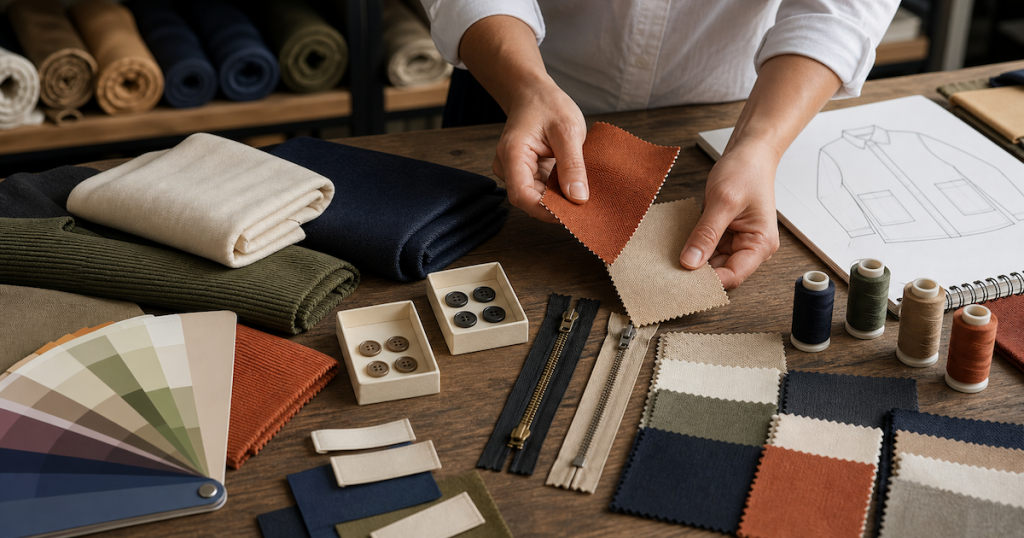
Fabric and trim suppliers usually need to know which companies touch design, sourcing, product development, production, or brand-facing apparel programs. The most relevant businesses are not always the largest. They are the companies where material choice, garment category, production workflow, or client specifications shape the conversation.
Apparel Production Inc. represents a long-established Garment District production model. Its 10-49-person operation, estimated in the $5M-$15M revenue band, handles men's, women's, and children's apparel from design through final production. For fabric, trim, sample-room, and quality-control suppliers, the company illustrates a full-cycle production environment where materials, development, and production coordination may overlap. The first qualification check is whether sourcing decisions sit locally, with client brands, or with domestic, nearshore, and overseas partners.
Fashion Designers Concepts, LLC is useful for studying customized apparel production across streetwear, loungewear, merchandise, and promotional products. At 11-50 employees and roughly $5M-$15M in revenue, the company sits in a size range where project variety and client customization are likely to shape supplier conversations. Relevant supplier angles include heavyweight cottons, fleece, embroidery, screen printing, labels, tags, and branded packaging.
InStyle USA illustrates a Queens-based full-service manufacturer working with private label and designer brands. Its smaller operating scale, roughly $2M-$10M in revenue, is tied to activewear, streetwear, and general apparel. That makes product-specific fit important. A performance fabric supplier might lead with recovery, hand feel, moisture management, or durability. A trim supplier might research sportswear-specific components, branding, and garment testing requirements.
Bliss Apparel Group, also associated with Vertical Apparel Group, operates at a 51-200 employee scale with a $10M-$50M revenue band. Its work across garment production, manufacturing management, quality assurance, trade compliance, logistics, wovens, knits, dyeing, and washing creates several material and production touchpoints. Fabric mills, finishing providers, trim vendors, dyeing-related suppliers, compliance software firms, and logistics partners would need different messages for this type of business.
For fabric and trim vendors, the first outreach list starts with garment type and influence path. A supplier of denim hardware, activewear fabric, sustainable cotton, or custom labels gains little from approaching every NYC apparel company. Priority belongs to companies whose product categories match the supplier's material strengths.
Companies That Point to Equipment or Factory Operations
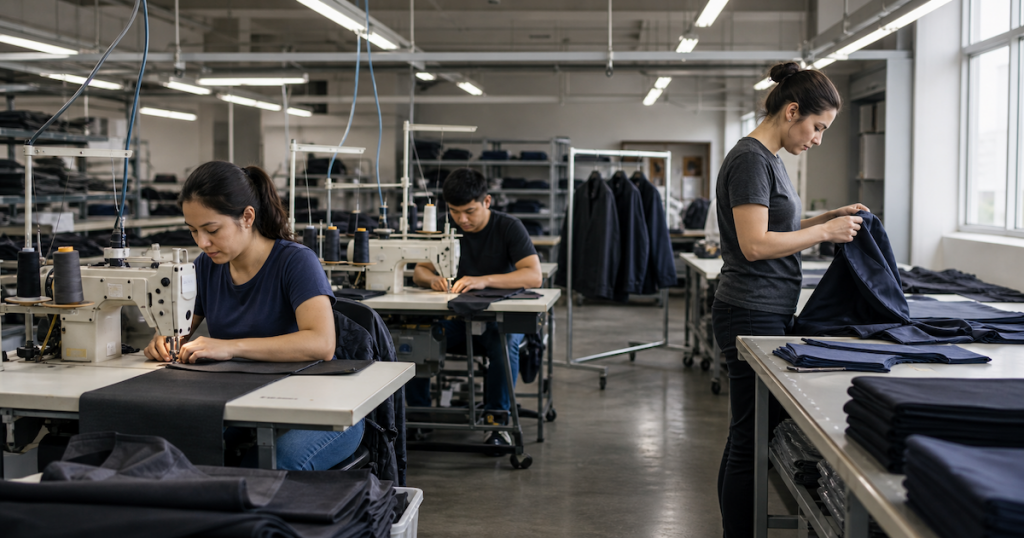
Equipment and operations suppliers gain more from companies with production workflow, factory activity, high-volume programs, or manufacturing management. The relevant question is whether the company owns, manages, or strongly influences production processes.
From an operations angle, Bliss Apparel Group is relevant again because its vertically integrated structure and quality assurance responsibilities point to a different supplier conversation than fabric or trim. Its 51-200 employee scale suggests a more complex organization than a small sample studio. Sewing equipment, production tracking, quality systems, compliance tools, cutting solutions, and logistics services may all require different internal conversations. Qualification depends on identifying which roles influence equipment decisions, facility processes, and vendor approval.
TAA Apparel represents a heritage factory profile. Active since 1978, its 10-49-person operation sits in an estimated $3M-$12M revenue range. That scale makes operational reliability, uptime, repair cycles, production consistency, and gradual modernization stronger outreach angles than trend-led brand messaging.
Ferrara Manufacturing represents a higher-volume uniform and government-contract profile. This mid-sized operation, estimated in the $10M-$40M revenue band, has experience with large uniform programs, full-scale production, government contracts, and high-volume cutting and sewing. Supplier angles may involve government-compliant fabrics, industrial equipment, uniform accessories, certification services, documentation, and logistics. Before outreach, confirm the procurement rules, compliance requirements, and supplier onboarding steps that apply.
Carina NY shows a different production logic. Its boutique-scale business, estimated between $1M and $5M in revenue, starts minimums at 12 pieces. Large capital equipment may be less natural than tools and services that support low-MOQ workflows, small-batch production, sample-to-run transitions, pattern grading, cutting room organization, and flexible production management.
Equipment-related prospecting works best when factory scale is separated from production influence. A smaller company can still influence tools and workflow, while a larger organization may route equipment decisions through a facility, operations team, owner, or external production partner.
Companies That Matter for Packaging, Logistics, and Wholesale Flow
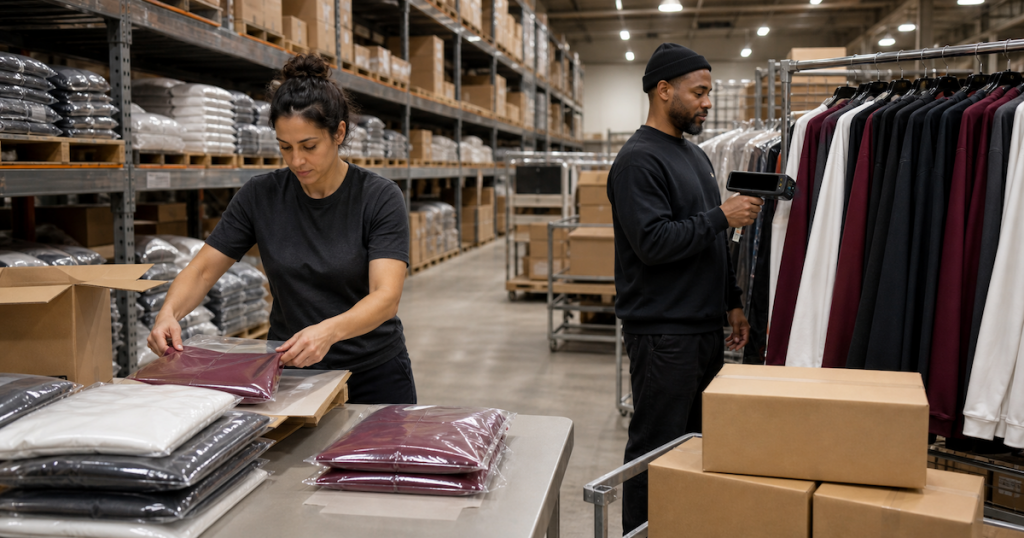
Packaging and logistics suppliers benefit from focusing on companies that manage wholesale distribution, retail programs, corporate apparel, multi-channel delivery, or branded product flow. These companies often influence labels, packaging, fulfillment, warehousing, seasonal peaks, and inventory systems even when they are not traditional factories.
Randa Apparel & Accessories operates at global scale, with 1,001-5,000 employees and an estimated revenue level above $500M. Its portfolio includes men's dress pants, tailored clothing, women's sportswear, belts, small leather goods, neckwear, hats, slippers, and seasonal accessories. For suppliers, Randa shows how a large apparel and accessories organization may create openings around category management, packaging, hardware, retail displays, global logistics, and inventory planning. The key is to identify the right product category or supply chain team rather than approach it as a simple local manufacturer.
IHL Group operates with 51-200 employees and an estimated $10M-$50M revenue range, a scale that supports wholesale and distribution complexity while still requiring category-specific supplier research. It combines apparel manufacturing and wholesale distribution for women's and children's apparel, making it relevant for fabric selection, product variety, children's apparel testing, packaging, labeling, e-commerce fulfillment, and wholesale readiness. The better message depends on whether the offer improves product development, safety, retail timing, packaging accuracy, or distribution support.
Mornington Corp provides a uniform and corporate apparel example. The business sits in the small-to-mid-sized range, with 11-50 employees and roughly $5M-$20M in estimated revenue, and specializes in corporate uniforms, hospitality wear, workwear, and team apparel. Packaging, embroidery, branding, bulk order logistics, uniform accessories, and corporate apparel platforms may all fit the company profile. Timing signals could include client program launches, hospitality demand, repeat order cycles, and service-level expectations.
Legasy Enterprises LLC sits at the smaller end of corporate apparel, with 1-10 employees and revenue under $1M. It points to a more relationship-driven buyer profile around branded apparel, logo services, embroidery, promotional product workflows, and small-run uniform support. For suppliers, this kind of business may require a concise message, smaller minimums, and clear value around client service rather than enterprise-level logistics.
Packaging and logistics companies can prioritize by channel flow. Wholesale apparel, uniform programs, accessories, merchandise, and corporate apparel each create different needs around labeling, presentation, storage, freight, delivery, and repeat order support.
Companies That Signal Sustainability, Traceability, or Compliance Fit

Sustainability, traceability, and compliance are not separate from apparel production. They influence material selection, supplier documentation, brand claims, audit readiness, and customer trust. For B2B suppliers, the key is to connect sustainability language to a verifiable use case.
Royal Apparel represents sustainable basics and knitwear production. Its multi-state, mid-sized operating profile and estimated $10M-$30M revenue range make sourcing authority an important verification point. The strongest supplier angles are likely to involve organic cotton, GOTS-certified fabrics, traceability support, eco-friendly packaging, and certification documentation. Sales teams should verify whether sourcing decisions sit with a New York office, another facility, or a central supply chain team.
MTI USA Inc. offers a technology-integrated sustainability profile. Its 11-50 employee size and estimated $5M-$15M revenue range suggest a focused business where traceable raw material sourcing and AI-supported sustainability platforms are central to positioning. This example helps suppliers study how blockchain traceability, AI supply chain tools, certification, carbon measurement, circular economy consulting, and R&D connect to apparel production. The likely buying influence may include innovation, sustainability, technology, supply chain analytics, and operations.
Seravine Sew is a premium ethical and sustainable apparel manufacturer in the 11-50 employee range, with estimated revenue of $2M-$10M. Its focus on jersey fabric garments and long-sleeve clothing makes premium jersey, ethical audit services, eco-friendly dyeing, sustainable certification, and fair trade compliance the more relevant supplier angles. The buying logic is likely to depend on quality, fabric feel, production transparency, and ethical positioning.
The Factory NYC adds a Brooklyn-based sustainable fashion production studio profile. As a small operation in the $1M-$5M revenue range, it handles small batches and larger collections with an emphasis on craftsmanship, sustainability, clear workflows, and hands-on collaboration. Practical supplier angles include organic fabrics, low-waste production tools, eco-friendly packaging, green certification services, and local logistics.
Strong sustainability outreach avoids broad claims and names the exact proof point: certified fabric, traceable raw material, audit support, production visibility, carbon measurement, packaging documentation, or a lower-waste workflow.
Companies That Influence Early Design and Sampling Decisions

Early design and sampling companies often influence the decisions that shape a brand's production path, even when their material volume is smaller than a factory's. This layer matters to suppliers of CAD tools, pattern services, sample materials, fit model services, tech pack software, small-order fabrics, and designer support.
Patternworks NYC is a Manhattan development studio specializing in precision pattern making, digital grading, sample sewing, and pre-production coordination. Operating in the $1M-$4M range, it helps sales teams study the technical design side of the market. The strongest fit is likely to involve CAD pattern-making software, digitizing equipment, pattern paper, fit model services, technical design training, and tools that improve sample accuracy.
Brooklyn Garment Factory is a boutique cut-and-sew studio listed through the CFDA Production Directory. At roughly $500K-$2M in revenue, it helps illustrate small-run production, custom work, sample making, and Brooklyn-based designer support. Supplier opportunities may cluster around sample-room tools, small-batch fabric, pattern supplies, local delivery, and relationships with fashion incubators or designer communities.
BIBIDOAN-New York is a boutique studio with 1-10 employees and revenue under $1M. It offers pattern making, cutting and sewing, alterations, tech-spec package development, handmade apparel, and wearable art. The company is useful for studying maker-oriented and design-heavy demand where small quantities, specialty materials, tech-pack tools, and local creative networks may matter more than production volume.
Lefty Production Co. is a small full-service manufacturer operating around the $2M-$8M revenue range, known for guiding brands from initial design through finished delivery. Its start-up-friendly model points to fabric sourcing services, pattern grading software, small-batch production equipment, mentorship tools, and support for designers moving through unfamiliar production steps.
Early-stage development companies can shape vendor preferences before a brand scales. Before outreach, determine whether the studio buys directly, recommends suppliers to designers, or influences technical choices during sampling and pre-production.
Companies Where Category Fit Changes the Supplier List
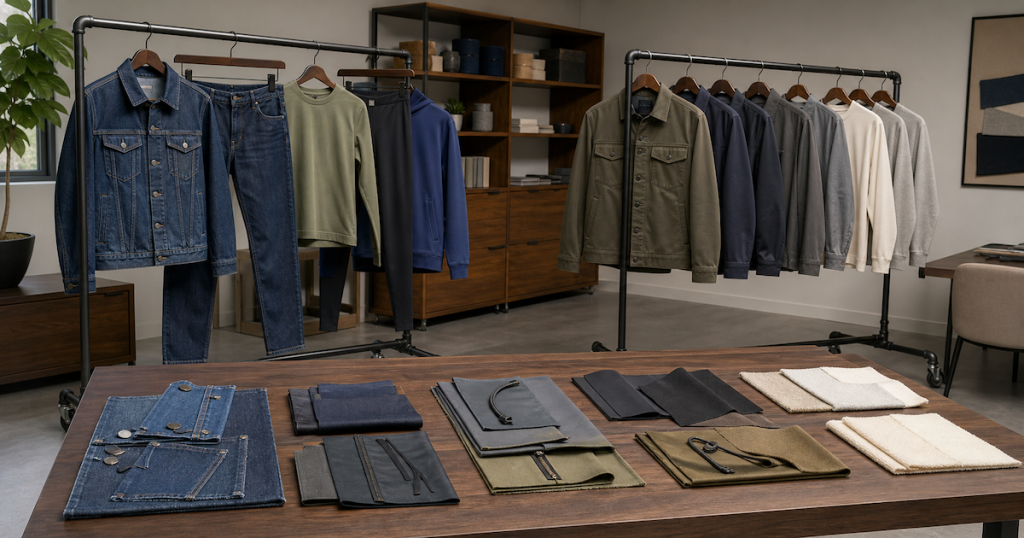
Some apparel companies deserve a second look by product category rather than by operating model. Denim, activewear, streetwear, jersey garments, uniforms, accessories, and merchandise create different supplier opportunities. A narrower category lens often produces a sharper prospect list than a broad company-type lens.
1822 Denim illustrates the denim specialist profile. Its 10-49-person operation, estimated in the $2M-$10M revenue band, focuses on denim jeans, jackets, and related apparel for brands and designers. Denim fabric mills, rivets, buttons, zippers, wash development services, indigo dye suppliers, laundry equipment, and denim quality control services all have clearer relevance here than a generic apparel pitch.
R13 sits between brand, luxury apparel, and production influence. Its scale, roughly 51-200 employees and $20M-$60M in estimated revenue, makes it relevant for premium denim mills, Japanese and Italian fabric suppliers, leather partners, luxury hardware suppliers, boutique packaging, and premium retail logistics. Sales teams should verify whether the New York team influences sourcing, production, product development, brand partnerships, or retail operations.
Viewed through category fit, Fashion Designers Concepts appears again because streetwear, loungewear, merchandise, and promotional products create different supplier triggers than traditional apparel. Heavyweight cotton, fleece, screen printing, embroidery, hang tags, branded packaging, and creator-led merchandise programs are stronger angles than broad manufacturing language.
InStyle USA adds activewear and streetwear overlap from a category-fit angle. Its smaller operating profile and roughly $2M-$10M in revenue point to performance fabrics, stretch trims, garment testing, sportswear branding, and fitness-related partnerships. A supplier with strong category fit should prioritize this kind of company before larger but less relevant businesses.
Category fit is often the fastest way to reduce wasted outreach. Qualification depends on garment type, production method, order size, quality expectation, and decision-maker role before a company enters the first prospect list.
How Different Suppliers Should Build the First NYC Prospect List
Each supplier category requires a different view of the same market. A single list of clothing manufacturers in NYC is too broad to guide outreach.
Fabric suppliers start with garment type, material need, and production influence. Sustainable fabric vendors might review Royal Apparel, MTI USA, Seravine Sew, and The Factory NYC. Performance fabric suppliers might prioritize InStyle USA and related production partners where stretch, recovery, hand feel, comfort, and testing matter.
Trim, label, and packaging suppliers can narrow the list around multi-client production, branded apparel, wholesale flow, merchandise, uniforms, or category programs. Apparel Production Inc., IHL Group, Mornington Corp, and Randa Apparel & Accessories illustrate four distinct conversations. Denim hardware belongs with denim specialists, branded labels with merchandise and private label producers, and compliance labels with children's apparel or uniform programs.
Equipment suppliers prioritize factory-centered companies, uniform manufacturers, and production operators. Bliss Apparel Group, Ferrara Manufacturing, TAA Apparel, and Carina NY deserve closer review for sewing machines, cutting equipment, repair, maintenance, production efficiency, or quality systems. The first verification point is whether the company owns or manages production equipment locally.
Logistics and fulfillment partners focus on wholesale, uniform, corporate apparel, and multi-channel companies. Randa Apparel & Accessories, IHL Group, and Mornington Corp illustrate different needs around freight, warehousing, last-mile delivery, retail timelines, seasonal peaks, SKU flow, and repeat order support.
Software and compliance providers split the market by workflow. CAD and pattern tools fit Patternworks NYC, boutique studios, and development-focused manufacturers. Inventory visibility, traceability, and supply chain analytics point toward MTI USA, Royal Apparel, and larger production groups. Certification, testing, and compliance services may fit sustainable manufacturers, children's apparel, government uniform programs, and export-oriented workflows.
This approach helps sales teams avoid the most common mistake: building a list around a keyword, then sending one message to every company. A strong prospect list is built around supplier use case, company role, product category, local relevance, and likely decision-maker path.
What to Verify Before Treating a Company as a Prospect
Before outreach, verify the company's role. Is it a factory, studio, brand office, wholesaler, distributor, sourcing partner, uniform supplier, or production coordinator? The role determines which message makes sense.
Next, verify local relevance. A New York address may be a headquarters, showroom, studio, production facility, warehouse, or sales office. A nearby-state company may still serve NYC brands. The question is where production decisions, sourcing influence, and supplier conversations actually happen.
Then review product-use fit. A denim supplier, packaging provider, CAD software vendor, embroidery partner, and sustainability consultant each reads the same company differently. Product category, order size, garment type, certification need, and channel position shape the pitch.
Decision-maker roles also need verification. Owners and founders often matter in small studios. Production managers, factory managers, and operations directors matter for equipment and workflow. Sourcing managers, fabric buyers, and supply chain leaders influence materials. Technical designers and pattern makers shape development tools. Sustainability, compliance, and quality teams influence certification, traceability, testing, and audits.
Finally, check whether the company gives enough evidence for outreach. Website language, LinkedIn roles, product pages, facility details, client types, hiring signals, certifications, and production descriptions can all help confirm whether the company belongs in the first prospect list or a later research pool.
How Futern Helps With Company-Role Mapping
Futern helps B2B sales teams move from keyword search to company-role mapping. For a topic like clothing manufacturers NYC, that means separating a broad list into clearer company groups: production operators, development studios, wholesale organizations, uniform suppliers, sustainable manufacturers, technology-enabled producers, and category-specific apparel businesses.
From there, Futern supports deeper company research. Sales teams can enrich company information, compare size and revenue signals, review locations, inspect business descriptions, check websites and LinkedIn profiles, and look for evidence of local relevance. This context helps distinguish a factory, a brand office, a boutique studio, a sourcing partner, a wholesale distributor, and a nearby company serving New York designers.
Futern also helps teams shape outreach angles by supplier use case. A fabric vendor researches different companies from a logistics provider. A CAD software seller can focus on pattern specialists and development studios. A certification provider can prioritize sustainable manufacturers, children's apparel, and uniform programs. A packaging supplier can review private label, wholesale, accessories, corporate apparel, and merchandise-heavy businesses.
For role research, teams can move beyond one generic contact and identify likely decision-maker paths: founder, production manager, sourcing manager, fabric buyer, technical designer, sustainability director, compliance officer, supply chain director, wholesale manager, or operations lead. The goal is to understand the company well enough to make outreach specific, cautious, and relevant without assuming demand.
Used this way, Futern turns a broad market keyword into a clearer prospecting workflow: define the market, map company roles, enrich company context, verify local relevance, identify likely buying influence, and tailor outreach by use case.
Conclusion
NYC remains a meaningful apparel production and fashion supply chain market. The opportunity is real, but it is spread across different types of companies: production operators, sample studios, pattern specialists, private label manufacturers, uniform suppliers, wholesalers, sustainable producers, technology-enabled manufacturers, and category-specific apparel brands.
For B2B suppliers, list quality depends on company role, local relevance, product category, supplier fit, and decision-maker access rather than total company count. A small Brooklyn studio, a Garment District production partner, a Queens private label manufacturer, a uniform contractor, and a global accessories organization all require different research and different outreach.
The NYC clothing manufacturer market becomes easier to work with when companies are grouped by buying influence rather than by keyword alone. Sales teams that read the market this way can build a more focused prospect list, avoid generic messaging, and approach each company with a clearer reason for why the supplier's product or service may fit.