Akron Polymer Manufacturers: A Supplier Qualification Guide
by Yu T
Help B2B suppliers qualify 20 Akron-area polymer manufacturers by process, scale, and facility role.
Akron's polymer economy gives B2B suppliers an unusually broad field to study. The Greater Akron Chamber reports more than 150 polymer-related companies in the Akron metropolitan area and more than 500 across Northeast Ohio. The cluster spans specialty chemistry, compounding, molding, extrusion, coated fabrics, engineered rubber, and recycling.
The practical challenge is deciding where an offer fits. A development laboratory values formulation flexibility and scale-up support, while a high-volume converter focuses on repeatability, uptime, traceability, and delivery. A headquarters, laboratory, warehouse, pilot line, and production plant also create different reasons for outreach.
Research information and company estimates were reviewed on July 25, 2026. The companies mentioned below are research examples based on public information, local relevance, operating model, company size, product categories, and possible use cases. Their inclusion does not indicate confirmed demand or purchasing intent. Sales teams should verify facility details, current operations, supplier requirements, and decision-maker roles before outreach.
This guide organizes the market into five qualification paths: formulation-led material producers, development-to-production specialists, production-floor converters, process-specific converters, and circular or focused manufacturers. Each path changes the evidence a supplier should prepare, the facility role it should verify, and the technical or commercial stakeholders most likely to influence qualification.
How the Geography Changes the Research
The Akron-centered polymer cluster extends beyond city limits, so location should be read in layers.
The industrial core includes Akron producers such as Akron Porcelain & Plastics, Ferriot, Finite Fiber, Alterra Energy, Promerus, Akron Polymer Products, and LyondellBasell's Advanced Polymer Solutions operations. Nearby Cuyahoga Falls, Barberton, and Tallmadge add Americhem, Polymerics, NovationSi, and Universal Polymer & Rubber.
The next ring reaches Aurora, Middlefield, Chagrin Falls, and Burton, where Orazen Extruded Polymers, MVP Plastics, National Polymer Laboratories, and HEXPOL operate. Wooster and Massillon add Seaman Corporation and PolyKinetix, while Lubrizol's Avon Lake and Painesville operations, current Brecksville site, and planned Wickliffe consolidation require facility-level qualification.
For every prospect, record the exact location, facility function, production technology, and likely purchasing authority. Regional relevance alone does not prove that a site controls supplier selection.
Start With the Material Recipe

For compounders and specialty polymer producers, supplier qualification begins before material reaches a molding press or extrusion line. Consistency between batches, compatibility with proprietary formulations, contamination control, regulatory documentation, and technical support often carry more weight than a broad product catalog. Suppliers of pigments, additives, carriers, process aids, fillers, packaging, testing services, and plant equipment need to show how their offer affects formulation performance.
Americhem
Americhem's Cuyahoga Falls presence includes its world headquarters on Americhem Way and a separate manufacturing facility on East Steels Corners Road. The business has roughly 1,000 employees and ten plants worldwide, with Pritzker Private Capital acquiring a majority interest in 2025. Local ISO 9001 and ISO 14001 systems point toward structured evaluation of raw materials, dispersion, environmental controls, and supply continuity. The first research step is determining whether a proposal belongs with local color development, quality, operations, or a wider sourcing category.
HEXPOL Compounding
HEXPOL's Akron operation focuses on silicone compounding, while Burton adds regional rubber compounding activity. Public estimates place the regional business in the 51-200 employee range, backed by a global organization with approximately $2 billion in annual sales. ISO 9001 and ISO 14001 certifications signal formal qualification. Silicone raw-material, mixing, laboratory, and process-control suppliers should distinguish the Akron site and identify whether technical, purchasing, quality, or operations teams influence the material family.
LyondellBasell Advanced Polymer Solutions
LyondellBasell acquired A. Schulman in 2018 and integrated it into Advanced Polymer Solutions. The former name is historical context, not a separate prospect. The 1353 Exeter Road compounding plant closed in December 2023, while current certification records show processing, blending, and compounding at 1183 Home Avenue and 790 East Tallmadge Avenue. These sites belong to a global group with tens of thousands of employees. Qualification starts by identifying the relevant line and current plant roles in procurement, engineering, maintenance, quality, or operations.
Synthomer
Synthomer acquired OMNOVA Solutions in 2020, so OMNOVA belongs only in ownership history. The Gilchrist Road site supports R&D, Tech Way handles dried-resin manufacturing, and Mogadore produces polymer dispersions, latex, coatings materials, and fluorochemicals. Synthomer reported about GBP 1.7 billion in 2025 continuing revenue. Raw-material, drying, filtration, process-safety, packaging, and emissions-control suppliers should qualify the exact facility. R&D may influence technical acceptance, while plant purchasing and operations govern implementation.
The buying logic across these four companies centers on formulation risk. Strong early evidence includes technical data, lot-to-lot controls, change-notification procedures, sample support, and a clear path from laboratory evaluation to production supply.
Follow Development Into Controlled Production
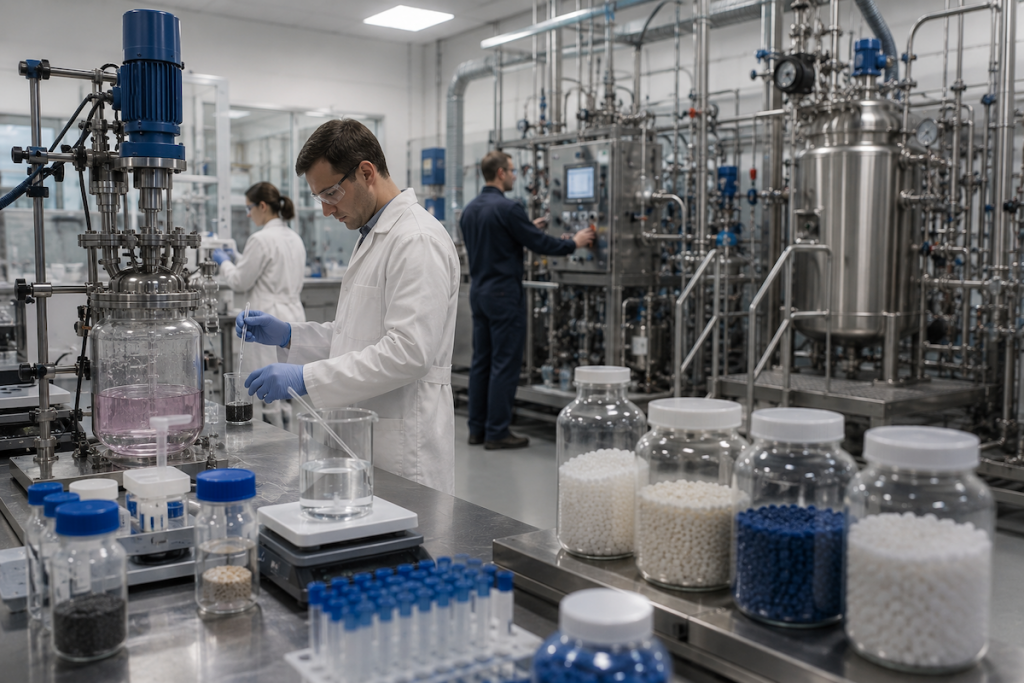
Some Akron-area businesses move materials from concept through pilot work, validation, and repeatable output. Sales teams should examine batch size, development ownership, confidentiality, analytical capabilities, and when purchasing becomes involved.
Promerus
Promerus develops and produces polynorbornene materials from a roughly 38,000-square-foot Akron facility with an estimated 31-38 employees. The Sumitomo Bakelite subsidiary maintains ISO 9001:2015 certification. High-purity inputs, solvents, filtration, laboratory instruments, controlled packaging, and technical services fit this specialty environment. Product development and quality may shape approval, with operations and parent-company sourcing influencing commercial supply.
National Polymer (National Polymer Laboratories)
National Polymer, also known as National Polymer Laboratories, combines custom development, pilot work, and production in Chagrin Falls. LinkedIn currently places the privately held company in the 11-50 employee range, while its 2026 American Coatings Show activity highlights polymer synthesis, scale-up, and pilot manufacturing. Its work across polymers, coatings, and adhesives suits suppliers that support experimentation and scale-up through samples, testing, toll services, and documentation. The next qualification step is confirming current certification, available reactor or mixing capacity, and whether technical, laboratory, operations, or ownership leaders manage evaluation.
NovationSi
NovationSi operates from a 127,126-square-foot Barberton site: about 67,000 square feet for manufacturing and R&D plus 60,000 for warehousing. The RDAbbott-owned company reports 20-25 employees, and its ISO 9001 certification runs through January 2027. Silicone additives, colorants, containers, material handling, testing, and equipment support are plausible angles. Decision influence may span NovationSi technical personnel and RDAbbott commercial leadership.
Lubrizol
Lubrizol is an outer-ring strategic example. The Berkshire Hathaway company employs more than 7,000 people and operates over 100 manufacturing, sales, and technical locations. In January 2026, Lubrizol announced a phased plan to integrate Brecksville employees and capabilities into its expanded Wickliffe headquarters, with the transition expected to continue through 2028. Avon Lake and Painesville remain part of its Northeast Ohio operating footprint. A productive search connects one capability to one process, followed by the technical owner, plant buyer, quality contact, or category leader with authority there.
These organizations reward suppliers that explain how a sample becomes a controlled production input, including scale-up limits, test methods, intellectual-property handling, and change control.
Qualification Lives on the Production Floor
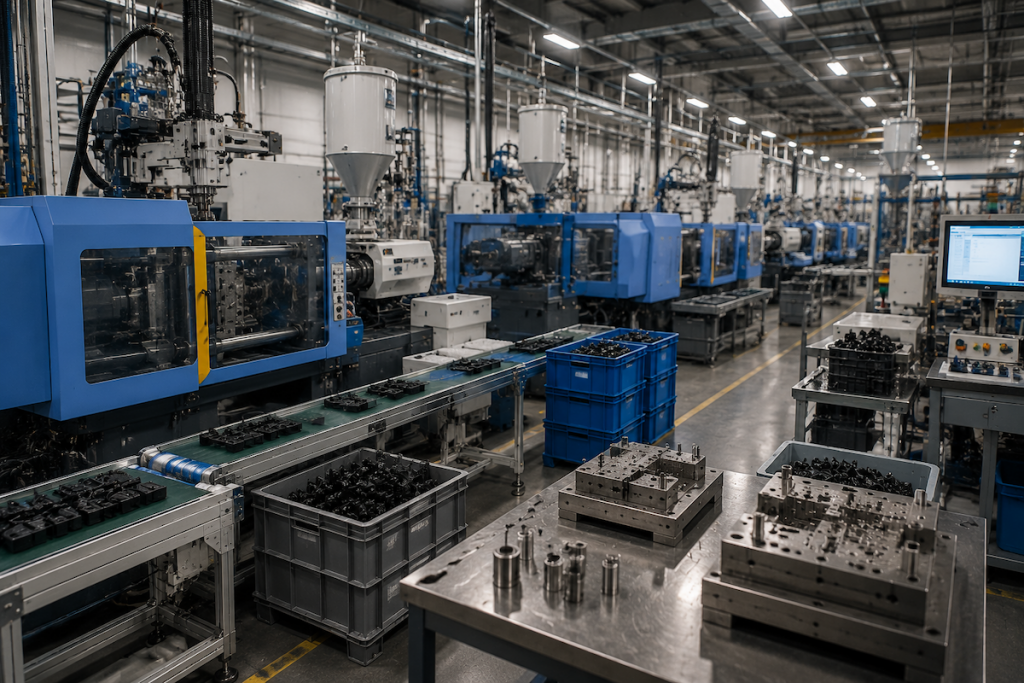
Converters buy around repeatability. Resin and compound behavior must translate into stable cycle times, low scrap, predictable dimensions, surface quality, traceability, and on-time output. Tooling, automation, maintenance, inspection, packaging, and production consumables may be as important as polymer inputs.
Akron Porcelain & Plastics
Akron Porcelain & Plastics operates two Akron plants with more than 50 presses across three shifts and an estimated local workforce near 100. Its capabilities include thermoset and thermoplastic molding for demanding electrical and industrial applications. ISO 9001 certification reinforces a structured quality environment. This producer helps illustrate why suppliers should discuss processing windows, tooling life, dimensional control, and continuity across shifts. Likely stakeholders include molding engineering, tooling, quality, maintenance, plant management, and procurement. Facility-specific equipment compatibility should be verified before outreach.
Ferriot
Ferriot operates a roughly 200,000-square-foot Akron facility with 20 injection-molding presses ranging up to 2,250 tons. The ISO 9001-certified company combines design support, tooling, molding, assembly, and logistics. Supplier fit depends on the affected workflow: design engineering for manufacturability, operations for throughput, quality for validation, or supply chain for material availability. A focused opening should lead with one measurable production issue rather than a general molding pitch.
MVP Plastics
MVP Plastics reports more than 75,000 square feet across facilities, presses up to 1,300 tons, and IATF 16949 accreditation. Its multi-site operation includes Middlefield, Ohio, McAllen, Texas, and Dongguan, China. Material suppliers, tooling specialists, automation providers, recyclate experts, and inspection vendors should prepare evidence on repeatability and production risk. Program management, manufacturing engineering, quality, purchasing, and plant leadership are likely sources of influence.
Roechling Automotive USA
Roechling's Akron plant is a current manufacturing location led by local plant management and connected to an automotive division of roughly 6,000 employees worldwide. Regional research estimates describe an operation of about 160 employees in a facility near 160,000 square feet, and current hiring confirms ongoing Akron activity. The plant produces engineered plastic mobility components, so qualification can involve material performance, lightweighting, process stability, recycled content, tooling, automation, and launch support. Suppliers should verify the active product program and local production process. Plant engineering and quality may own implementation, while regional sourcing or program teams may influence commercial approval.
For production-floor prospects, the first message should connect a supplier capability to scrap, uptime, cycle stability, validation effort, or delivery reliability. Company size alone reveals little about the ease of entry.
Specialized Conversion Changes the Proof
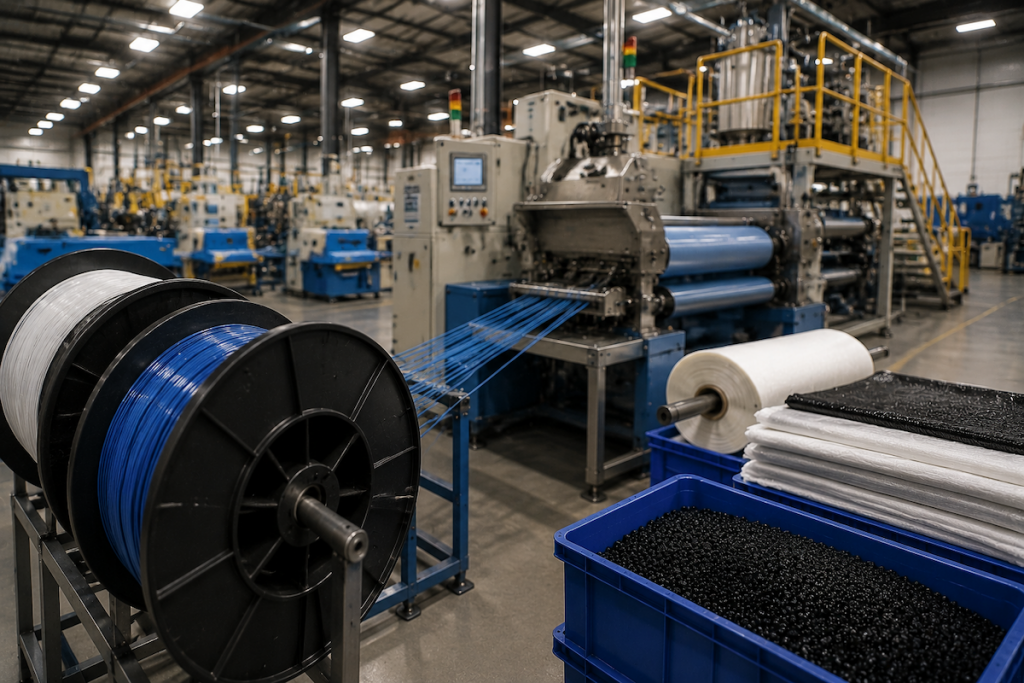
Extrusion, fiber cutting, coated fabrics, and engineered rubber parts create different technical tests. Geometry, surface behavior, dispersion, adhesion, weathering, cure, and downstream fabrication can replace molding cycle time as the central buying concern.
Orazen Extruded Polymers
Orazen runs rubber and plastic extrusion from a roughly 45,000-square-foot facility in Aurora. Public estimates place the team near 21 employees, and the company operates under ISO 9001 systems. Its size points toward a focused manufacturer where engineering and leadership may stay close to customer programs. Suppliers of compounds, dies, extrusion controls, cooling systems, inspection equipment, packaging, and maintenance services should study profile tolerances and production materials before making contact. Technical fit and responsiveness may matter more than a wide national footprint.
Finite Fiber
Finite Fiber manufactures precision-cut fibers and related reinforcement products from its Akron operation. The ISO 9001-certified business has an estimated workforce near 59 and operates as a specialized single-site producer. Its products serve rubber, friction, coatings, composites, and industrial formulations, giving sales teams a view of an ingredient manufacturer whose output must disperse consistently downstream. Fiber inputs, cutting technology, dust collection, classification, packaging, testing, and material handling offer practical supplier angles. Quality, operations, technical service, and plant leadership may share qualification responsibility.
Seaman Corporation
Seaman Corporation is headquartered in Wooster and manufactures high-performance coated fabrics in Ohio and Tennessee. The family-owned company reports more than 450 associates across its Wooster and Bristol operations, along with approximately $30 million in annual capital investment. Its vertically integrated capabilities include fabric formation, polymer compounding, coating, printing, finishing, and fabrication. A coating additive requires different proof from weaving equipment or inspection technology, making the affected production step the natural starting point. Technical, plant, sourcing, quality, and product-line leaders may each influence a decision.
Universal Polymer & Rubber
Universal Polymer & Rubber operates about 200,000 square feet across Middlefield and Tallmadge. The company reports more than 119 million parts produced, use of roughly 1,935 tons of rubber annually, and output capabilities across molding, extrusion, die cutting, and tooling. Both Ohio locations operate under ISO 9001 systems. The current IATF certificate identifies Middlefield as the approved production site and Tallmadge as a supporting location for purchasing and supplier management. This scale gives compound, tooling, process-control, automation, packaging, and maintenance suppliers a clear operational context. Outreach should name the relevant plant and process, then determine whether engineering, quality, operations, or purchasing owns the qualification step.
Specialized converters favor evidence that mirrors their process. A supplier selling across this group should change the proof package for extrusion tolerances, fiber consistency, coating adhesion, or rubber-part capability rather than reuse one broad materials message.
Circular and Focused Producers Need a Different Test
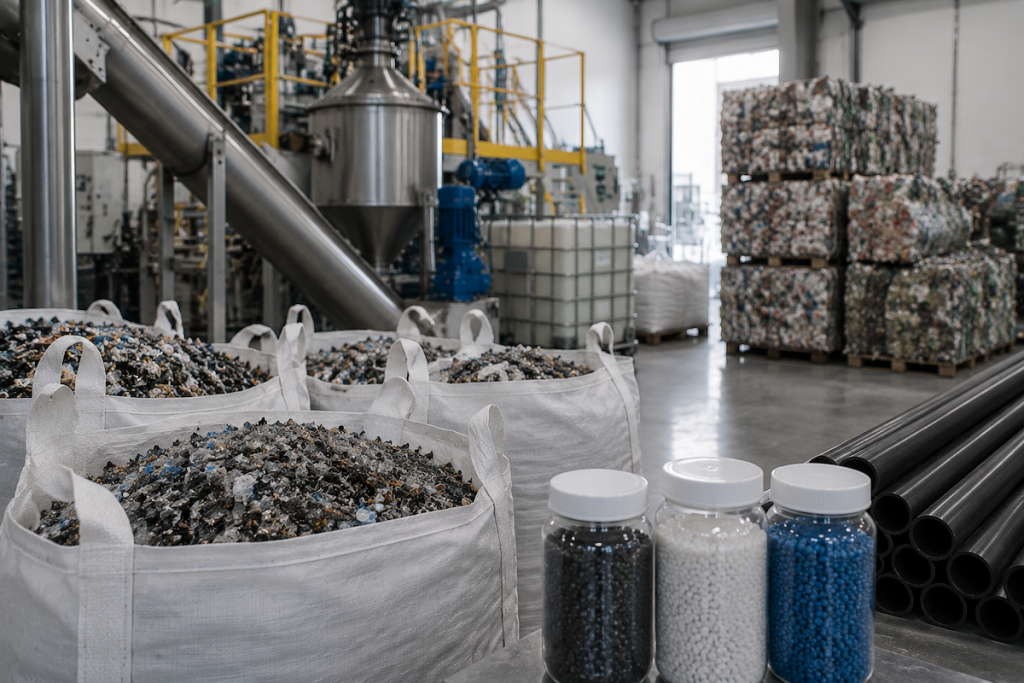
Smaller or emerging manufacturers can offer faster technical access, though commercial scale, feedstock quality, financing, and expansion timing require closer verification. They deserve a separate research lens from established multi-plant producers.
Alterra Energy
Alterra Energy operates a full-scale advanced-recycling showcase facility in Akron. The company reports more than 50 employees, and the plant has design capacity of 60 tons per day. A June 2026 Nerea announcement with Technip Energies and Neste states that the technology has completed more than five years of continuous commercial operation, supporting Alterra's inclusion as an active research example. However, the latest publicly located ISCC PLUS certificate expired in February 2024, and no newer certificate was confirmed during this review. Suppliers should treat current certification, actual operating rate, accepted feedstock, expansion plans, procurement priorities, and relevant decision-maker roles as qualification questions.
PolyKinetix
PolyKinetix established its first Massillon production site in 2025 and remains in early commercialization. The roughly 11,000-square-foot operation has a team estimated below a dozen people and focuses on processing difficult polymer waste for further use. Public information does not establish stable 2026 production volume. The profile may offer direct access to technical and executive decision makers while capacity and procurement routines develop. Equipment, testing, feedstock, logistics, and commercialization support are plausible areas to investigate. Commissioning status, output, funding milestones, and the immediate technical bottleneck should be established before proposing a long-term supply arrangement.
Akron Polymer Products
Akron Polymer Products has manufactured extruded thermoplastic tubing and fabricated tube components in Akron since 1986. Public workforce estimates vary from 11-50 to 50-99 employees, while the operation covers extrusion, forming, assembly, testing, and product development. Its longstanding single-city profile helps show how a focused converter may combine engineering access with established production expectations. Resin, tubing equipment, joining technology, test systems, tooling, and packaging suppliers should qualify the relevant tube family and end-use specification. Engineering, quality, operations, and purchasing are more useful targets than a general corporate contact.
Polymerics
Polymerics operates rubber mixing in Cuyahoga Falls and chemical blending activity in Kent. The privately held company lists 11-50 employees and has worked in custom rubber compounding since the 1970s. Current ISO 9001 certification and its mix of compounds, dispersions, preweighs, and chemical blends point toward batch consistency and formulation confidentiality as central concerns. Raw materials, mixing aids, dust-control systems, packaging, laboratory services, and maintenance support are credible areas for research. Sales teams should confirm which site performs the target process and whether technical leadership, operations, quality, or ownership guides supplier selection.
These companies call for milestone-based qualification. A supplier should learn whether the immediate priority is process stabilization, capacity, yield, certification, feedstock access, or repeatable customer validation.
How Suppliers Can Prioritize the First Prospect List
The largest company is rarely the automatic first choice. Priority should reflect product fit, facility authority, qualification burden, timing, and the strength of the supplier's proof.
A pigment or additive supplier might begin with Americhem, HEXPOL, Polymerics, or Synthomer because formulation and dispersion sit close to the buying logic. A molding automation provider could place Ferriot, Akron Porcelain & Plastics, MVP Plastics, and Roechling higher. Extrusion tooling or in-line inspection suppliers have a clearer reason to study Orazen, Akron Polymer Products, and Universal Polymer & Rubber. Recycling equipment, feedstock preparation, and environmental-service providers might lead with Alterra Energy and PolyKinetix.
Long-cycle strategic research belongs in a separate tier. Lubrizol, LyondellBasell, Synthomer, and other global groups may offer substantial opportunity, yet site-level entry often requires corporate standards, formal onboarding, and multiple technical approvals. Smaller specialists such as National Polymer Laboratories, Promerus, or NovationSi may provide a more direct technical conversation when the offer supports development or controlled scale-up.
A practical shortlist should contain three categories: immediate technical fit, promising fit that needs facility verification, and strategic companies requiring longer qualification. That structure keeps large names from crowding out better first conversations.
Verify the Facility Before Writing the Message

Several common mistakes weaken Akron polymer outreach:
- Treating a headquarters, laboratory, warehouse, pilot line, and production plant as the same type of location.
- Using historical company names after an acquisition without checking the current operating identity.
- Assuming that a nearby facility controls purchasing for a global material category.
- Combining compounders, molders, recyclers, and coated-fabric producers in one message.
- Leading with company size instead of process fit and qualification evidence.
- Contacting a senior executive when plant engineering, technical service, quality, sourcing, or operations owns the problem.
Before outreach, verify the site address, current operating status, process performed there, relevant certification, likely buying authority, and one credible use case. Then adapt the message to the production outcome that the role influences.
Turning Akron Research Into a Focused Futern Workflow
Futern helps sales teams move from a broad regional search to a more workable prospecting process. Users can group Akron-area companies by material role, production technology, scale, ownership, and local facility type; enrich company records; review websites and LinkedIn profiles; and identify likely decision-maker roles.
The workflow can begin with one supplier hypothesis, such as reducing dispersion variability or improving extrusion inspection. The team can then build a narrow company group, check which local sites perform the relevant process, compare size and operating signals, and research technical, quality, sourcing, operations, or plant leadership. Outreach angles can be tied to a specific use case rather than the generic fact that a company works with polymers.
Futern supports the organization and enrichment of this research. Final qualification still depends on current facility evidence, direct conversations, and confirmation of supplier requirements.
Conclusion
Akron and the surrounding Northeast Ohio cluster offer substantial supplier opportunity because polymer activity appears across chemistry, development, compounding, molding, extrusion, coated systems, rubber conversion, and recycling. A broad list of company names is difficult to act on. The useful distinctions are material role, production process, facility function, operating scale, qualification burden, and decision-maker influence.
Sales teams that group prospects around those distinctions gain a clearer starting point. They can approach focused manufacturers with a specific technical hypothesis, reserve global producers for longer qualification cycles, and verify each site's authority before outreach. The Akron polymer market becomes easier to research when every company is connected to a production use case and a realistic path to supplier approval.
Wichita Aerospace Manufacturers: A Qualification Guide
Southern California Handbag Manufacturers: A B2B Supplier Guide
Clothing Manufacturers NYC: How B2B Suppliers Should Read the Market