Wichita Aerospace Manufacturers: A Qualification Guide
by Yu T
Qualify Wichita aerospace manufacturers by facility role, process, proof, and supplier fit.
Wichita is one of the few North American markets where aircraft programs, major aerostructures, precision machining, composites, special processing, avionics equipment, and production tooling sit within the same regional supply chain. Kansas produces approximately one-third of all general aviation aircraft delivered in the United States, and the state counts more than 450 aerospace supply-chain companies, according to the Kansas Department of Commerce. Much of that industrial depth is concentrated in Greater Wichita.
For suppliers, the density creates opportunity and a qualification problem. A large final-assembly operation evaluates risk differently from a 20-person machine shop. A surface-treatment facility cares about chemistry, process control, throughput, and customer approvals. A composite producer may place greater weight on material traceability, tooling behavior, cure performance, and inspection evidence. The same outreach message will rarely fit all three.
This guide treats Wichita aerospace manufacturers as a sequence of qualification questions. It helps sales teams decide which companies match their offer, what proof to prepare, which local operation matters, and which roles are likely to influence a supplier review.
Research information and company estimates were reviewed on July 23, 2026. The companies mentioned below are research examples based on public information, local relevance, operating model, company size, product categories, and possible use cases. Their inclusion does not indicate confirmed demand or purchasing intent. Sales teams should verify facility details, current operations, supplier requirements, and decision-maker roles before outreach.
A Geographic Map of Greater Wichita Aerospace
Geography in Wichita often signals facility function. It also helps sales teams separate a corporate name from the plant, shop, or technical team that could evaluate a specific offer.
East and northeast Wichita contain major Textron Aviation operations around Beech Factory Airport and Lee Aerospace's window and composite activities. This area points toward aircraft production, flight-test support, transparencies, interiors, and engineered composite work. Large-campus outreach usually requires program evidence and a clear route through engineering, quality, or supply chain.
South and southeast Wichita are anchored by the Boeing-owned Spirit AeroSystems campus on South Oliver. Electromech Technologies, Leading Technology Composites, Harlow Aerostructures, and Omni Aerospace add systems, composites, machining, assemblies, and wiring across the southern manufacturing belt. Ownership and operating-unit checks matter here.
West Wichita and the airport corridor bring together the Atlas Group's PMC operation, PCC Aerostructures' former Exacta site, MAX Aerostructures, B&B Airparts, Raptor Manufacturing, and several machine shops. Machining, sheet metal, tooling, and assemblies overlap here, making facility capability more informative than proximity alone.
Central and north Wichita, plus nearby Maize and Park City, include J&J Machining, United Machine, Aero-Tech Engineering in Maize, and the Atlas Group's FMI and WASI operations in Park City. The named facilities explain the group's presence in two zones. These companies may offer a shorter route to technical conversations, subject to program, capacity, and customer-approval checks.
Qualification Gate 1: Establish Who Owns the Production Risk

The first question is less about company size than responsibility. Aircraft producers and large aerostructures operations carry program-level exposure: delivery schedules, configuration control, regulatory requirements, supplier continuity, and the cost of a production interruption. Suppliers approaching this layer need evidence that connects their offer to manufacturing risk, total cost, quality escape prevention, or repeatable output.
Textron Aviation represents the region's broadest general-aviation production environment. Its Cessna and Beechcraft operations span final assembly, interiors, paint, flight test, delivery, parts, and service. The research set places the business at roughly 16,000 employees, including an estimated 9,500 to 10,000 in Wichita. In May 2026, Textron completed a 57,000-square-foot expansion of its East Wichita flight-test hangar, adding six bays for SkyCourier and Denali test activity. This scale makes it a strategic, long-cycle prospect for production equipment, approved materials, tooling, and factory support. The relevant campus and aircraft family should guide the search for engineering, quality, supply-chain, or commodity contacts.
Boeing-owned Spirit commercial and defense operations in Wichita illustrate why current ownership and operating structure matter. Boeing completed its acquisition of Spirit AeroSystems in December 2025. Wichita's commercial and aftermarket operations are integrating into Boeing, while Spirit Defense remains a non-integrated Boeing-owned subsidiary with separate governance and operations. The local complex is estimated at about 13,000 workers across 178 buildings and supports fuselage, wing-component, nacelle, strut, and defense work. Suppliers should establish whether a use case belongs to Boeing commercial production, Spirit Defense, or another local organization because the answer changes documentation, security expectations, and decision authority.
The Atlas Group gives sales teams a view of a large, multi-operation aerostructures supplier. Current company profiles list PMC in Wichita at 425 employees and more than 230,000 square feet, FMI in Park City at 250 employees and 222,000 square feet, and WASI in Park City at 102 employees and 66,000 square feet. Machining, sheet metal, assemblies, spares, welding, and electrical work sit in different operating contexts. Offers should match a specific division and process.
PCC Aerostructures' Wichita operation, the former Exacta Aerospace site, shows how acquisition history can obscure the correct prospect name. The West Harry facility has been consolidated into PCC Aerostructures' Waldens organization and supports complex multi-axis machining and assembly. Futern research estimates 200 to 400 local employees, while parent Precision Castparts has more than 30,000 workers globally. The supplier angle combines local production with corporate qualification discipline; outreach should use the current identity and establish where sourcing authority sits.
These organizations favor suppliers with aerospace references, stable capacity, and documentation ready for formal review. A strong opening message should name the process or risk being addressed.
Qualification Gate 2: Match the Offer to the Manufacturing Scope
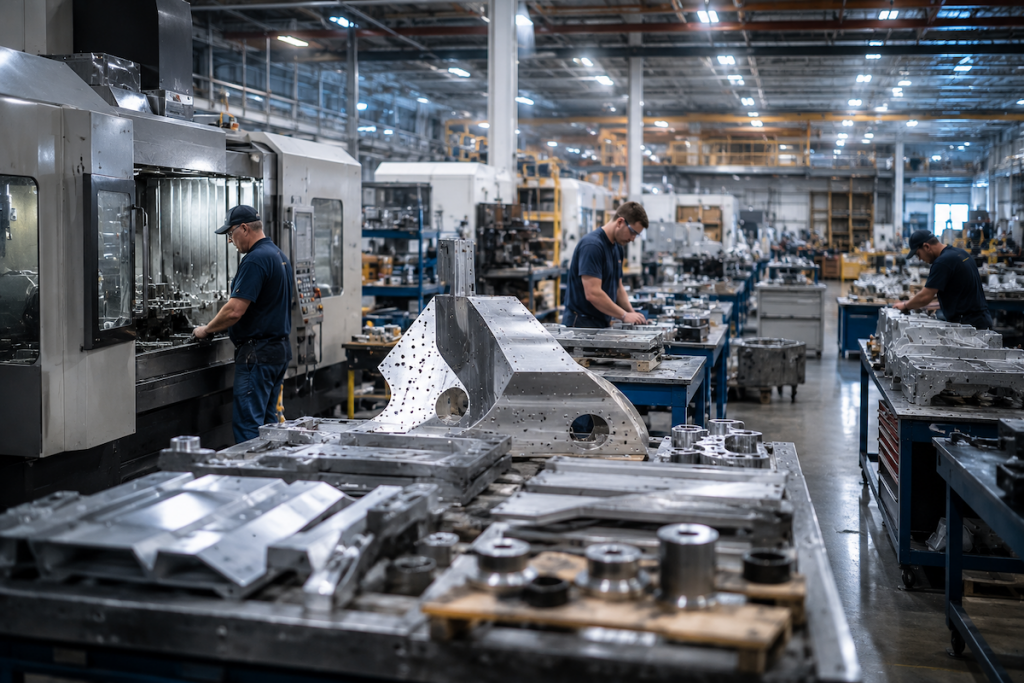
After establishing responsibility, the next filter is what the local operation actually makes. "Aerospace manufacturing" may mean hard-metal machining, aluminum details, formed sheet metal, major assembly, repair work, or a mix of processes. Equipment footprint, part size, tolerance range, material expertise, and assembly content determine supplier fit.
Cox Machine combines close-tolerance machining and assembly in Wichita with sheet-metal fabrication in Harper, Kansas. Official company pages describe roughly 200,000 square feet across four locations. Research estimates place 50 to 100 employees in Wichita and 66 to 157 companywide, while LinkedIn lists a broader 201-to-500 band. Because the scopes differ, location-specific headcount needs verification. Published credentials cover AS9100D and ISO 9001 systems, ITAR registration, and NADCAP heat treatment. Supplier angles include cutting tools, automation, metrology, workholding, and production software.
Harlow Aerostructures has operated in Wichita since 1954 with a research range of 100 to 250 employees. It covers machined components, sheet metal, structural and electro-mechanical subassemblies, special processes, and FAA repair activity. Before outreach, define whether the offer supports new production, internal processing, assembly, or repair, then approach the corresponding operations, quality, engineering, or purchasing role.
MAX Aerostructures runs engineering, machining, processing, and assembly from a 206,000-square-foot West Wichita facility. A research estimate of 50 to 150 employees places it in the mid-sized supplier tier. Complex components, close tolerances, and kits make it relevant to suppliers serving multi-axis machining and controlled production. MAX publishes a NADCAP heat-treatment accreditation valid through August 2027. The AS9100 certificate currently listed on its website shows a February 2026 expiration date, so sales teams should verify the current certification status and scope before outreach.
B&B Airparts, acquired by Spartan Aerospace Group in January 2026, operates from a 94,000-square-foot Wichita facility. Machining, sheet metal, and complex assemblies make it a useful example of coordinated production in a mid-sized operation. New ownership may introduce group-level sourcing practices while the B&B brand and local team remain relevant. Tooling, fabricated inputs, inspection, and subcontract-processing offers should be tied to local capabilities and checked against Spartan's approval procedures.
Process fit should determine the first prospects. A five-axis workholding supplier might favor Cox or MAX, while a fabrication consumables provider could study Harlow and B&B.
Qualification Gate 3: Test Repeatability at the Right Scale
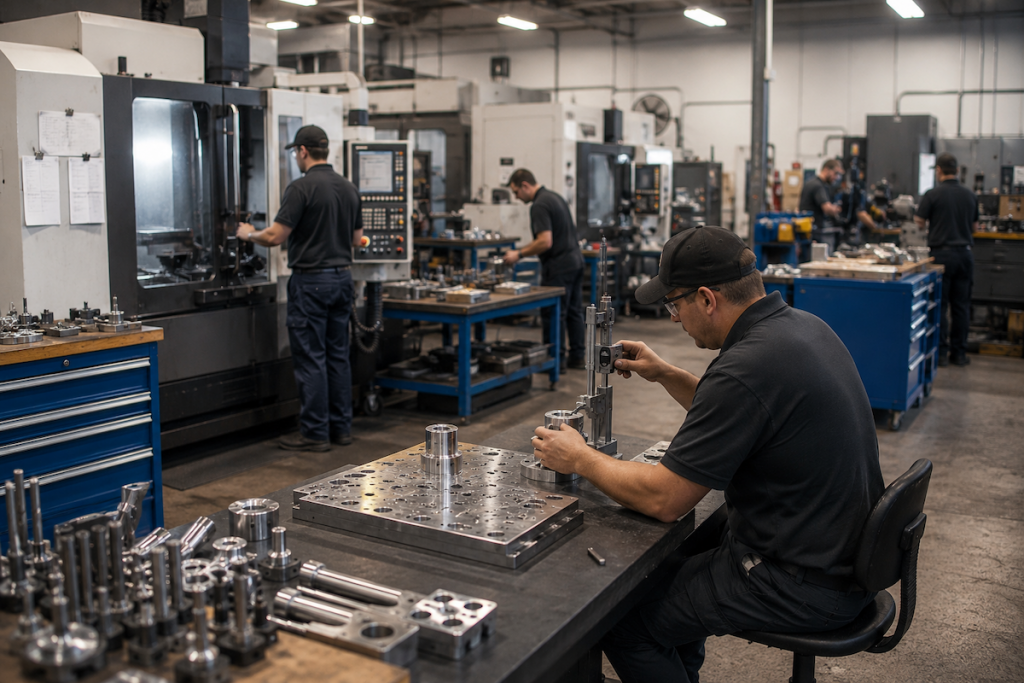
Large aerospace names often attract the first outreach effort, yet smaller shops may provide a clearer technical entry point. Their qualification logic still revolves around traceability, drawing control, first-article inspection, delivery performance, cyber requirements, and customer approvals. The practical difference is that ownership, operations, and quality leadership may sit closer together.
Metal Arts Machine is a compact Wichita manufacturer. An estimated workforce of 20 to 50 keeps ownership and operating leadership relatively close to multi-axis machining, assembly, and kitting work across aluminum and harder materials. Its published credentials include AS9100D, ISO 9001, and ITAR registration. Suitable offers could improve setup time, inspection throughput, tool life, or detail-part flow.
United Machine Company operates a 50,000-square-foot employee-owned facility on North Hydraulic. More than 50 years of close-tolerance machining and assembly experience, ISO 9001 certification, and ITAR registration give it a distinct scale signal despite an estimated workforce of 10 to 25. Reported quantities range from five to 50,000 pieces, so supplier value could sit in low-volume setups, repeat production, inspection, material handling, or assembly.
J&J Machining represents the smaller specialist end of the cluster. Founded in 2005, the Wichita shop appears to operate with roughly 10 to 25 local employees and focuses on complex mill-turned aircraft components with very tight tolerances. It publishes AS9100D certification and describes landing-gear-related experience in its history. Tooling, workholding, measurement, specialty-material, and outsourced-process suppliers should lead with responsiveness and application knowledge.
Aero-Tech Engineering operates in nearby Maize, within the practical Wichita supplier geography. Its footprint includes a 60,000-square-foot main facility and a 25,000-square-foot assembly building, supported by an estimated team of 20 to 50. Precision machining, formed sheet metal, assemblies, and aftermarket work sit under AS9100D, ISO 9001, ITAR, and FAA repair credentials. Production and aftermarket activity bring different lead-time and documentation pressures, so outreach should specify which side the offer supports.
These businesses suit early outreach when the value is process-specific and demonstrable. Influence often sits with ownership, shop operations, manufacturing engineering, quality, and purchasing.
Qualification Gate 4: Verify Materials and Special-Process Evidence
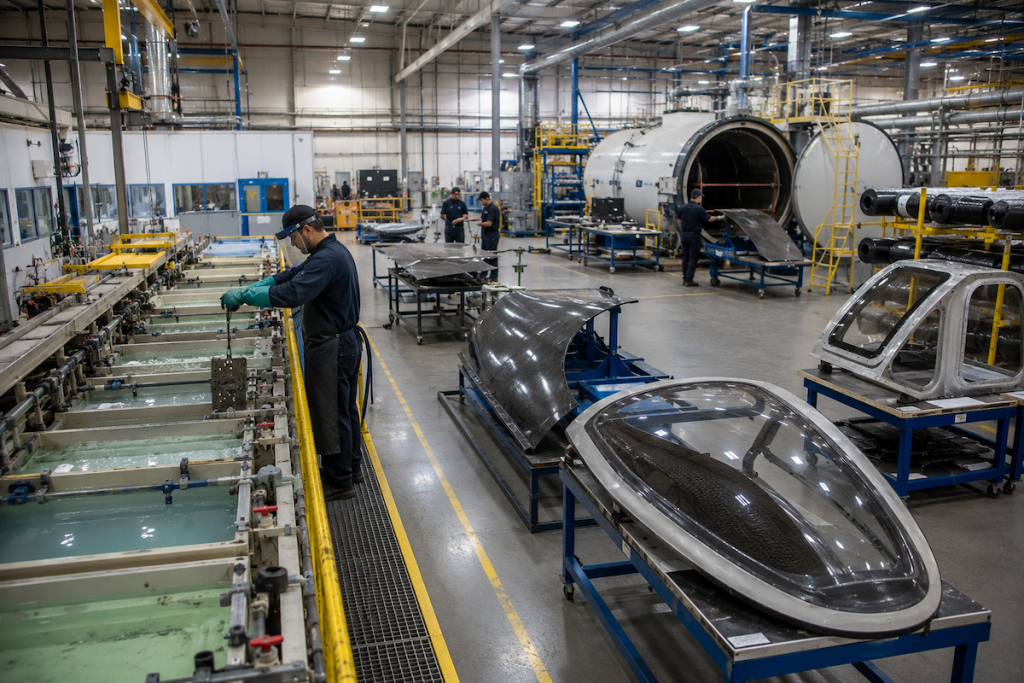
Composite fabrication, transparency production, plating, chemical processing, and non-destructive testing carry qualification requirements that extend beyond general manufacturing capability. Material systems, controlled-process approvals, inspection methods, environmental handling, and customer-specific authorizations can determine whether an offer is commercially usable.
Valence Surface Technologies' Wichita facility reports 57 employees, 21,342 square feet, and annual capacity of approximately 480,200 parts. Its services include plating, anodizing, chemical processing, paint, and non-destructive testing under aerospace quality and NADCAP frameworks. Chemical, masking, racking, environmental, inspection, and automation suppliers should verify approved processes and customer authorizations. A general "metal finishing" message would miss the qualification detail.
Leading Technology Composites, or LTC, spans three Wichita facilities and serves aerospace structures and protective armor markets. Company materials report more than 380,000 square feet and 400-plus employees, while April 2026 reporting places the workforce closer to 500. That public range is more useful than treating one headcount as exact. Its scale points suppliers toward composite materials, consumables, tooling, cure support, inspection, and production infrastructure. Aerospace and defense work may follow different program and security routes, so the business line should be established before contact research.
Fiber Dynamics is a smaller advanced-composites producer. Futern research identifies roughly 38 local employees and revenue in the high-single-digit millions, while LinkedIn uses a broader 51-to-200 company-size band. Resin transfer molding and end-to-end composite development create angles around resin systems, preforms, tooling, monitoring, automation, inspection, and prototypes. The company publicly describes itself as AS9100- and NADCAP-certified. The NADCAP certificate currently available on its website shows a May 2026 expiration date, so sales teams should verify the current accreditation status, scope, and covered address.
Lee Aerospace has built a specialized Wichita position around aircraft windows, transparencies, and composite aerostructures. Research places the Wichita team at 50 to 100 employees, within LinkedIn's broader 51-to-200 band, and the business has more than 35 years of history. Transparency materials and coatings should be separated from composite-structure requirements because technical users and evidence may differ. Influence points include engineering, composites, quality, operations, and supply chain.
A first conversation should name the relevant specification, process, and approval boundary. Useful proof includes traceability practices, test data, and process-control evidence.
Qualification Gate 5: Follow System, Test, and Tooling Influence
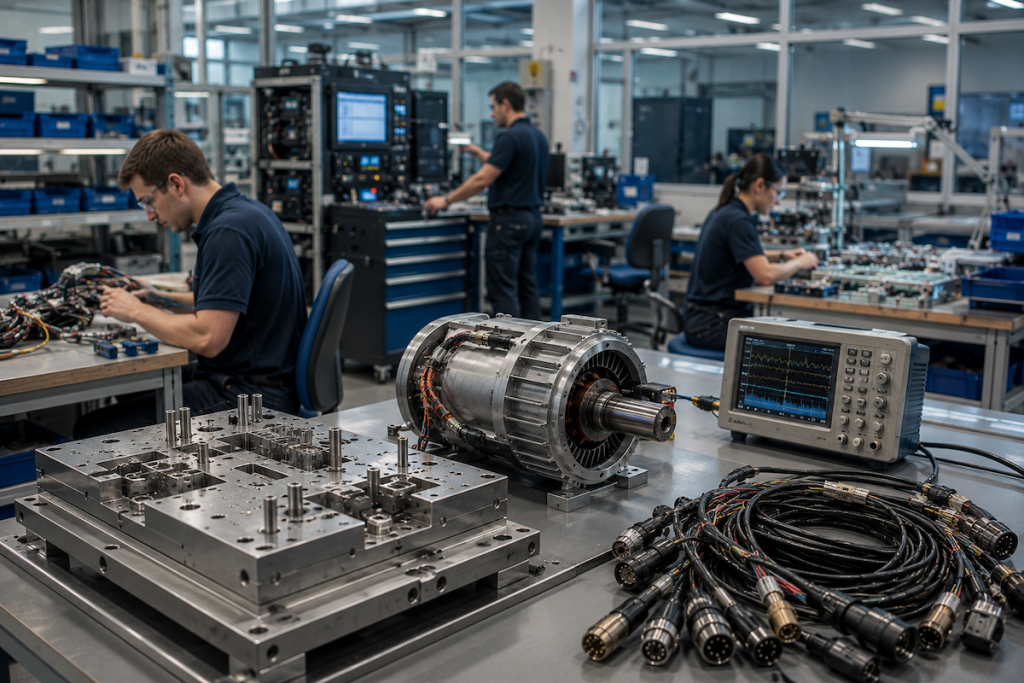
Some Wichita manufacturers influence aircraft production through motors, wiring, test systems, and tooling rather than large structural parts. Their purchasing logic centers on performance verification, configuration stability, calibration, electrical standards, manufacturability, and support across the equipment life cycle.
Electromech Technologies designs, qualifies, and manufactures motors, fans, blowers, actuators, and position-feedback devices in Wichita. Founded in 1968, the local operation is estimated at roughly 94 employees; LinkedIn uses a broader 201-to-500 company-size band. Its AS9100D certificate runs through October 2027. The engineering-intensive model points toward magnets, windings, bearings, electronics, housings, test equipment, and thermal solutions. Design engineering and quality are likely to influence supplier evaluation alongside purchasing.
Omni Aerospace combines engineering, electrical assembly, wire-harness fabrication, machining, stocked parts, and kitting. Operating with an estimated 20 to 50 employees, it works under AS9100, ISO, ITAR, and IPC/WHMA-A-620 requirements. Components, connectors, wire, labels, test tools, and inventory services each need a defined application. Engineering, electrical production, quality, and materials roles offer focused entry points.
VIAVI Solutions' Wichita AvComm operation, the legacy Aeroflex Wichita business, develops and manufactures avionics test equipment for engineering, factory, flight-line, and return-to-service settings. Parent VIAVI has about 3,600 employees and roughly $1.1 billion in annual revenue; the Wichita center is estimated at 100 to 200 people. Relevant offers include electronics, RF components, displays, enclosures, calibration, embedded software, and contract manufacturing. Local product-team influence should be separated from parent-level procurement.
Raptor Manufacturing runs a roughly 30,000-square-foot Wichita facility focused on metallic tooling, fixtures, and dies for aerospace forming and assembly. A research range of 20 to 50 employees reflects a specialized production enabler rather than an aircraft-component producer. Tool steel, machining technology, metrology, coatings, maintenance, and design software fit the model. New programs, rate changes, line modifications, and replacement-tool requirements provide useful timing context.
This gate covers offers that shape how aircraft and components are built, tested, or supported. Searches limited to "aircraft parts manufacturers" can overlook these prospects.
Turn the Gates Into a First Prospect List
A practical first list should reflect the supplier's strongest proof rather than the fame of the company name.
| Supplier offer | Strong starting companies | Evidence to prepare | Likely influence roles |
| CNC tooling, workholding, or metrology | Cox, MAX, Metal Arts, United Machine, J&J | Material and tolerance examples, cycle-time impact, calibration, local support | Manufacturing engineering, shop operations, quality, purchasing |
| Composite materials or process technology | LTC, Fiber Dynamics, Lee Aerospace | Traceability, test data, cure or molding compatibility, aerospace references | Materials engineering, composites engineering, quality, supply chain |
| Chemicals, coatings, NDT, or environmental systems | Valence, Harlow, large approved-process operations | Specification coverage, process controls, safety data, approval support | Special-process engineering, EHS, quality, operations |
| Electrical components, test, or calibration | Electromech, Omni, VIAVI | Reliability data, configuration control, electrical standards, calibration support | Design engineering, test engineering, quality, materials |
| Tooling, automation, and production infrastructure | Raptor, Atlas, Boeing Wichita, Textron Aviation | Capacity, installation plan, uptime support, security and program experience | Manufacturing engineering, facilities, operations, program supply chain |
Smaller machining and tooling companies may suit early technical outreach because the decision path is often concentrated. Mid-sized manufacturers require a sharper facility match. Textron, Boeing, Atlas, and PCC are strategic targets for suppliers with aerospace proof, sufficient capacity, and resources for a longer qualification cycle.
What to Verify Before Outreach
Start with the local facility, then work outward. Confirm the address, legal entity, parent company, facility function, active capabilities, and whether local teams influence supplier selection. A Wichita listing may represent manufacturing, engineering, repair, distribution, or service; those roles create different use cases.
Review certification scope and dates instead of relying on a logo. AS9100 may cover one site or process, while NADCAP and customer approvals are usually process-specific. Check whether a certificate is current, which address it covers, and whether the proposed product falls within that scope.
Then connect the offer to a production condition: material, tolerance, part size, process, throughput, inspection method, aircraft program, or lifecycle stage. Identify likely technical and commercial influence roles only after that match is clear. Manufacturing engineering, quality, operations, materials, supply chain, and program leadership will respond to different evidence.
Avoid combining OEMs, machine shops, repair stations, distributors, and engineering offices into one undifferentiated list. Also avoid assuming local presence equals local purchasing authority. A short, facility-specific prospect list with differentiated messages is more actionable than a large list built around the aerospace label alone.
From Wichita Research to a Futern Workflow
Futern helps sales teams move from a broad regional search to structured prospecting by separating Wichita companies according to facility role, manufacturing process, scale, certification, ownership, and possible use case. Company enrichment adds business descriptions, websites, locations, size estimates, and other qualification context.
Evidence review follows. Sales teams compare Futern data with company websites and LinkedIn profiles, verify whether a location performs manufacturing, and look for ownership, hiring, expansion, certification, or program signals. Those checks point toward likely roles in engineering, quality, operations, supply chain, and purchasing and support messages built around the relevant process problem.
This workflow keeps human verification at the center. Futern provides a faster way to discover, organize, enrich, and prioritize companies; the sales team decides which evidence is strong enough for outreach and which details require another check.
Conclusion
Wichita offers meaningful supplier opportunity because its aerospace economy contains several layers of production responsibility within a compact region. The useful unit of research is a qualified company-and-facility profile: what the local operation makes, how it proves quality, where scale affects the sales cycle, and who influences the decision.
Suppliers with mature aerospace evidence may place Textron, Boeing, Atlas, or PCC in a strategic pipeline. Process-focused offers may find a clearer first conversation among Wichita's machining, composite, special-process, electrical, test, and tooling specialists. Grouping prospects by qualification gate turns a crowded market into a focused sequence of research and outreach decisions.
Minnesota Medical Device Manufacturers: Five Supplier Paths
Northern Virginia Data Center Operators: Five Supplier Paths