Northwest Georgia Flooring Manufacturers: Six Supplier Paths
by Yu T
Qualify 20 Northwest Georgia flooring manufacturers by process, facility role, scale, and fit.
Northwest Georgia remains one of North America's most concentrated flooring-production regions. March 2026 Dalton-Whitfield employer data lists Shaw Industries, Mohawk Industries, and Engineered Floors as the county's three largest manufacturers, with 6,133, 4,172, and 3,600 local employees respectively. The Georgia Department of Economic Development continues to describe Dalton as the Carpet Capital of the World.
That concentration does not create one buying model. A carpet group running extrusion, tufting, dyeing, and finishing lines evaluates suppliers differently from a rigid-core plant, a recycled-PET needle-punch producer, or a custom hospitality mill. Scale also changes the route into a company. Global manufacturers tend to require enterprise approval and multi-plant proof, while specialist businesses often place more weight on technical access, short lead times, and flexible production support.
Research information and company estimates were reviewed on July 31, 2026. The companies below are research examples selected for local relevance, operating model, company scale, product categories, and possible use cases. Their inclusion does not indicate confirmed demand or purchasing intent. Sales teams must confirm facility details, current operations, supplier requirements, and decision-maker roles before outreach.
This guide organizes 20 companies into six supplier paths: global-scale manufacturers, broad-portfolio operators, hard-surface plants, performance-surface producers, niche commercial specialists, and hospitality mills. The framework helps suppliers compare production systems, qualification evidence, decision influence, and sales-cycle complexity before building a prospect list.
Read the Manufacturing Corridor Before Building a Prospect List
Northwest Georgia flooring activity follows a corridor rather than a single city boundary:
- Dalton and Whitfield County contain global headquarters, large carpet plants, and commercial, event, and hospitality specialists. Corporate influence and plant-level authority need separate research.
- Calhoun, Resaca, and Gordon County combine corporate leadership, carpet processing, rigid-core production, synthetic turf, matting, and custom hospitality operations.
- Chatsworth, Eton, and Murray County support integrated carpet production, hard-surface manufacturing, and regional plant operations.
- Cartersville and Bartow County add domestic rigid-core manufacturing to a region historically associated with soft flooring.
- Rome and Floyd County extend the map westward into recycled-PET flooring and needle-punch production.
This geographic view prevents two common errors: treating a headquarters as the only relevant location and assuming every local address represents manufacturing. Warehouses, design offices, showrooms, and distribution operations belong in separate research groups.
Start With the Production System
The most useful segmentation question is what happens inside the local facility. Carpet manufacturing may involve polymer extrusion, yarn processing, tufting, dyeing, coating, backing, cutting, testing, and packaging. Rigid-core flooring shifts attention toward resin formulation, extrusion equipment, wear layers, printing, profiling, dimensional stability, and packaging. Project-driven mills add design approvals, sampling, installation schedules, and specification compliance.
These processes demand different proof. Material suppliers need test data and lot consistency. Machinery and maintenance providers need uptime, safety, and integration evidence. Contract services need traceability, turnaround, and capacity support. The following six paths show where those requirements diverge.
Where Scale Raises the Qualification Bar
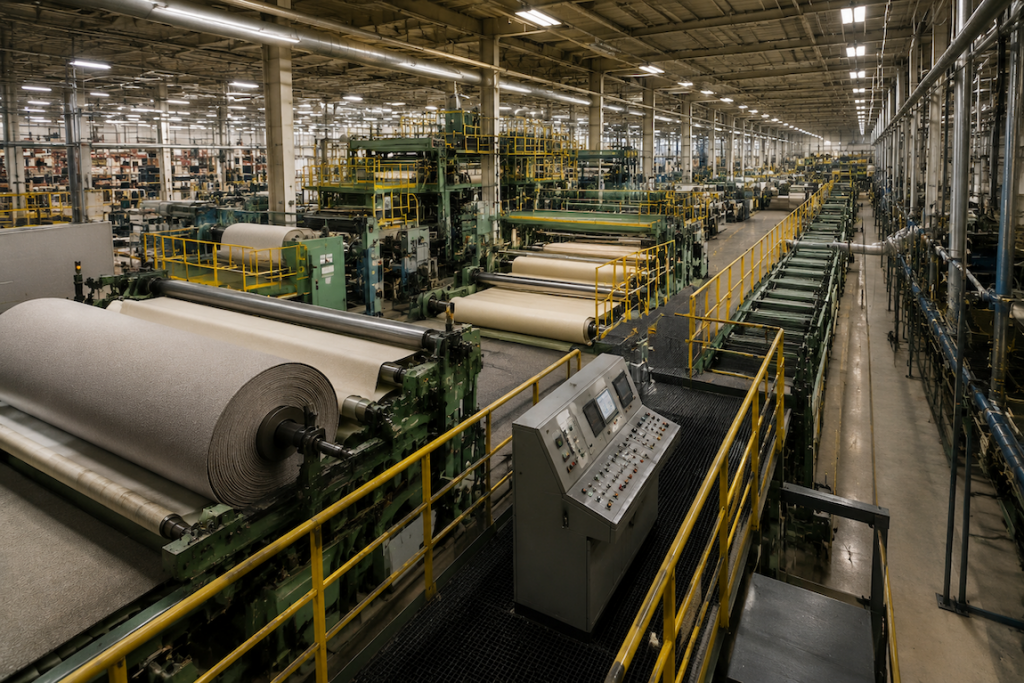
The region's largest manufacturers offer broad potential for materials, automation, industrial services, testing, logistics, and sustainability solutions. Their size brings formal onboarding, approved-supplier processes, and several layers of technical and commercial review. A plant-specific proposal carries more weight than a general corporate pitch.
Shaw Industries
Shaw operates at global scale with approximately 18,000 associates and maintains its headquarters plus numerous manufacturing sites across Northwest Georgia. Its regional footprint spans carpet, resilient flooring, and related processes. The useful starting point is the exact plant, production line, and operating problem, followed by the procurement, engineering, operations, quality, or sustainability roles connected to that process.
Mohawk Industries
Mohawk reported about 40,500 employees and $10.8 billion in 2025 net sales, making it the largest company in this guide by financial scale. Its Calhoun headquarters sits near multiple regional operations, although local presence does not establish local purchasing authority. Entry depends on the relevant product division and facility, supported by evidence on enterprise quality, supply continuity, technical service, and multi-site coverage.
Engineered Floors
Engineered Floors reports more than 4,700 employees across its family of brands in Northwest Georgia. Its large plant network and integrated "Four Walls" carpet process place continuous-process reliability, material consistency, waste reduction, and maintenance response near the center of qualification. Plant operations, process engineering, quality, and strategic sourcing provide stronger research targets than a general corporate contact.
When a Broad Portfolio Hides Different Plant Logic

Large portfolios can obscure what is produced locally. Carpet, rubber, rigid core, dyeing, and finishing create separate supplier requirements even when they share one corporate name.
Mannington Mills
Mannington employs more than 3,500 associates worldwide. Its current location information identifies Calhoun as the headquarters of Mannington Commercial, with commercial carpet and rubber manufacturing, residential rigid-core production, distribution, and customer service. The discontinued Phenix residential-carpet operation should not be counted as a separate current prospect.
The Dixie Group
The Dixie Group reported $257.4 million in 2025 sales and lists a 193,300-square-foot carpet dyeing and processing site in Calhoun plus a 408,000-square-foot manufacturing and distribution facility in Eton. These operations create research angles around yarn, color systems, process controls, maintenance, and finishing. The company remained active in the first quarter of 2026, reporting $59.4 million in net sales and $3.3 million in operating income, although that result included a $3.3 million anticipated tariff-refund benefit. In its Form 10-Q for the quarter ended March 28, 2026, filed on May 11, 2026, The Dixie Group disclosed that management's plans had not alleviated substantial doubt about its ability to continue as a going concern as of the filing date. Sales teams should treat this as a dated risk signal and verify current financial condition, purchasing continuity, and credit exposure before prioritizing the company.
Marquis Industries
Marquis operates more than 1.2 million square feet across four North Georgia facilities and manages carpet production from yarn extrusion through finishing. Its integrated structure creates distinct openings in polymer and fiber inputs, color and printing systems, backing materials, quality controls, and plant equipment. Because Marquis also sells hard-surface products, a proposal should distinguish local carpet manufacturing from sourced product categories.
Which Hard-Surface Investments Merit Facility Research

Hard-surface plants broaden the supplier base beyond carpet. Their buying logic centers on formulation control, extrusion stability, surface performance, dimensional tolerances, profiling, packaging protection, and ramp-up efficiency. Ownership may place technical approval outside Georgia.
AHF Products
AHF Products acquired the former Wellmade rigid-core plant in Cartersville in late 2025. The 328,000-square-foot site became the company's tenth US manufacturing facility and established a domestic rigid-core production base. Compounds, wear layers, films, tooling, inspection systems, and packaging all offer credible research angles, provided the proposal matches active lines and the correct local or central decision owner.
CFL Flooring
CFL's Georgia operation is a 700,000-square-foot rigid-core plant developed through an investment of more than $100 million. Current company materials do not publish a Georgia-specific headcount or annual capacity, so the facility footprint is the stronger local scale signal. Qualification centers on active lines, material systems, quality controls, automation, laboratory evidence, and purchasing ownership.
Huali Floors USA
Huali continues to identify Chatsworth as one of its four global production bases and reports more than 2,000 employees and annual turnover above $350 million worldwide. The Georgia project was announced in 2020 with more than $27 million in planned investment and at least 315 jobs; a 2022 OneGeorgia annual report listed 315 jobs created, but no current local headcount is public. The site's production scope, line utilization, and relationship with Huali's global technical organization determine whether an offer belongs with local operations or wider category leadership.
How Performance Surfaces Change Material Requirements
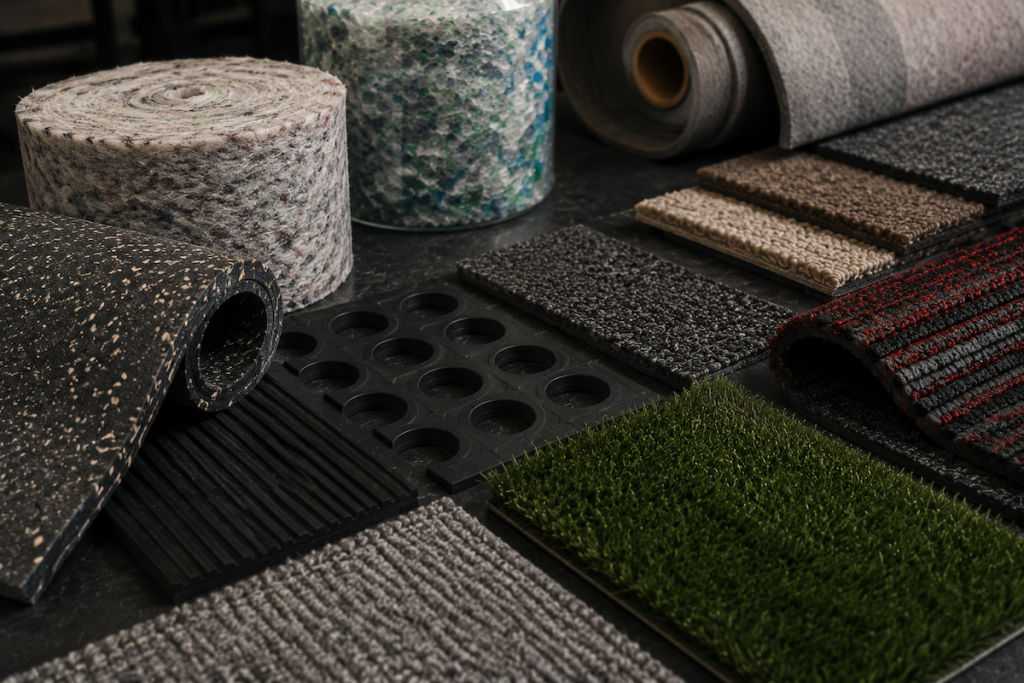
Performance surfaces are defined by safety, recycling, weather exposure, vehicle specifications, or athletic use. Application testing and certification evidence often carry as much weight as price and delivery.
Apache Mills
Apache Mills employs more than 800 associates in Calhoun manufacturing and distribution facilities, and the company states that over 90% of its mats are made there. Its processes include rubber and vinyl work, extrusion, molding, tufting, printing, cutting, and lamination. Recycled feedstock, polymers, adhesives, pigments, tooling, automation, and test services fit commercial, industrial, retail, and OEM matting programs.
Foss Floors
Foss produces needle-punch and specialty flooring across three facilities in Rome and Chatsworth. Processing about 40 million pounds of recycled PET each year gives the company a scale signal tied directly to its material model. Fiber quality, contamination control, needle-loom components, backing, converting, packaging, and recycled-content verification provide more focused openings than a general carpet-supply message.
FieldTurf – Tarkett Sports
FieldTurf operates a 500,000-square-foot Calhoun plant with more than 200 employees. Current company materials place fiber production at Tarkett's facility in Germany and tufting and coating in Calhoun, where the operation maintains ISO 9001, ISO 14001, and ISO 45001 systems. Coating inputs, tufting support, testing equipment, maintenance, quality controls, and production traceability shape the local qualification agenda.
Why Niche Commercial Specialists Buy Around End Use

Automotive, exhibition, area-rug, and contract-interior markets bring different wear, color, safety, cleaning, and delivery requirements. In smaller organizations, technical relevance and response speed may carry more weight than enterprise reach.
Dorsett Industries
Dorsett designs and manufactures automotive and marine carpet in Dalton and operates as an employee-owned business with ISO 9001:2015 certification. March 2026 local employer data lists 129 employees, placing it within the 51-to-200 employee band. OEM and aftermarket programs create supplier angles around specification-grade yarn, backing, color control, testing, and converting support, with quality, engineering, and program management influencing approval.
Emerald Carpets
Emerald is listed in the 51-to-200 employee band and vertically integrates extrusion, tufting, dyeing, and finishing in Dalton for trade shows and special events. That market places extra weight on color availability, fast fulfillment, recyclability, fabrication, and schedule reliability. A useful opening connects directly to event-flooring throughput or circular-material goals and the operations, product-development, or procurement role that owns the issue.
Oriental Weavers USA
Oriental Weavers USA operates from Dalton, where March 2026 local employer data lists approximately 150 employees. Company materials describe a combined manufacturing, marketing, and distribution role while noting that much of the product flow originates from the group's Egyptian operations. That mixed model makes facility function the first qualification question. Suppliers should establish which manufacturing, finishing, quality, packaging, and distribution steps are controlled in Dalton before targeting operations, sourcing, product, or logistics roles.
Totally Carpet
Totally Carpet operates within the 51-to-200 employee band and produces high-performance broadloom and carpet tile in Dalton. Solution-dyed nylon and a focus on corporate, healthcare, and hospitality interiors create openings around fiber performance, backing, low-emission systems, sampling, and project support. Its specialist profile favors a precise technical proposition over a broad volume pitch.
Where Hospitality Projects Shift the Buying Calendar
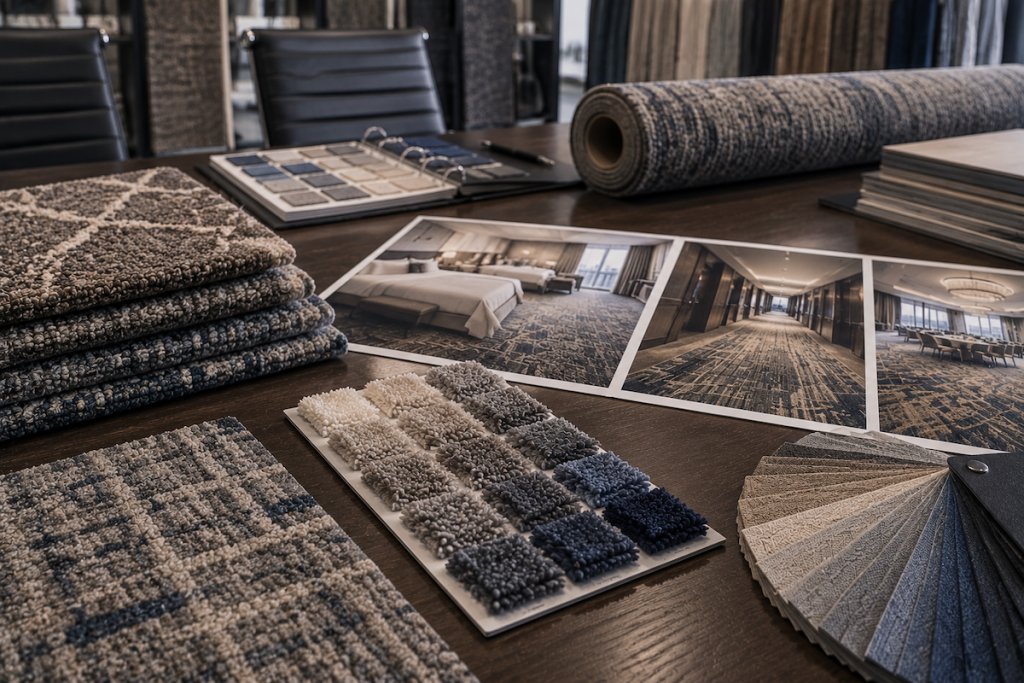
Hospitality mills work around design specifications, prototypes, approvals, installation dates, and property renovation cycles. Sample speed, custom-color discipline, repeatability, and realistic lead times shape buying influence before procurement enters the process.
CM Hospitality Carpets
CM Hospitality operates in the 51-to-200 employee band and maintains in-house design and manufacturing capabilities in Dalton. It produces custom carpet for guestrooms, corridors, ballrooms, and public spaces. Supplier value is strongest when tied to custom development, color matching, sample turnaround, tufting flexibility, or performance documentation, with design, product development, manufacturing, and purchasing sharing influence.
Encore Hospitality Carpet
Encore is part of family-owned Brumlow Mills and runs vertically integrated production in Calhoun. Its 51-to-200 employee range combines specialist access with broadloom, carpet tile, dye-injection, and custom capabilities. Materials or services that improve customization, recycled content, technical consistency, or project lead times fit the operating model, provided they do not add unnecessary production complexity.
Signature Flooring
Signature Flooring is a Dalton-based hospitality and multifamily specialist in the 51-to-200 employee band. Current company materials describe broadloom and carpet-tile manufacturing alongside design and digital sampling tools. Yarn, backing, imaging, color management, sample production, and specification support align with this profile. Local mill decisions still need to be separated from choices made by outside designers, hotel groups, or project owners.
Shaheen Carpet Mills
Shaheen has manufactured carpet in Resaca since 1964 and operates as a small family-owned mill in the 11-to-50 employee band. Its work spans hospitality, main-street commercial, senior living, and custom projects. Specialty yarns, custom color, backing, testing, and dependable short-run support match a business where service and production access matter more than enterprise-scale coverage.
Prioritize by Proof and Sales Cycle
Material suppliers can begin with integrated carpet and hard-surface plants, supported by lot-consistency, capacity, test-data, and traceability evidence. Machinery and maintenance providers fit continuous-process facilities where uptime, safety, integration, and response coverage shape qualification. Recycled-input and environmental-service firms have clearer reasons to study Foss, Apache, event-carpet producers, and major groups.
Hospitality and specialty mills suit custom color, sampling, and design support, while packaging and logistics offers align more closely with rigid-core, matting, and project-driven operations. Smaller specialists often support a faster technical conversation. Global manufacturers fit suppliers prepared for formal onboarding, dependable capacity, and multi-site service.
Verify the Facility Before Outreach
Before adding a company to the first prospect list, confirm six points:
- Local role: Is the address a headquarters, factory, warehouse, showroom, or distribution center?
- Current owner: Check acquisitions and brand consolidation. Lexmark, for example, has belonged to Tarkett since 2018 and should not be counted as an independent manufacturer.
- Active process: Establish what the local site currently makes.
- Qualification fit: Match the offer to the process, end market, certifications, scale, and sales cycle.
- Decision influence: Research operations, engineering, quality, product development, supply chain, procurement, sustainability, and category leadership according to the use case.
- Operating signal: Look for recent filings, hiring activity, product documents, certifications, or facility updates. An accessible website alone does not establish active local production.
A rigid-core plant should receive a different opening from a hospitality mill, and a local warehouse should not receive a plant-efficiency proposal.
Turn the Research Into a Futern Workflow
Futern helps sales teams separate a broad regional market into workable company groups based on local facility role, production model, scale, end market, and ownership. Teams can enrich selected companies with website, location, and LinkedIn information before researching the roles connected to a specific supplier hypothesis.
A materials supplier may focus on quality, process engineering, and strategic sourcing. An automation provider may prioritize plant engineering, maintenance, and operations. Custom-design services fit product-development, design, and project roles. Futern supports the filtering and enrichment process so each outreach angle reflects the company's operating context.
Current titles, facility responsibility, and recent operating signals still require confirmation before contact. The workflow turns a mixed regional directory into a smaller prospect list with explicit qualification reasons.
Conclusion
Northwest Georgia offers unusual flooring-industry depth across global carpet groups, domestic rigid-core plants, recycled-PET producers, turf facilities, specialty flooring companies, and custom hospitality mills. The useful distinctions are production system, facility role, operating scale, qualification burden, end market, and decision influence.
Sales teams can use the six supplier paths to choose a realistic starting group, match technical proof to the local process, and separate immediate-fit companies from longer qualification cycles. A smaller, verified prospect list will support more credible outreach than a broad directory of regional names.
Rochester Optics Manufacturers: Five Qualification Tests
Akron Polymer Manufacturers: A Supplier Qualification Guide
Hotel Amenities in Miami: 8 Target Buyer Segments for B2B Sales Teams