What an AI Sales Agent Actually Does in a Global Outbound System
by Stella L
An AI Sales Agent executes global outbound workflows continuously, turning signals into action at sc…
This builds on our broader analysis of what actually scales global outbound sales in 2026.
Introduction
Over the past year, the term “AI Sales Agent” has become increasingly common in global B2B discussions.
Yet the definition remains vague.
Some treat it as a new label for automation. Others assume it is simply a writing assistant for outbound emails. In practice, neither description captures its structural role.
As global outbound sales becomes more complex—across regions, languages, channels, and buyer behaviors, the limiting factor is no longer effort. It is execution continuity.
The real question is not what tasks AI can perform.
The real question is this:
In a global outbound system, what responsibility does an AI Sales Agent actually hold?
Understanding that boundary is critical. Without it, “AI Agent” becomes another feature. With it, it becomes an execution layer capable of supporting scale.
An AI Sales Agent Is an Execution Actor, Not a Tool
A tool is invoked.
An automation script is triggered.
An agent operates continuously toward a defined objective.
This distinction matters.
Traditional outbound stacks consist of tools: databases, CRM systems, outreach platforms, analytics dashboards. Each tool performs a specific function when activated by a human.
Automation improves efficiency within these tools but still depends on human orchestration.
An AI Sales Agent represents something different.
It acts as an execution actor inside the system. It maintains context, tracks state, responds to signals, and progresses workflows without requiring constant human initiation.
In complex global environments, where signals are distributed and timing windows are narrow, this persistent execution layer becomes essential.
Without it, outbound remains fragmented across time zones and handoffs.
The Core Responsibilities of an AI Sales Agent
An AI Sales Agent does not replace sales strategy. It executes the operational layer of global outbound. Its responsibilities typically fall into four areas.
Prospecting with Context
At scale, prospecting is not about generating long lists. It is about maintaining a continuously updated target universe.
An AI Sales Agent can:
- Interpret ideal customer profiles (ICPs)
- Filter across multiple attributes such as industry, region, role, and company signals
- Dynamically update target pools as data changes
This moves prospecting from a static export task to an ongoing process.
In global outbound, where markets shift quickly, maintaining contextual relevance is more important than expanding volume.
Data Enrichment and Knowledge Integration
Global B2B data decays rapidly. Contacts change roles. Companies expand into new regions. Organizational structures shift.
An AI Sales Agent supports outbound execution by:
- Validating and updating contact information
- Enriching company and role-level data
- Integrating fragmented data into a coherent profile
Without reliable enrichment, outbound becomes guesswork. With it, engagement becomes informed.
At scale, the quality of execution depends on the depth and reliability of underlying data.
Signal Detection and Timing
In modern outbound, timing often determines outcome.
Signals such as leadership changes, hiring activity, product launches, funding events, or regional expansion can significantly affect buying intent.
An AI Sales Agent can:
- Monitor structured and behavioral signals
- Identify trigger events
- Prioritize accounts based on signal strength
- Act within critical timing windows
In global environments, responding within 24–48 hours to meaningful signals can materially increase engagement effectiveness.
Scale is not achieved by increasing message volume. It is achieved by improving signal sensitivity.
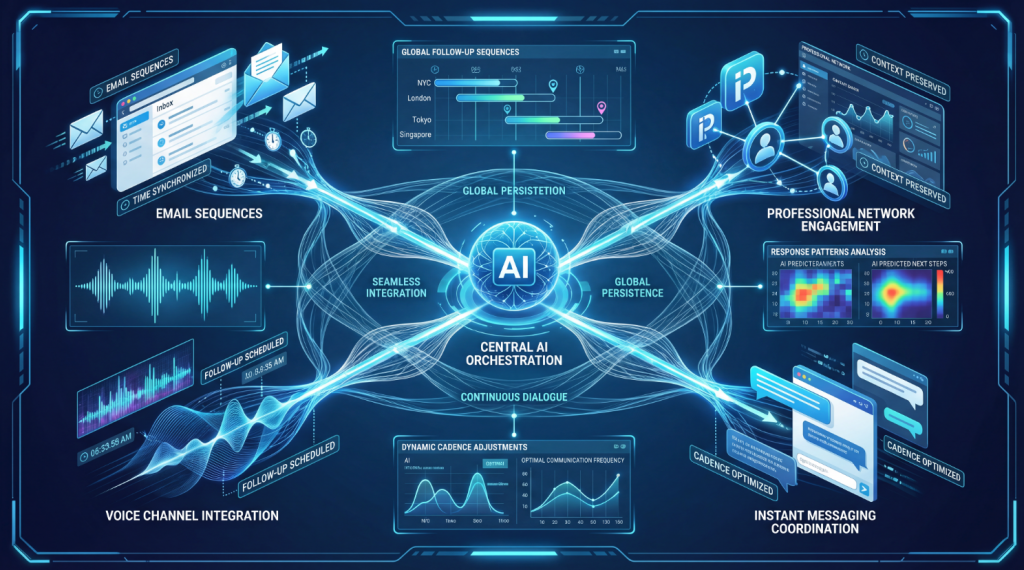
Multi-Channel Engagement and Follow-Through
Outbound execution today spans multiple channels: email, professional networks, messaging platforms, and voice.
An AI Sales Agent supports this by:
- Coordinating outreach sequences across channels
- Preserving context between interactions
- Adjusting cadence based on response patterns
- Maintaining follow-up continuity
One of the most common failure points in global outbound is inconsistency. Follow-ups are delayed. Context is lost between time zones. Responses are not integrated into a unified workflow.
Continuous execution reduces these breakdowns.
In this sense, the agent’s primary value is not creativity. It is persistence and coordination.
What an AI Sales Agent Should Not Do
Defining responsibility also requires defining limits.
An AI Sales Agent should not:
- Replace human relationship-building
- Make final deal-closing decisions
- Define go-to-market strategy
- Override human judgment in complex negotiations
Human sales professionals remain responsible for interpretation, trust-building, and strategic direction.
The agent executes.
The human decides.
Clear boundaries prevent over-reliance and build trust in the system.
Why Data Depth Determines Agent Effectiveness
An AI Sales Agent is only as effective as the data environment it operates within.
Without structured, high-quality, and continuously updated data, an agent’s actions degrade into scripted automation.
Effective global outbound systems require:
- Broad company coverage across regions
- Accurate contact verification
- Up-to-date role and organizational changes
- Integrated enterprise knowledge graphs
Data depth determines whether an agent can operate contextually or merely repeat predefined steps.
As global markets expand and buying behavior becomes more distributed, the ability to integrate and interpret large-scale data sets becomes foundational.
In this sense, the agent is not defined by intelligence alone, but by the quality of its operating substrate.
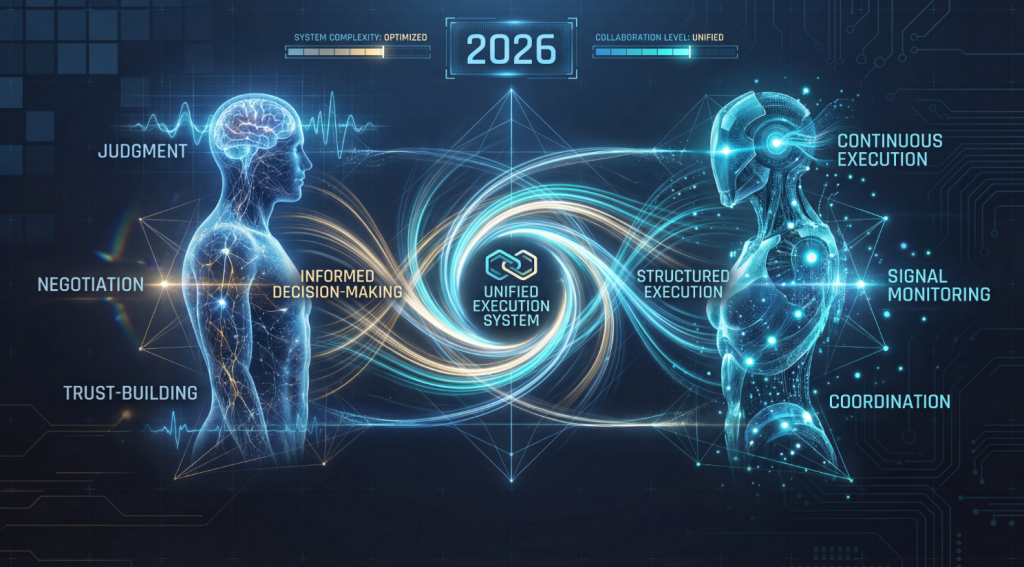
Human and Agent as a Unified Execution System
The future of global outbound is neither human-only nor automation-only.
It is a unified execution system.
In this system:
- AI Sales Agents handle continuous execution, signal monitoring, enrichment, and coordination.
- Human sales professionals focus on judgment, negotiation, positioning, and trust.
Scale emerges from the interaction between structured execution and informed decision-making.
In 2026 and beyond, global outbound growth will not depend on increasing activity. It will depend on designing execution systems capable of operating across complexity.
An AI Sales Agent is not a feature inside that system.
It is part of the system itself.