From Sales Automation to AI Sales Agents: What Actually Changed
by Stella L
AI Sales Agents go beyond automation by executing global outbound workflows continuously and context…
Introduction
Sales automation reshaped outbound over the past decade.
It enabled teams to send emails at scale, automate sequences, and reduce repetitive work. For a time, that was enough.
But global outbound sales in 2026 operates under very different conditions: distributed markets, fragmented signals, and multi-channel engagement across time zones.
As explored in our broader analysis of global outbound sales in 2026, scale today is no longer a question of volume. It is a question of execution systems.
This is where the shift from sales automation to AI Sales Agents begins.
The difference is structural.
What Sales Automation Was Designed to Do
Sales automation was built to optimize tasks.
Its core capabilities include:
- Scheduled email sequences
- Rule-based triggers
- CRM updates
- Workflow branching
- Activity tracking
Automation improves efficiency within predefined workflows. It reduces manual repetition and increases activity throughput.
In environments with stable markets and predictable buyer journeys, this model works well.
Automation assumes:
- Workflows are known in advance
- Rules can cover most scenarios
- Humans remain central coordinators
For many years, these assumptions held.
Where Automation Breaks in Global Outbound
Global outbound sales introduces complexity that rule-based systems struggle to manage.
First, markets are no longer centralized. Outreach spans multiple regions, languages, and channels simultaneously. Static sequences cannot easily adapt to regional nuance.
Second, signals are dynamic. Leadership changes, hiring activity, funding events, and organizational shifts occur continuously. Automation reacts only when explicitly configured to do so.
Third, workflows become fragmented. Different tools handle prospecting, enrichment, engagement, and follow-up. Humans orchestrate the handoffs.
As complexity grows, rule trees expand. Branches multiply. Maintenance becomes difficult. Coordination costs rise.
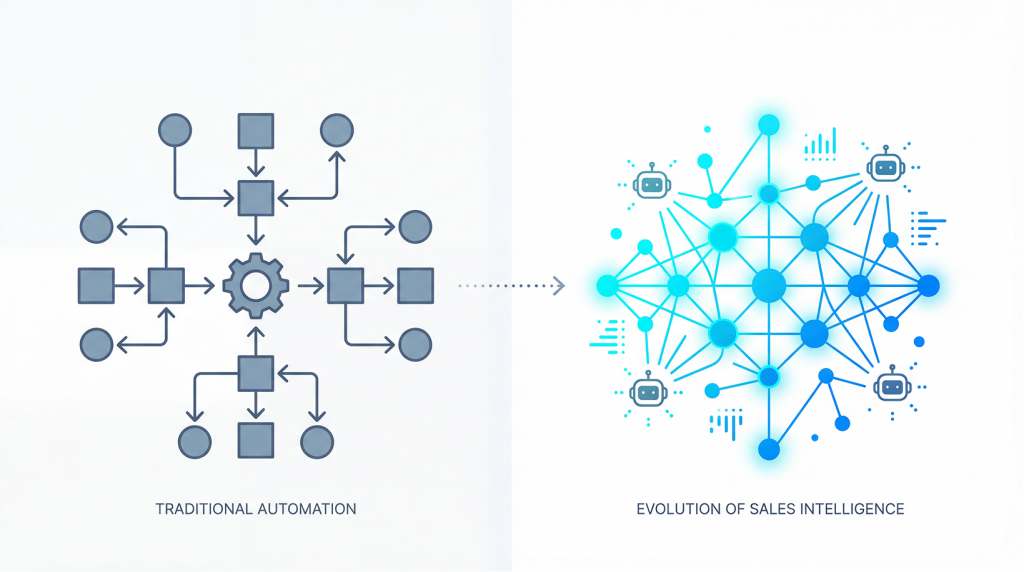
Automation optimizes tasks.
Global outbound requires coordination across an evolving system.
What Changed with AI Sales Agents
The shift to AI Sales Agents is not about sending better emails. It is about redefining who—or what—executes outbound workflows.
An AI Sales Agent operates as a persistent execution actor inside the system.
Instead of waiting for rule triggers, it can:
- Monitor signals continuously
- Maintain state across accounts
- Adjust sequencing dynamically
- Prioritize based on evolving context
- Coordinate across channels
Where automation executes predefined instructions, an AI Sales Agent executes toward objectives within structured boundaries.
This changes the role of humans.
Humans no longer need to orchestrate every workflow branch. Instead, they focus on judgment: positioning, negotiation, and relationship-building.
The agent maintains continuity.
From Workflow Trigger to System Actor
The most important change is conceptual.
Automation is workflow-centric.
AI Sales Agents are system-centric.
In a workflow-centric model:
Human → Tool → Trigger → Action
In a system-centric model:
Signals → Agent → Coordinated Execution → Human Judgment
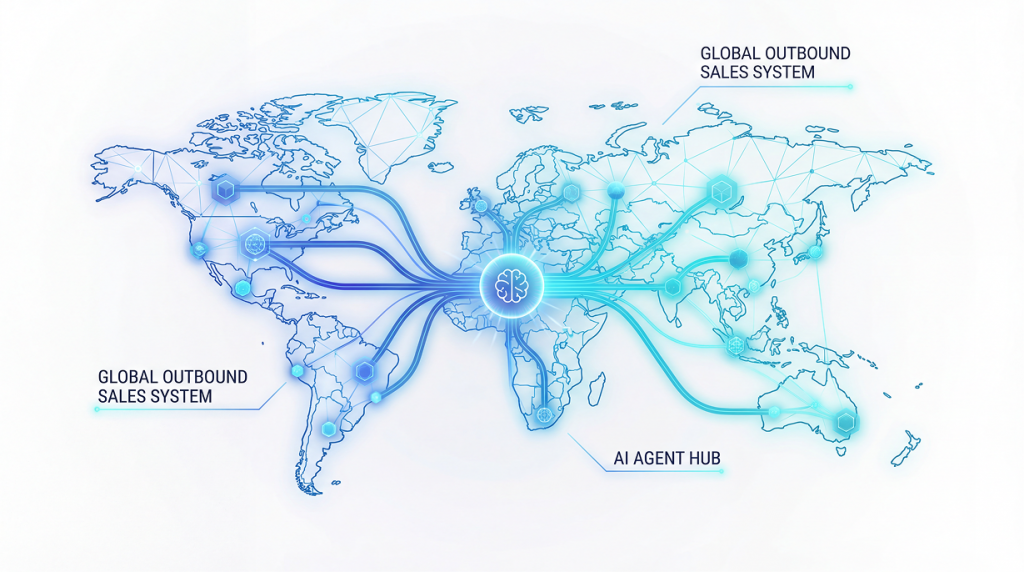
The agent becomes an execution layer between data and human decision-making.
This shift matters most in global contexts, where:
- Timing windows are short
- Signals are distributed
- Follow-up consistency determines conversion
- Execution must continue beyond human working hours
As discussed in our analysis of what actually scales global outbound sales in 2026, scale is now a system property.
AI Sales Agents are part of that system redesign.
Why This Shift Matters for Scale
Automation increases activity. AI Sales Agents increase continuity.
Automation reduces repetitive work. AI Sales Agents reduce orchestration burden.
Automation scales volume. AI Sales Agents scale coordinated execution.
In global outbound environments, coordination—not activity—is often the bottleneck.
By introducing a persistent execution layer, organizations decouple growth from constant human oversight.
This does not eliminate the role of sales teams. It redefines it.
Humans remain responsible for strategic decisions and high-value interactions.
The agent sustains execution across complexity.
Closing Reflection
Sales automation was the first stage of outbound digitization. AI Sales Agents represent the next stage.
The difference is not a new feature set. It is a new execution model.
As global outbound continues to evolve, the question is no longer how to automate more tasks.
It is how to design systems capable of continuous, context-aware execution.
That is what actually changed.